

Among various mobility aids, the 4-wheel rollator walker has long been considered a flexible, lightweight, and convenient tool for outdoor use. However, a growing number of clinical experts, rehabilitation therapists, and care facilities are emphasizing that not everyone is suitable for continued use of a 4-wheel rollator walker.
For individuals with poorer physical condition, insufficient stability, or a higher risk of falls, a wheelchair is a safer and more secure option.
This blog will delve into the core question of "Why are 4-wheel rollator walkers no longer recommended, and why are wheelchairs preferred?" to help readers clearly understand the topic.
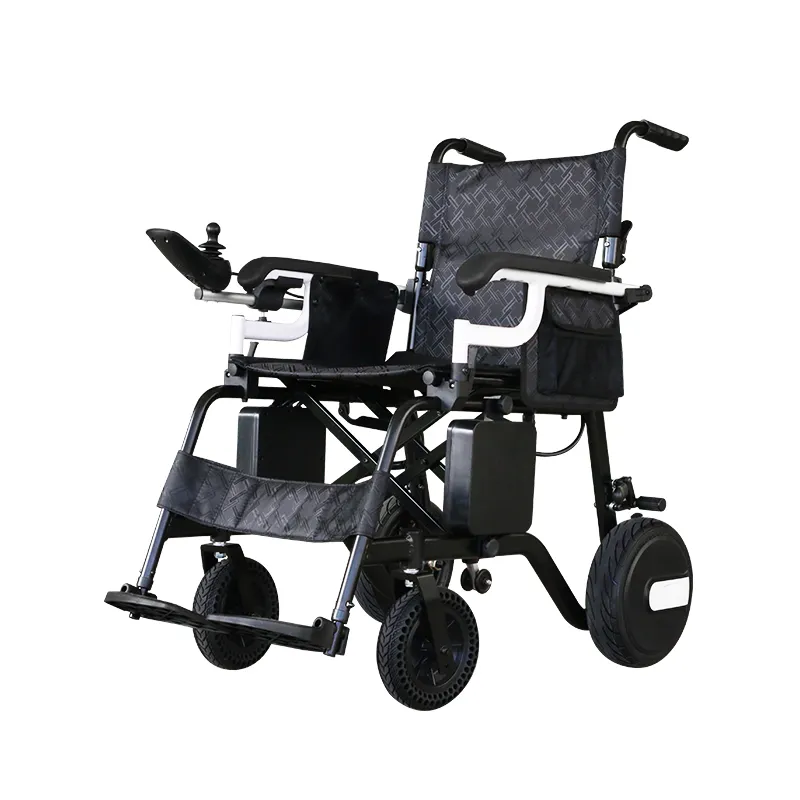
What are the fundamental functional differences between a 4-wheel rollator and a wheelchair?
To understand why many professionals no longer recommend 4-wheel rollators for some individuals, but instead recommend wheelchairs, it's essential to clarify the functional differences between 4-wheel rollators and wheelchairs.
1. The function of a 4-wheel rollator
A 4-wheel rollator is primarily used for:
• Assisting with walking
• Providing temporary seating
• Improving walking stability
• Enhancing gait and muscle engagement
• Encouraging active movement
A 4-wheel rollator does not provide continuous seating support or replace walking entirely, nor is it sufficient to completely take over mobility.
2. The function of a wheelchair
A wheelchair is primarily used for:
• Completely or largely replacing walking
• Providing continuous and stable seating support
• Bearing the entire burden of movement when physical strength is insufficient
Wheelchairs provide effortless mobility for individuals who are unable to walk, effectively reducing the risk of falls.
Therefore, the core difference is:
A 4-wheel rollator walker"assists walking," while a wheelchair "replaces walking."
When a person is no longer suitable for standing or walking, continued use of a 4-wheel rollator walker becomes a potential danger.
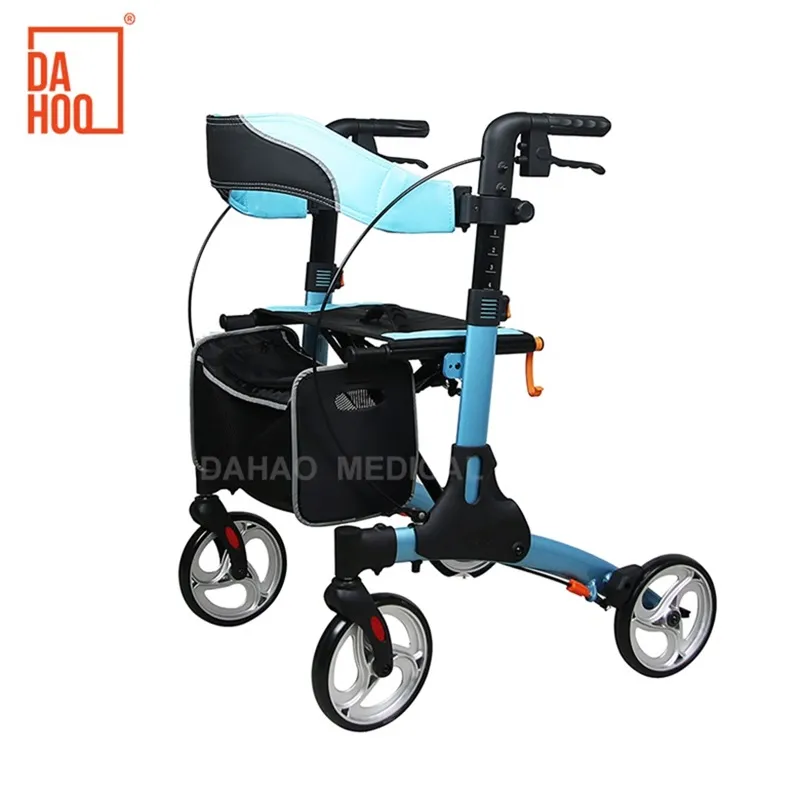
Why are some people no longer advised to use 4-wheel rollators?
The following clearly answers, from a medical and rehabilitation perspective, why more and more experts are recommending that some individuals switch from 4-wheel rollators to wheelchairs.
1. Due to insufficient physical support capabilities
A 4-wheel rollator requires the user to have the following abilities:
• Basic standing balance
• Lower limb weight-bearing capacity
• Trunk control
• Coordination in operating the rollator
• Ability to stably grip and brake with their arms
If these basic abilities are insufficient, the 4-wheel rollator walker can become a source of risk.
A wheelchair, on the other hand, does not require the user to bear weight and is suitable for those with significantly weakened physical abilities.
2. Due to increased risk of falls
Many people using 4-wheel rollators experience:
• Walking too fast
• Loss of control on slopes
• Forgetting to brake
• Leaning too far forward while using it
• Tripping over steps or obstacles
For elderly people with poor balance, these risks are sufficient to cause serious falls.
A wheelchair is obviously more stable and does not present these risks.
3. Due to repeated fatigue leading to unsafe walking
Some people can initially walk with difficulty, but after 5–10 minutes of walking:
• Unsteady gait
• Shortness of breath
• Weakness in the lower limbs
• Inability to stand for long periods
• Dragging gait
Continuing to use a 4-wheel rollator walker at this point is dangerous, but a wheelchair allows them to move safely.
4. Because the 4-wheel rollator seat cannot replace sitting and resting
Many people mistakenly believe they can "sit and push themselves along," which is very dangerous.
The seat on a 4-wheel rollator is only for resting and cannot withstand the pressure of sliding or moving.
A wheelchair, however, is designed for prolonged sitting and movement.
5. Due to cognitive decline leading to inability to operate correctly
A 4-wheel rollator requires understanding:
• Brake usage
• Speed control
• Safe standing and sitting movements
• Avoiding obstacles
• Turning and direction judgment
For individuals with cognitive decline (such as Alzheimer's patients), a wheelchair is a much safer alternative.
What situations indicate that you should switch from a 4-wheel rollator to a wheelchair?
The following are common criteria used in rehabilitation assessments. If any of these apply, experts typically recommend switching to a wheelchair:
•Unable to stand for more than 1-2 minutes
•Unable to walk more than 10-30 meters
•Significant imbalance when going uphill or downhill
•Frequently forgets to use the brakes
•Severe forward leaning posture
•Insufficient arm strength to grip or control the device
•History of dizziness or falls
•Poor balance, TUG test > 15 seconds
•Unstable gait or severe shuffling
•Insufficient cardiopulmonary endurance to support walking
•Severe pain (hip, knee, spine, etc.)
These are all signs that a 4-wheel rollator walker is no longer suitable, and a wheelchair can provide more stable support.
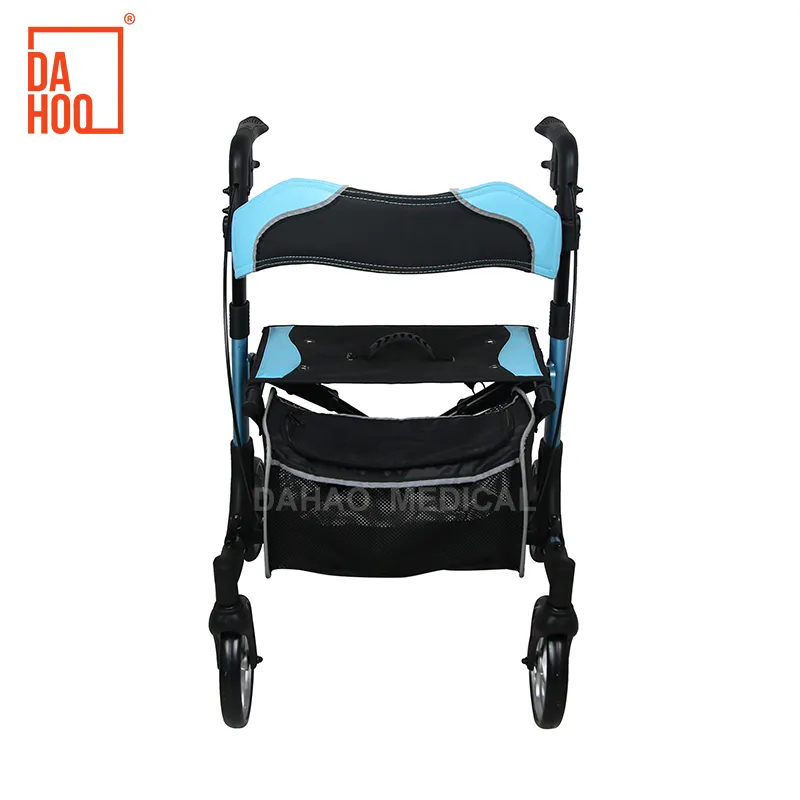
What are the potential dangers of continuing to use a 4-wheel rollator?
To clearly understand why some people no longer recommend using a 4-wheel rollator walker, it's necessary to analyze the potential risks it may pose.
1. Loss of control and falling forward
4-wheel rollators are prone to generating "propulsive force," especially when going downhill. Many users accidentally walk too fast and lose control.
2. Inability to grip the brakes due to insufficient strength
Elderly people often experience:
•Weak hand muscles
•Arthritis
•Gout
•Stiff fingers
This makes braking difficult, and the inability to react quickly in an emergency can lead to falls.
3. Getting stuck on obstacles leading to forward leaning
4-wheel rollator walkers are most likely to cause danger in the following scenarios:
•Door thresholds
•Carpet edges
•Uneven surfaces
•Steps or curbs
•Narrow spaces in kitchens and bathrooms
When the wheels get stuck, the forward leaning posture can cause a direct fall.
4. Users mistakenly using the seat as a "mobile chair"
Some people try to sit on the 4-wheel rollator and be pushed by family members, which is a very dangerous behavior.
Because:
•The seat has limited weight capacity
•The rear wheels lack safety protection
•It cannot protect the user's sitting posture stability
•It is prone to tipping over
Wheelchairs are designed for sitting while moving. 5. Over-reliance on the device for gait increases fatigue
If your physical condition is poor, continuing to use a 4-wheel rollator walker will make walking a burden, leading to accumulated fatigue and ultimately making you more prone to losing balance.
Why are wheelchairs safer for some people?
Since 4-wheel rollator walkers have many potential risks, why are wheelchairs safer? The following explains this from multiple perspectives.
1. Wheelchairs can fully support body weight
This means:
• No weight-bearing on the lower limbs is required
• No need to maintain standing balance
• No need to worry about fatigue
• No sudden falls due to decreased physical strength
This is a huge safety advantage for frail elderly people.
2. Wheelchairs have a stable center of gravity structure
Wheelchair design inherently prevents:
• Tilting forward
• Tipping over
• Uncontrolled rolling
• Unstable movements caused by walking fatigue
When used correctly, the overall risk of a wheelchair is far lower than that of a 4-wheel rollator.
3. Wheelchairs are suitable for long outings/long-distance travel
Many 4-wheel rollator walker users cannot walk far, so a wheelchair naturally becomes a safer option.
4. Wheelchairs provide complete seating support
Including:
• Backrest
• Armrests
• Footrests
• Adjustable structure
These are all features that a 4-wheel rollator walker completely lacks.
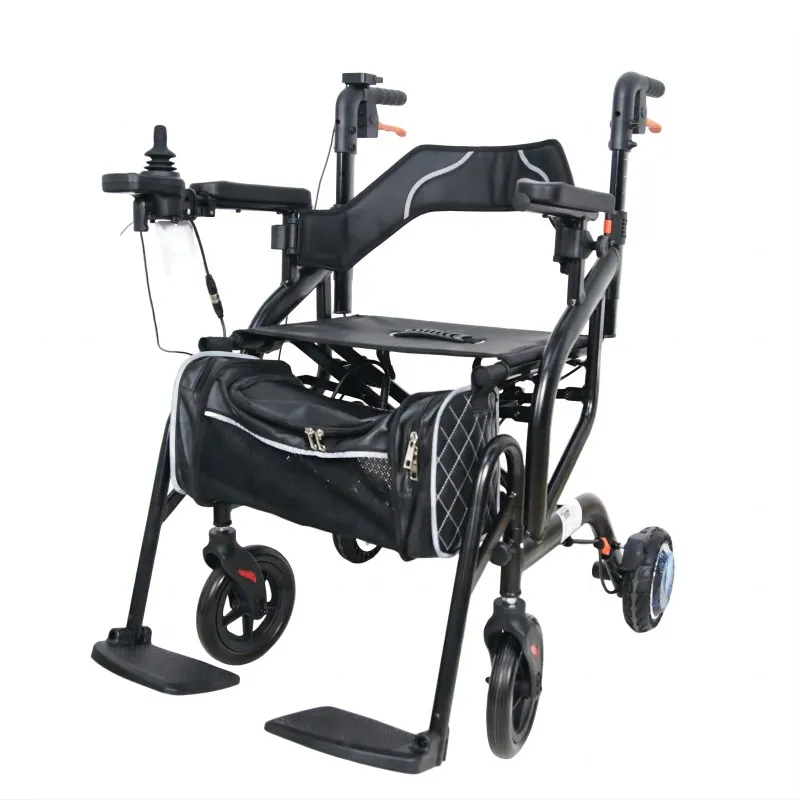
Why do many people mistakenly insist on using a 4-wheel rollator?
1. Believing "if you can walk, you should walk," but neglecting safety
Many family members or individuals are unwilling to use a wheelchair, believing that "using a wheelchair will lead to deterioration," but in reality:
Using a 4-wheel rollator walker when you lack the ability to do so will only accelerate falls and injuries.
2. Mistakenly believing that a 4-wheel rollator is easier
In fact, for people with insufficient physical strength, a 4-wheel rollator is more tiring than a wheelchair.
3. Worrying that using a wheelchair means losing independence
But true independence comes from safe mobility, not risky walking.
4. Family members are unaware of the risks
Many people are unaware of the extremely high risks of using a 4-wheel rollator walker when used by the wrong people.
How to determine if you should consider transitioning from a 4-wheel rollator to a wheelchair?
The following questions can be used as assessment criteria:
1. Do you feel increasingly strained when using a 4-wheel rollator walker?
If yes, it indicates a decline in physical strength or balance, and a wheelchair should be used instead.
2. Do you frequently trip or nearly fall?
This is a clear signal that should not be ignored.
3. Has your doctor or therapist recommended switching to a wheelchair?
Any professional advice indicates an increased risk.
4. Can you independently and safely operate the brakes and steering of a 4-wheel rollator?
If not, you should stop using it.
5. Are you unable to walk for extended periods due to fatigue?
A wheelchair is safer than continuing to walk with difficulty.
Why are more and more experts recommending wheelchairs instead of 4-wheel rollators?
The answer can be summarized in one sentence:
Because for many people with physical weakness, poor balance, cognitive impairment, or a risk of falling, a wheelchair is safer, more stable, and better suited to their actual needs than a 4-wheel rollator walker.
4-wheel rollator walkers are suitable for:
• Those who still have good balance
• Those who can still walk steadily
• Those who can still brake and operate independently
• Those with sufficient physical strength to participate in standing and moving
Wheelchairs are suitable for:
• Those with poor balance
• Those who tire easily
• Those who walk unsafely
• Those who have difficulty standing
• Those whose condition affects lower limb function
• Those who are prone to falls or have a history of falls
Choosing the right assistive device is not about "insisting on walking" or "giving up walking," but about ensuring safe, comfortable, and effective mobility.
What is Dahao Medical’s approach to customer satisfaction?
At Dahao Medical, customer satisfaction is at the core of our business. We believe in building long-term relationships with our clients by providing high-quality products and exceptional service. From your initial inquiry to after-sales support, our team is dedicated to meeting your needs.
We offer personalized guidance to help you choose the right products, and we are always available to assist with any concerns after your purchase.