

In medical and home care settings, lift transfer chairs have become essential assistive devices for helping patients with movements such as transferring, getting up, and sitting down.
Among the many lift transfer chair designs, the term "hydraulic lift transfer chair" is frequently mentioned, but many people don't truly understand the hydraulic system within it.
Many people have these questions:
• What exactly is the hydraulic system in a lift transfer chair?
• What role does the hydraulic system play in a lift transfer chair?
• Why do many lift transfer chairs use hydraulics instead of other methods?
To understand the value of a hydraulic lift transfer chair, we must first clarify the nature and working logic of the hydraulic system.
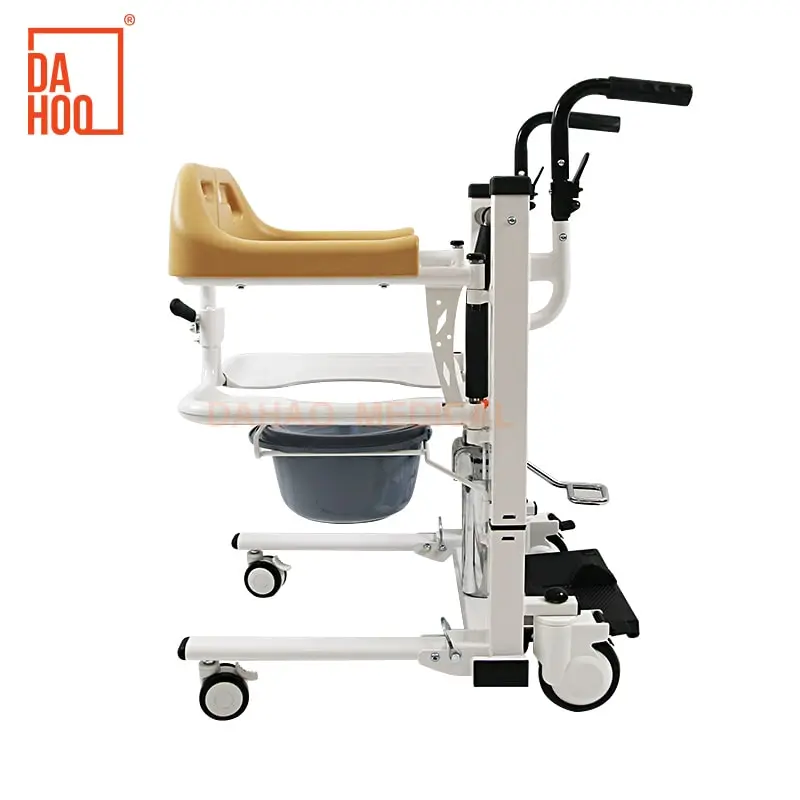
What is a lift transfer chair? Why is a "lifting" function needed?
Before discussing the hydraulic system, it's necessary to clarify a basic concept: What is the lift transfer chair itself used for?
Core Uses of a Lift Transfer Chair
A lift transfer chair is an assistive device used for:
• Assisting patients from bed to chair
• From chair to bed
• From indoors to the bathroom
• From a low position to a high position
To ensure safe transfer. Its core value lies not in the "distance of movement," but in height adjustment and stable support.
Why must a lift transfer chair have height adjustment capabilities?
The height a patient needs varies depending on the usage scenario, for example:
• Bed height
• Wheelchair height
• Sofa height
• Toilet height
If the lift transfer chair cannot adjust its height, it cannot achieve "barrier-free, low-risk" transfers.
Therefore, height adjustment is an indispensable core structure of a lift transfer chair.
What exactly is the hydraulic system in a lift transfer chair?
Basic definition of a hydraulic system
In a lift transfer chair, the hydraulic system is a mechanical system that uses fluid pressure to achieve smooth lifting.
Simply put:
The hydraulic system utilizes the pressure transmission characteristics of a sealed fluid to achieve "stable and controllable lifting motion with relatively small operating force."
In a hydraulic lift transfer chair, the hydraulic system is not an electronic component, but a combination of purely mechanical and fluid structures.
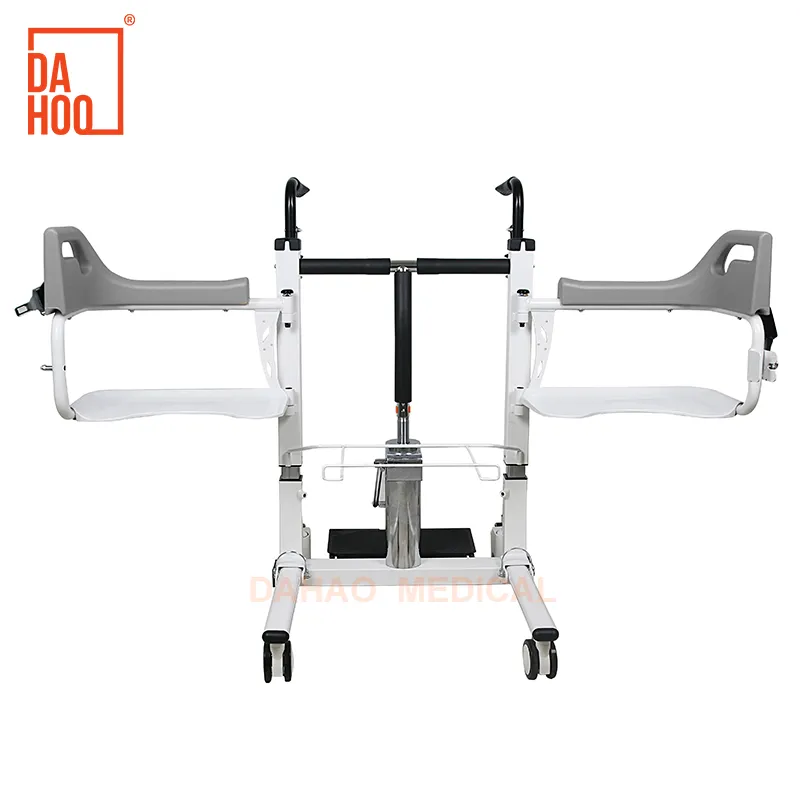
What are the basic components of a hydraulic system?
A typical lift transfer chair hydraulic system usually includes:
• Hydraulic cylinder
• Piston assembly
• Hydraulic oil
• Check valve or control valve
• Operating pedal or handle
These components together form a closed, controllable lifting system.
How does the hydraulic system work in a lift transfer chair?
What is the basic principle of hydraulic lifting?
The working principle of the hydraulic system is based on a very classic physical principle: Liquids are almost incompressible in a confined space, and pressure can be transmitted evenly.
In a lift transfer chair, this principle is used to:
• Convert the mechanical force input by foot pedal or manual operation
• into a pressure change within the liquid
• then push the piston to complete the lifting action
The entire process requires no electrical power.
How does the lift transfer chair achieve "rising"?
When the operator steps on or pushes the operating device:
1. The piston is driven
2. Hydraulic oil flows within the confined space
3. The internal pressure rises
4. This pushes the supporting structure upwards
Because the liquid pressure is transmitted evenly, the lifting process of the lift transfer chair is very smooth.
How does a lift transfer chair achieve its "lowering" motion?
The lowering process isn't a sudden release, but rather achieved through:
• Slow opening of the control valve
• Orderly return of hydraulic oil
• Gradual pressure release
This results in a controllable, slow, and safe lowering action.
This is one of the key reasons why hydraulic lift transfer chairs are widely used.
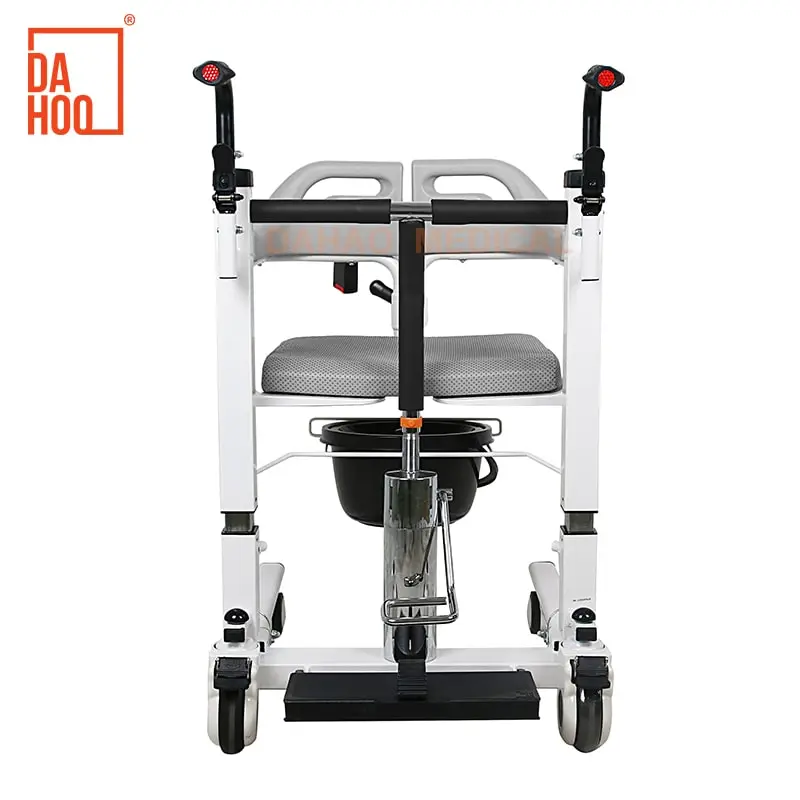
Why do many lift transfer chairs choose hydraulic systems?
What are the advantages of hydraulic systems in lift transfer chairs?
Among various lifting methods, hydraulic systems offer the following significant advantages:
• Smooth lifting process
• Controllable operation
• No reliance on electricity
• Relatively reliable structure
• Low maintenance requirements
For patient lift transfer chairs, these advantages directly relate to safety and controllability.
Why are hydraulic lift transfer chairs suitable for patients?
Patients using lift transfer chairs often exhibit the following characteristics:
• Weak body stability
• Inability to withstand sudden displacement
• Sensitivity to vibration and swaying
Hydraulic systems, on the other hand, offer the following advantages:
• Slow movement
• Continuous pressure
• No sudden acceleration
This makes hydraulic lift transfer chairs more suitable for the safety needs of patient transfers.
What are the fundamental differences between hydraulic lift transfer chairs and other lifting methods?
Hydraulic Lifting vs. Manual Mechanical Lifting
Compared to purely mechanical lifting, hydraulic lift transfer chairs offer the following advantages:
• Lower operating force
• Easier lifting effort
• More precise height control
This is why hydraulic systems are often used in patient lift transfer chairs, rather than simple gear or lever structures.
Hydraulic Lifting vs. Electric Lifting
The biggest difference between hydraulic and electric lift transfer chairs is:
• Hydraulic systems do not rely on a power source
• Electric systems rely on a motor and battery
In terms of stability and predictability, hydraulic systems exhibit very clear mechanical logic, without the complex variables of electrical systems.
What is the safety significance of hydraulic systems in lift transfer chairs?
Why are hydraulic lift-transfer chairs less prone to sudden drops?
This is a key characteristic of hydraulic systems.
Due to:
• Incompressible hydraulic fluid
• Strictly controlled flow via valves
Even if the operator stops moving, the hydraulic system naturally maintains the current height.
This is an extremely important safety feature for patient lift-transfer chairs.
How does the hydraulic system help maintain the stability of the lift-transfer chair?
The hydraulic system balances internal pressure:
• Distributes localized stress
• Reduces instantaneous impact
• Reduces sway amplitude
This prevents the lift-transfer chair from tilting or shaking significantly during lifting and lowering.
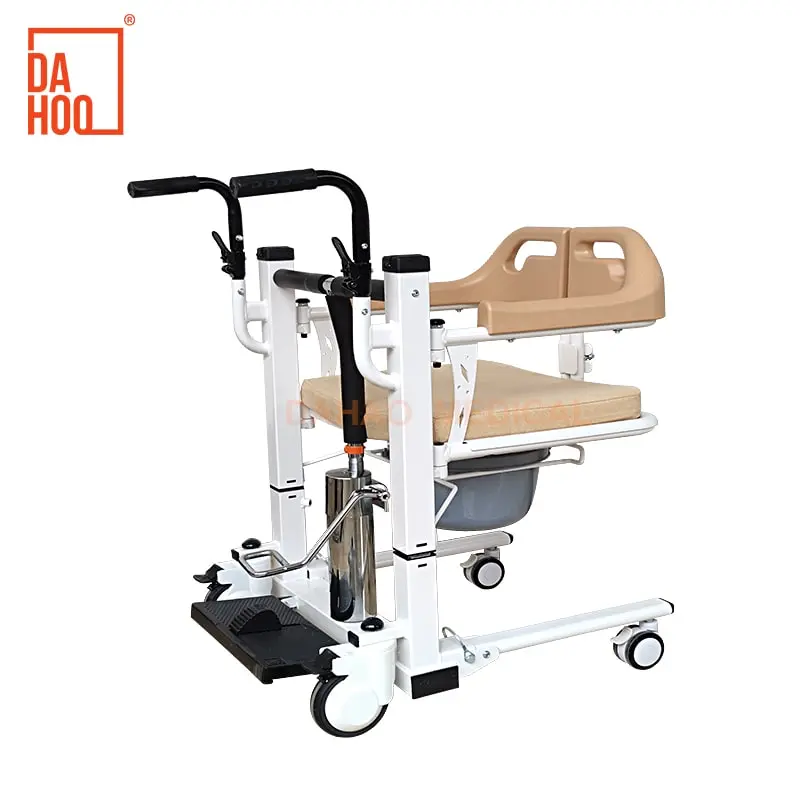
Does the hydraulic system in a lift-transfer chair require frequent maintenance?
Maintenance logic for the hydraulic system
The hydraulic system of a hydraulic lift-transfer chair is a closed system. Under normal circumstances:
• Hydraulic fluid will not leak
• The pressure system remains stable
• It has a long service life
This is also a major reason why hydraulic systems are widely used in medical assistive devices.
Why is the stability of the hydraulic system important?
For lift transfer chairs:
• Frequent lifting and lowering operations
• Large load capacity per lift
• High requirements for continuous stability
The design logic of the hydraulic system revolves around these usage needs.
Does a hydraulic lift transfer chair mean complex operation?
Many people mistakenly believe that hydraulic systems are "complex and difficult to use," but the opposite is true.
Operating characteristics of a hydraulic lift transfer chair:
• Intuitive operation
• Clear lifting and lowering feedback
• No need for fine adjustments
It is precisely because the hydraulic system "hides" the complex mechanical processes internally that the lift transfer chair is simpler to operate externally.
How to correctly understand the role of the hydraulic system in a lift transfer chair?
Essentially:
• The hydraulic system is not an additional function
• It is the core structure for the lift transfer chair to achieve safe lifting and lowering
Without the support of the hydraulic system, it is difficult for a lift transfer chair to achieve a good balance between:
• Stability
• Controllability
• Safety
How does Dahao Medical ensure product consistency for wholesale buyers?
For wholesale buyers, consistency is critical. Dahao Medical follows strict quality control procedures under ISO13485 standards, ensuring that every batch of Electric Wheelchairs or Hospital Beds meets the same specifications. This reliability helps distributors maintain stable sales channels and reduces after-sales issues, making the company a dependable wholesale supplier.