

Whether in home care, medical facilities, or public places, many people often see family members instinctively trying to "push" an elderly person using a 4-wheeled rollator when they are unsteady on their feet. While this may seem to help the elderly person save energy or maintain balance, from a safety, equipment design, intended use, and risk control perspective, this behavior is extremely dangerous.
A 4-wheeled rollator is a "walking aid," not a "transportation tool."
Its design purpose is to help users walk independently and maintain balance, not to be pushed by others or to be sat on and propelled.
This blog post will explain in detail and systematically why you should not push an elderly person using a 4-wheeled rollator, and will delve into related safety issues, sources of risk, correct usage methods, and assistive care principles, providing you with the most comprehensive reference guide.
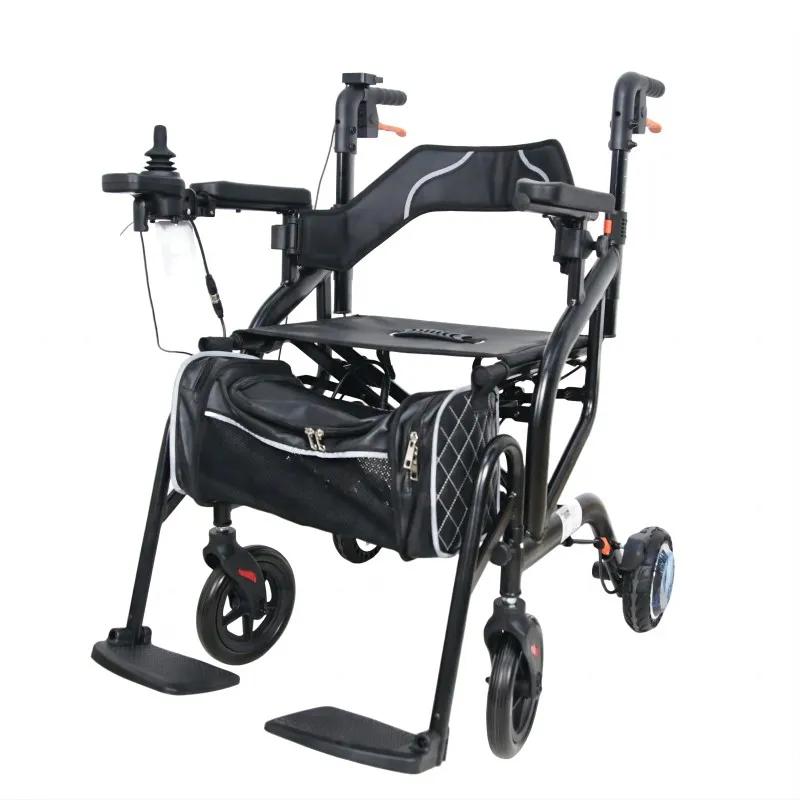
Why you should absolutely not push an elderly person using a 4-wheeled rollator?
Many people mistakenly believe that 4-wheeled rollator walkers are similar to wheelchairs, allowing elderly people to sit in them and be pushed around. However, the two differ significantly in design purpose, structural strength, center of gravity stability, and braking systems.
1. Four-wheeled walking aids are not designed to "carry someone being pushed."
The primary functions of a four-wheeled walking aid are:
• Providing walking support
• Enhancing walking stability
• Maintaining balance
It is not designed to withstand the lateral forces and continuous pressure of being pushed.
In contrast, wheelchairs are specifically designed to be pushed, while four-wheeled walking aids completely lack this carrying function.
2. Being pushed can cause a four-wheeled walking aid to lose its center of gravity.
When an elderly person is sitting in a four-wheeled walking aid and being pushed by someone, the following may occur:
• The center of gravity shifts forward
• The center of gravity becomes high
• The device suddenly loses its balance.
This makes it very easy for the device to tip over or tilt forward when turning, going downhill, or on uneven surfaces, which is a common source of serious accidents involving four-wheeled walking aids.
3. The braking system cannot withstand the inertial force of being pushed.
The brakes on a 4-wheeled rollator walker are designed for slowing down walking or stopping and stabilizing, not for braking after acceleration while being pushed.
Even with the brakes engaged, it's difficult to stop stably while being pushed, posing a significant risk.
4. Improper leg support for the elderly can lead to falls.
With no leg support while seated on a 4-wheeled rollator walker, while being pushed:
• The elderly person may slip forward.
• Their feet may get caught in the wheels.
• They may become unstable due to bumps.
Therefore, the danger is extremely high.
5. Pushing may lead to dependence and loss of independent walking ability.
One of the purposes of a four-wheeled walking aid is to promote activity, but pushing it actually reduces the elderly person's opportunity to actively use their lower limbs for walking.
In conclusion, the answer to "Should we push elderly people using 4-wheeled rollator walkers?" is very clear: Absolutely not!

Why do many people mistakenly believe that 4-wheeled rollator walkers can be pushed?
To understand why these misconceptions are so prevalent, we need to start with the appearance and structure of four-wheeled walking vehicles.
1. Because four-wheeled walking vehicles look like they have a "seat"
Many four-wheeled walking vehicles do have a seat, but this seat is:
• For use during rest
• For the user to sit down
• For resting after stopping
It is not designed to "bear the weight of the body while moving."
2. Some models have a "backrest," which is misleading
The backrest is simply to allow the user to sit more comfortably when stationary, not to bear the back pressure during movement like a wheelchair.
3. Family members instinctively want to help the elderly conserve energy
Many family members, seeing an elderly person get tired after walking for a while, immediately want the elderly person to sit down and then push them.
This "well-intentioned" approach is actually the most dangerous.
Therefore, correctly understanding the function of a four-wheeled walking vehicle is crucial.
Since it cannot be pushed, how should a four-wheeled walking vehicle be used correctly?
Understanding the correct usage is key to avoiding danger. This section details the standard procedures for using a 4-wheeled rollator walker.
1. The elderly person must always walk upright, not sit.
When using a four-wheeled walking aid, the user should maintain independent walking; the vehicle is only used to provide stability.
2. The seat is only for "stopping and resting," not for sitting while moving.
It must be ensured that:
• The vehicle is completely stopped.
• The brakes are locked.
• The user is sitting down to rest.
• No movement is made.
3. Both hands must hold the handlebars.
The handlebars are key to maintaining balance.
4. The four-wheeled walking aid should always be positioned in front of the body.
It should not be veering to the left or right, nor too close or too far.
5. Keep your gaze forward while walking, not on your feet.
This helps maintain a natural gait and better balance.

Can an elderly person use a 4-wheeled rollator walker if they cannot walk independently?
No!
Four-wheeled walking aids are only suitable for:
• People who can stand independently
• People who can take steps independently
• People who need mild to moderate balance support
Not suitable for:
• People who are completely unable to walk
• People with very weak standing ability
• People who need to be pushed
If the user cannot walk on their own, then they should use:
• Wheelchair
• Mobility chair
• Transfer chair
• Push-type mobility aid
not a four-wheeled walking aid.

If an elderly person insists on being pushed by a family member, how should you properly refuse?
Family members need to clearly tell the elderly person:
“A four-wheeled walking aid is not for being pushed; that is very dangerous. When you are being pushed while seated, the vehicle is prone to tipping over, not being able to brake, or slipping out of control. I will be beside you to support you and walk with you, but I will never push you while you are seated. For your safety, we must use it strictly according to the correct method.” The key point is safety, not “effortlessness.”
What serious risks might pushing a 4-wheeled rollator walker pose?
The following are the most common and serious hazards:
1. The entire vehicle tipping over forward or sideways
Especially on:
• Downhill slopes
• Turns
• Potholes
• Speed bumps
The risk of tipping over is extremely high.
2. Elderly people slipping off the seat and suffering fractures
Elderly people with osteoporosis are especially at risk.
3. Feet getting caught in the wheels, causing serious injury
This is a very typical but often overlooked hazard in many accidents.
4. If the person pushing the vehicle loses control or the brakes fail, they may crash into objects in front of them
For example:
• Bridge edges
• Steps
• Ends of ramps
• Obstacles ahead
Extremely dangerous.
5. Insufficient support in the elderly may lead to lumbar spine injuries
The seats of four-wheeled walking vehicles do not provide stable support and can cause unstable impacts to the body at high speeds or during swaying.
Is there any situation where it is safe to push a four-wheeled walking vehicle?
There is no situation where it is safe to push a four-wheeled walking vehicle.
Regardless of:
• Short distance
• Smooth road surface
• Elderly person's request
• Family member's preference
• Slow walking
It is not allowed.
This is the bottom line.
If family members want to assist an elderly person with walking, what tools should they use?
If the elderly person cannot walk independently, they can use:
• Wheelchair (safest)
• Transfer chair
• Walking belt (for assisted walking training)
• Wheeled walker with manual assistance function (some medical rehabilitation equipment)
However, under no circumstances should a 4-wheeled walking aid be pushed.
How to explain the correct use of a 4-wheeled walking aid to the user?
You can explain it like this:
"A 4-wheeled walking aid is for you to walk, not for someone to push you. You can use it when you sit down to rest, but you must stop and lock the brakes. When moving, you must stand and walk, otherwise it will be very dangerous." Make the elderly person understand that this is about safety, not charity.
How to ensure the elderly person uses a 4-wheeled rollator correctly?
1. Family members need to repeatedly remind them of the correct usage.
Especially emphasize "Do not push."
2. Store the walker in an easily accessible location.
This allows the elderly person to use it easily.
3. Teach the elderly person how to lock the brakes.
This includes both the temporary brake and the parking brake.
4. Assist the elderly person in maintaining correct posture.
For example, adjusting the handrail height and keeping the body upright.
5. Accompany, not push.
Family members should walk beside the elderly person, supporting their elbows if necessary, rather than gripping the walker.