

For those looking for walking aids, "4-wheel rollators" and "wheelless walking aids" are the two most common and easily confused choices. Although both are walking aids, their design purposes, usage methods, target audiences, and safety requirements differ significantly. Without understanding these differences, you may end up buying an unsuitable device, leading to difficulty walking, a lack of security, and even an increased risk of falls.
So, how should you choose between a 4-wheel rollator and a wheelless walking aid? Which is more suitable for people with poor balance? Which is more suitable for indoor environments? Which helps improve walking efficiency?
This article will provide a systematic, professional, and in-depth analysis to answer these questions one by one.
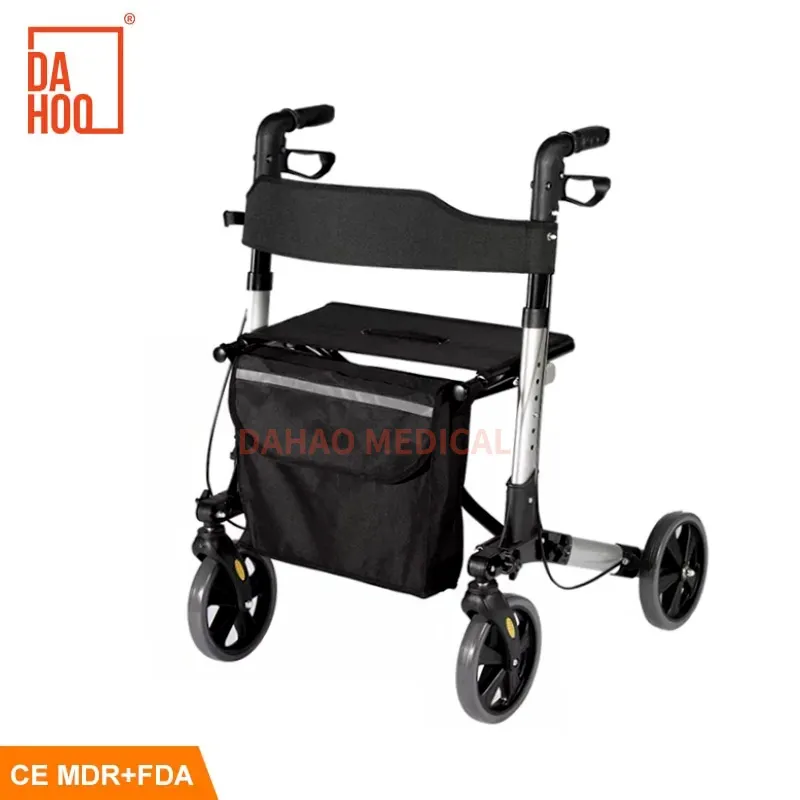
What is a 4-wheel rollator? What is a wheelless walking aid?
4-Wheel Rollator
A 4-wheel rollator is an assistive walking device with four wheels, typically equipped with:
• Lightweight frame
• Four front and rear wheels
• Braking system
• Built-in seat
• Storage basket or bag
• Adjustable handle height
Its design goal is to allow users to walk more easily and effortlessly while maintaining stability.
Because of the wheels, users don't need to lift the device; they simply push it forward, making it suitable for people with moderate walking ability who cannot walk long distances independently.
Wheelless Walking Aid
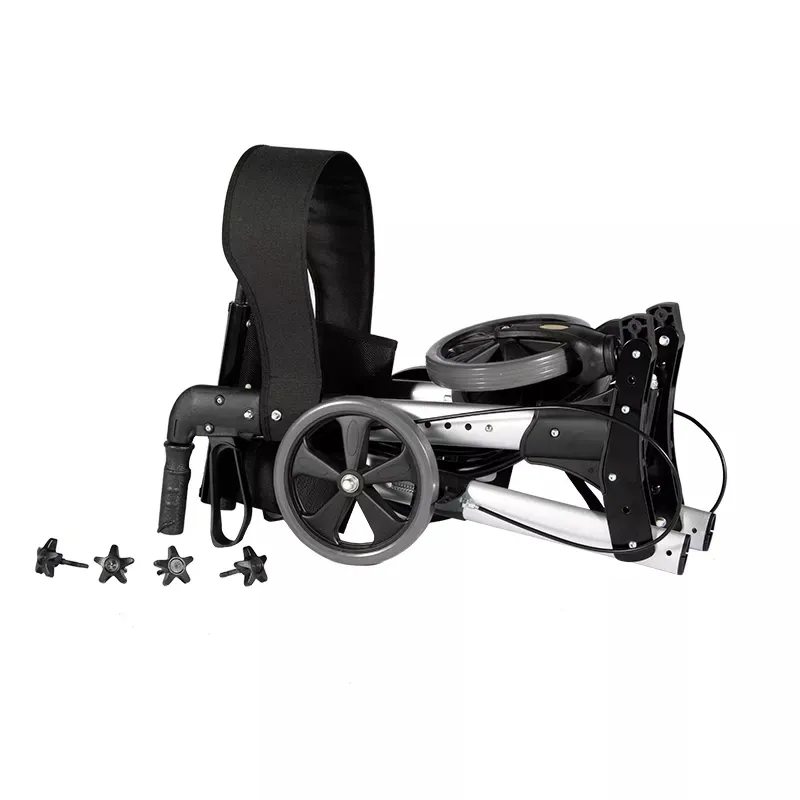
A wheelless walking aid is a traditional walking aid without any wheels. Its structure typically includes:
• Lightweight aluminum frame
• Four non-slip footpads
• Adjustable height
It is used by:
The user lifts the walking aid → lowers it forward → takes a step to follow.
Therefore, the wheelless walking aid provides the strongest support but also requires the most effort.
It is suitable for people who need maximum support, have very poor balance, a slow gait, and need to rely entirely on support.
Who is a 4-wheel rollator suitable for?
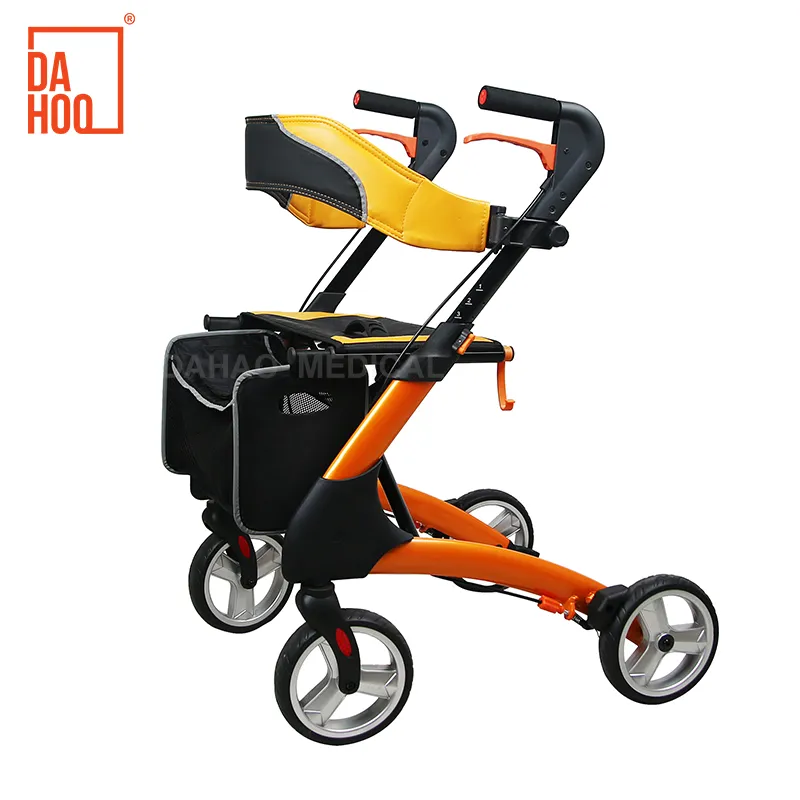
A 4-wheel rollator is more suitable for the following groups:
• Those who can maintain basic balance but need stable support
• Those who want easier and less strenuous walking
• Those who need to walk outdoors or travel long distances
• Those who need to sit down and rest frequently
• Those with weak arm strength who are not suitable for frequently lifting the walking aid
• Those experiencing joint pain, difficulty breathing, or insufficient endurance
• Those who want to carry personal items (the walking aid has a basket/bag)
If the user can stand independently and push the tool, the 4-wheel rollator can significantly improve walking efficiency and comfort.
Who is a wheelless walking aid suitable for?
A wheelless walking aid is more suitable for the following groups:
• Those with extremely poor balance
• Those who need maximum stability support
• Those who walk very slowly
• Those whose surfaces must be very stable (such as hospitals or rehabilitation centers)
• Those with insufficient lower limb strength
• Those who have just undergone surgery and need to limit their stride length
• Those who must strictly control the safety of each step
The main advantage of a wheelless walking aid is "maximum support," making it suitable for people in the early stages of rehabilitation and those with strong walking dependence.
4-wheel rollator vs. wheelless walking aid: Which device is more stable?
Stability must be discussed separately:
Static stability: Wheelless walking aid is more stable.
When the user is standing still:
• The wheelless walking aid is completely flat on the ground.
• The four-point support is very stable.
• There is no risk of slipping or rolling.
Therefore, if the user is unstable or prone to wobbling, the wheelless walking aid provides the highest level of standing support.
Dynamic stability: 4-wheel rollator is more stable.
When the user needs to walk:
• The 4-wheel rollator does not need to be lifted.
• The pushing motion is smooth and continuous.
• It does not disrupt gait rhythm while walking.
• It is safer on uneven outdoor surfaces.
Therefore, during walking, the 4-wheel rollator has better dynamic stability than the wheelless walking aid.
How to choose between a 4-wheel rollator and a wheelless walking aid for indoor use?
Indoor environments are typically narrow, have many turns, and have smooth surfaces.
Suitable for indoor use:
• Wheelless walking aid: Stable, non-slip, won't damage floors
• Small-wheeled 4-wheel rollator: Flexible, easy to push, suitable for spacious indoor areas
Recommended choices:
• Confined spaces requiring maximum support → Wheelless walking aid
• Spacious indoor spaces requiring less effort to walk → 4-wheel rollator
For outdoor use, which is better, a 4-wheel rollator or a wheelless walking aid?
Outdoor surfaces include:
• Stalled paths
• Uneven surfaces
• Grass
• Slopes
• Curbs
Wheelless walking aids are unsuitable for these surfaces because:
• Requires lifting, which is very strenuous
• Anti-slip mats can easily get stuck
• Stability decreases with many obstacles
4-wheel rollators are ideal for outdoor use:
• Larger wheels make it easier to overcome obstacles
• Effortless pushing
• Handbrake for handling slopes
• Includes a seat for resting
Therefore, for outdoor use, a 4-wheel rollator should be the priority.
Is a 4-wheel rollator less strenuous than a wheelless walking aid?
The answer is: Absolutely.
Here are the reasons:
1. No need to lift the device
A wheelless walking aid requires lifting and lowering the device with each step, which is very strenuous.
A 4-wheel rollator only requires pushing.
2. Less pushing resistance
The rolling wheels make walking smoother.
3. Maintains a continuous gait
Fewer movements mean less energy.
Therefore, if the user has poor stamina or limited endurance, a 4-wheel rollator is significantly easier.
Which is better for walking speed and gait?
A 4-wheel rollator promotes a natural gait
Reasons include:
• Stable hand position
• Continuous steps
• No need to pause to lift the walker
• More natural forward lean and arm swing
A wheelless walking aid disrupts gait rhythm
Because each step requires pausing to lift the walker, the speed is slower and the gait is less natural.
What are the differences in safety between the two?
The safety of a 4-wheel rollator depends on proper use:
• The handbrake must be used correctly.
• Do not use it as a wheelchair.
• Control your speed when going downhill.
• Pushing at high speed may cause imbalance.
The safety of a wheelless walking aid depends on the user's physical fitness:
• Stability during lifting depends on arm strength.
• Unstable outdoor ground may cause tripping.
• Short strides are necessary, leading to fatigue.
Therefore, there is no absolute difference in safety between the two, but the usage scenario and method determine the safety effect.
Is a rollator seat necessary?
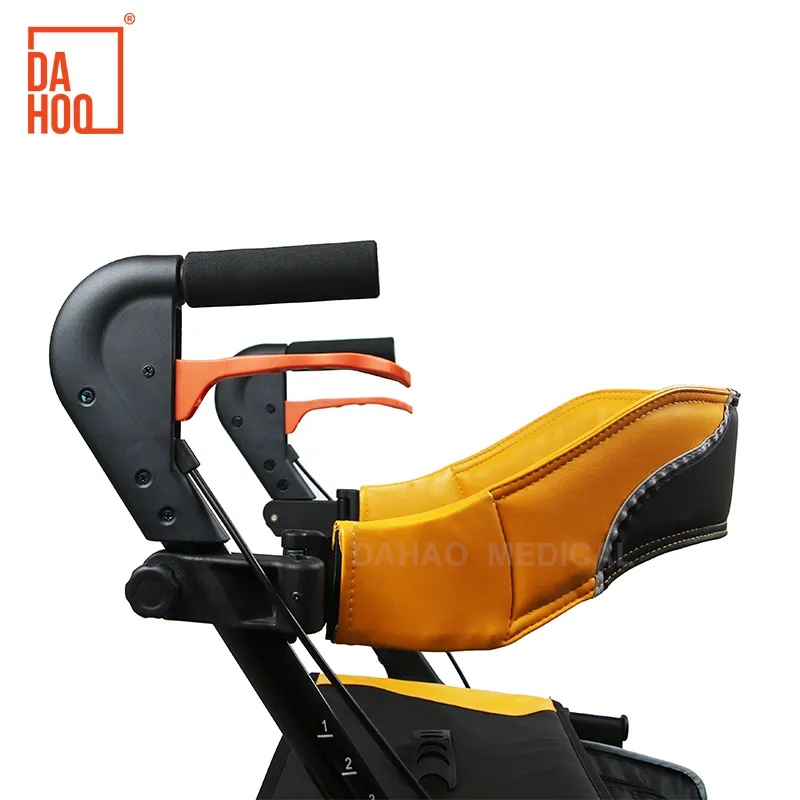
For people who tire easily, a 4-wheel rollator with a seat is almost essential.
Advantages include:
• Allows for rest when tired.
• Increased independence.
• Longer outdoor activity time.
• Prevents falls due to excessive fatigue.
Wheelless walking aids do not have a seat, so they are less suitable for people who tire easily.
Does the weight of walking aids affect the choice?
Wheelless walking aid: Lightest
• Extremely lightweight
• Easy to carry
• Requires significant physical strength for walking
4-wheel rollator: Slightly heavier
• More stable
• Easy to push
• May require slightly more effort when lifting onto a car or stairs
If the user needs to carry the tool frequently, the weight factor should be carefully considered.
How to choose between a 4-wheel rollator and a wheelless walking aid based on individual physical capabilities?
The following factors are crucial:
Suitable for 4-wheel rollators:
• Have basic balance
• Can stand independently
• Do not require strong upper body support when walking
• Can use the handbrake
• Primarily for outdoor or long-distance walking
Suitable for wheelless walking aids:
• Extremely poor balance
• Requires significant support when standing
• Insufficient lower body strength
• Not suitable for rapid movement after surgery
• Primarily for slow indoor walking
Which is easier to carry and fold: a 4-wheel rollator or a wheelless walking aid?
• Wheelless walking aid: Lightest, thin when folded, and easy to carry.
• 4-wheel rollator: Slightly larger, but modern models are mostly lightweight folding structures and can still fit in a car trunk.
If you frequently travel by car, portability may be a key factor.
Final Choice: How to determine which one is best for you?
Please assess yourself based on the following questions:
✔ Can you stand independently and maintain basic balance?
Yes → 4-wheel rollator
No → Wheelless walking aid
✔ Do you need to walk long distances?
Yes → 4-wheel rollator
No → Both are possible, choose according to your support needs.
✔ Do you tire easily?
Yes → 4-wheel rollator (with seat)
✔ Are you mainly indoors or outdoors?
Indoors → Wheelless walking aid or small-wheeled walking aid
Outdoors → 4-wheel rollator is a must.
✔ Do you need maximum stability?
Need → Wheelless Walking Aid
How to choose between a 4-wheel rollator and a wheelless walking aid?
Wheelless walking aid: Maximum stability, lightest, but strenuous, slow, no seat, suitable for early rehabilitation and those with very weak balance.
4-wheel rollator: Minimal effort, best suited for outdoor activities and long distances, includes a seat, improves independence, but requires basic balance and braking skills.
The core principle is simple: Need maximum support → Wheelless walking aid
Need easy and efficient walking → 4-wheel rollator
How does Dahao Medical ensure the safety of its products?
Safety is a top priority at Dahao Medical. All of our products, including Electric Wheelchairs and Hospital Care Beds, are designed with safety features such as anti-tip systems, adjustable heights, and secure locking mechanisms. Our manufacturing processes adhere to strict quality control standards, and our products undergo extensive testing to ensure they meet international safety certifications, including ISO 13485, FDA, and CE.