

As assistive mobility devices continue to evolve, an increasing number of consumers are turning their attention to a specific product category: "carbon fiber wheelchairs." Particularly as the demand for frequent outings, family vacations, and long-distance travel continues to rise, many people have begun to seriously consider a practical question:
Are carbon fiber wheelchairs truly suitable for travel?
In reality, for those who rely on a wheelchair for daily mobility, "travel" entails much more than simply reaching a destination. The truly complex aspect often lies in the entire process of getting from point A to point B.
For instance:
•How to load it into a vehicle;
•How to carry or handle it;
•Whether it folds easily;
•Whether it can pass through airport or high-speed rail security checkpoints;
•Whether it allows for convenient access to hotels;
•Whether it causes fatigue during prolonged periods of movement;
•Whether it occupies an excessive amount of space.
All of these factors directly impact the overall travel experience.
Compared to traditional, bulkier wheelchairs, a key reason why "carbon fiber wheelchairs" are gaining such traction is that they are—in terms of lightweight design, folding capabilities, and ease of mobility—genuinely better suited to the demands of travel scenarios.
This is especially true for "carbon fiber folding wheelchairs," the very design philosophy of which prioritizes portability, agility, and suitability for frequent movement.
Consequently, when evaluating the overall user experience, carbon fiber folding wheelchairs generally prove to be a superior choice for travel environments.
However, it is important to clarify:
Being "suitable for travel" does not imply that every carbon fiber wheelchair is perfectly adapted to every single travel scenario.
What truly matters remains the wheelchair's ability to accommodate the complexities inherent in the travel process itself.
Why Do Traditional Wheelchairs Often Feel Like a Burden During Travel?
Many consumers discover—only after taking their wheelchair on a trip for the first time—that the most exhausting part of the journey is rarely the act of sitting in the wheelchair, but rather the act of handling it.
This is particularly evident in the following situations:
•Getting in and out of vehicles;
•Checking into hotels;
•Passing through high-speed rail security;
•Checking in luggage at airports;
•Transferring between elevators;
•Navigating through tourist attractions.
A wheelchair is not merely something to be used for sitting.
It also requires repeated cycles of:
•Stowing;
•Carrying/Handling;
•Folding;
•Unfolding.
If the wheelchair itself is excessively bulky or heavy, the entire travel process becomes significantly more complicated.
Why Are Many Traditional Wheelchairs Unsuitable for Frequent Travel?
For many traditional wheelchairs, the single biggest drawback is simply that they are too heavy. Steel wheelchairs—and particularly certain large electric models—often reveal significant shortcomings during extended travel.
For instance:
•Difficulty loading into a vehicle;
•Insufficient trunk space;
•Strenuous handling;
•Remaining bulky even after folding;
•Difficulty navigating narrow spaces.
These issues may not be apparent during short-distance, daily use.
However, once you enter a travel environment, these problems can quickly become magnified.
Why are carbon fiber wheelchairs better suited for travel?
Compared to traditional wheelchairs, one of the most defining characteristics of a carbon fiber folding wheelchair is its lightness.
This is also the primary concern for many travelers who use wheelchairs.
1. Why is "lightweight design" particularly important for travel?
Travel entails frequent movement.
And every time a wheelchair is moved, it requires:
•Lifting;
•Lowering;
•Stowing;
•Changing direction;
•Loading into a vehicle;
•Passing through confined areas.
If a wheelchair is excessively heavy, performing these actions repeatedly places a continuous physical strain on the user.
Carbon fiber wheelchairs, by virtue of their lightweight carbon fiber construction, typically weigh significantly less than traditional models.
This difference becomes acutely apparent within a travel context.
2. Why do many people notice such a stark difference the very first time they lift a carbon fiber wheelchair?
Because the "lifting and carrying" involved in travel is not a one-off occurrence; rather, it happens repeatedly.
For example:
•Removing it from a car trunk;
•Loading it back into the vehicle;
•Entering a hotel;
•Transporting it to the room;
•Boarding and disembarking from various modes of transport.
These actions may be repeated many times throughout a single day.
Consequently, every ounce of weight saved on the wheelchair translates into a significant reduction in long-term physical exertion.
This is a key reason why carbon fiber folding wheelchairs offer such distinct advantages in travel scenarios.
3. Why is folding capability more important than many people realize?
Many consumers initially assume that "as long as the wheelchair is functional to sit in, that's enough." However, after actually traveling, they discover that the ease with which a wheelchair folds is, in fact, critical.
This is because space is often at a premium in travel environments.
For instance:
•Small car trunks;
•High-speed train luggage compartments;
•Hotel rooms;
•Elevators;
•Narrow corridors.
If a wheelchair cannot be stowed quickly and efficiently, it can significantly hinder the efficiency of one's travels.
4. Why do carbon fiber wheelchairs place a greater emphasis on foldability and portability?
Many carbon fiber folding wheelchairs are designed with mobility scenarios—specifically travel—in mind. Consequently, their folding mechanisms are typically given high priority during the design process.
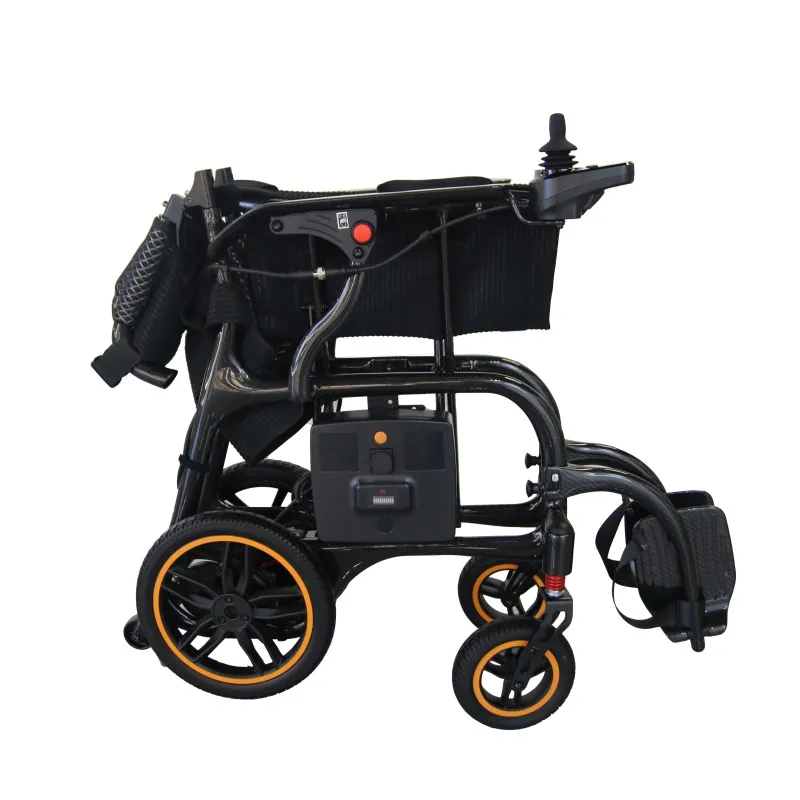
In particular, when certain carbon fiber folding wheelchairs are collapsed:
•They become more compact in size;
•They are easier to handle and carry;
•They fit more easily into a vehicle's trunk.
This is a crucial advantage for travel purposes.
5. Why is being "trunk-friendly" particularly important when traveling?
Many wheelchair users rely heavily on vehicles when traveling. However, vehicle cargo space is inherently limited.
This is especially true for:
•Standard sedans;
•Ride-hailing vehicles;
•Taxis;
•Small SUVs.
If a wheelchair is too bulky, it may:
•Completely fill the trunk, leaving no room for luggage;
•Prevent other luggage from being loaded;
•Be difficult to maneuver into the trunk due to restricted angles.
Because carbon fiber wheelchairs are generally lighter and more compact, they are typically much easier to stow alongside luggage.
Why do carbon fiber wheelchairs require less effort to push?
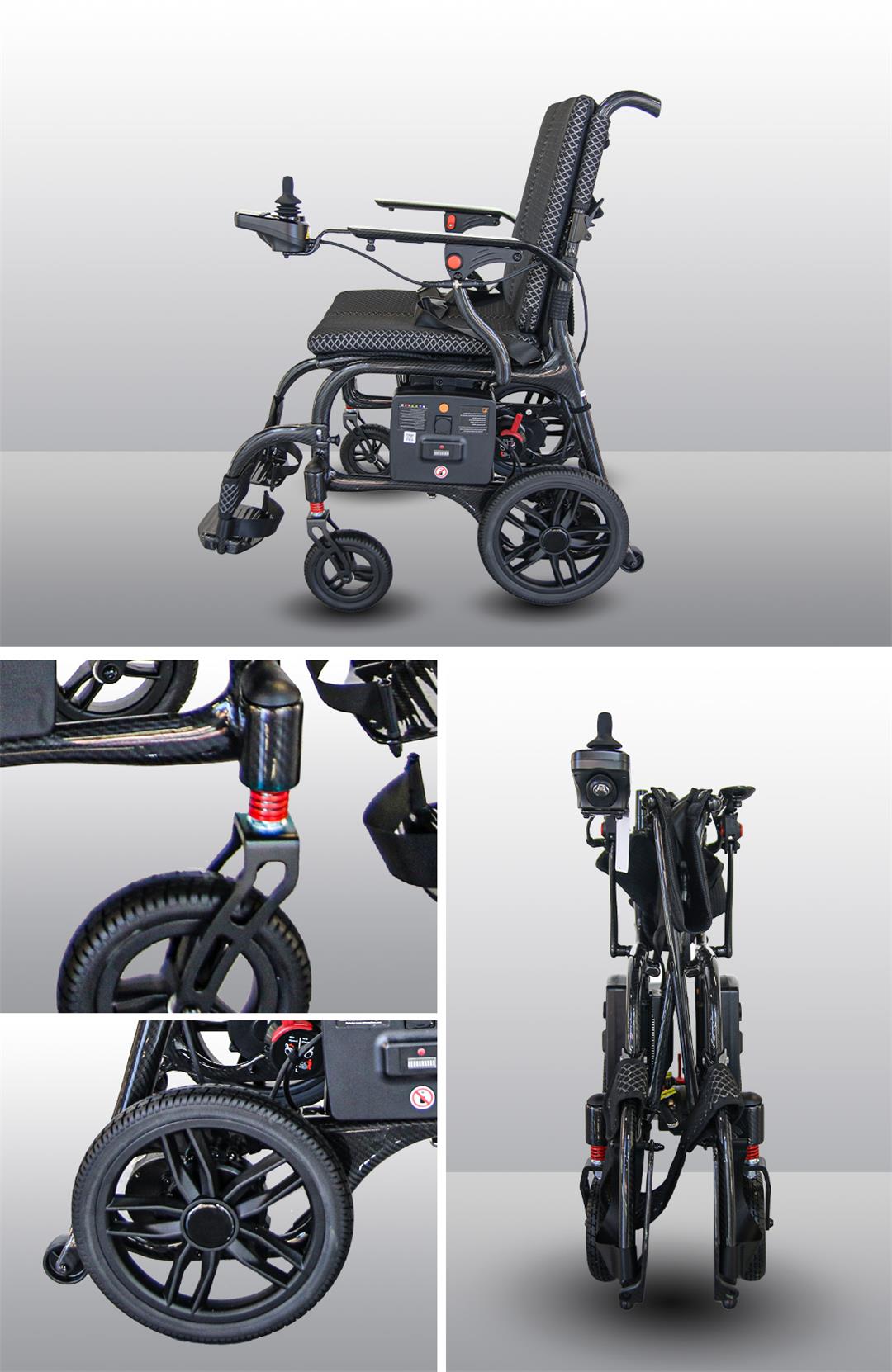
In addition to being lightweight, many carbon fiber folding wheelchairs feature high frame rigidity.
This means that when the chair is pushed, the transfer of force is more direct and efficient.
Consequently, moving over long distances typically requires less physical effort.
This difference becomes particularly noticeable in environments that require continuous movement, such as airports and high-speed train stations.
1. Why are carbon fiber wheelchairs better suited for airport and high-speed train environments?
The defining characteristic of airports and high-speed train stations is the long distances that must be covered.
Many users need to:
•Travel across long corridors;
•Perform multiple transfers (e.g., between modes of transport);
•Frequently change direction;
•Pass quickly through security checkpoints.
Therefore, wheelchair maneuverability and agility are of paramount importance.
2. Why is the "heaviness" of a wheelchair more noticeable during travel?
This is because the terrain and conditions encountered during travel are often more varied and complex.
For example:
•Long corridors;
•Ramps and inclines;
•Tiled flooring;
•Uneven surfaces;
•Roadways within tourist attractions.
If a wheelchair is heavy, moving it over extended periods can significantly increase physical fatigue.
In such scenarios, carbon fiber folding wheelchairs typically make the experience much less strenuous.
3. Why do many travelers prioritize "ease of operation"?
Travel environments often change rapidly and unpredictably. Therefore, the simpler a wheelchair is to operate, the more important that becomes.
For example:
•Making quick turns;
•Turning around in tight spaces;
•Entering and exiting elevators;
•Navigating through crowds.
All of these tasks require the wheelchair to possess excellent maneuverability.
Because carbon fiber wheelchairs have lower overall inertia, they are often much easier to handle in a wide variety of situations.
Are carbon fiber wheelchairs suitable for every travel environment?
Not necessarily. While carbon fiber folding wheelchairs are well-suited for most daily travel scenarios, their suitability must still be evaluated based on the specific environment.
For example:
•Extremely complex terrain;
•Prolonged travel over rough outdoor surfaces;
•Specialized off-road environments.
These situations place much higher structural demands on a wheelchair.
Consequently, not all carbon fiber folding wheelchairs are suitable for every conceivable environment.
What is the greatest travel advantage of a carbon fiber wheelchair?
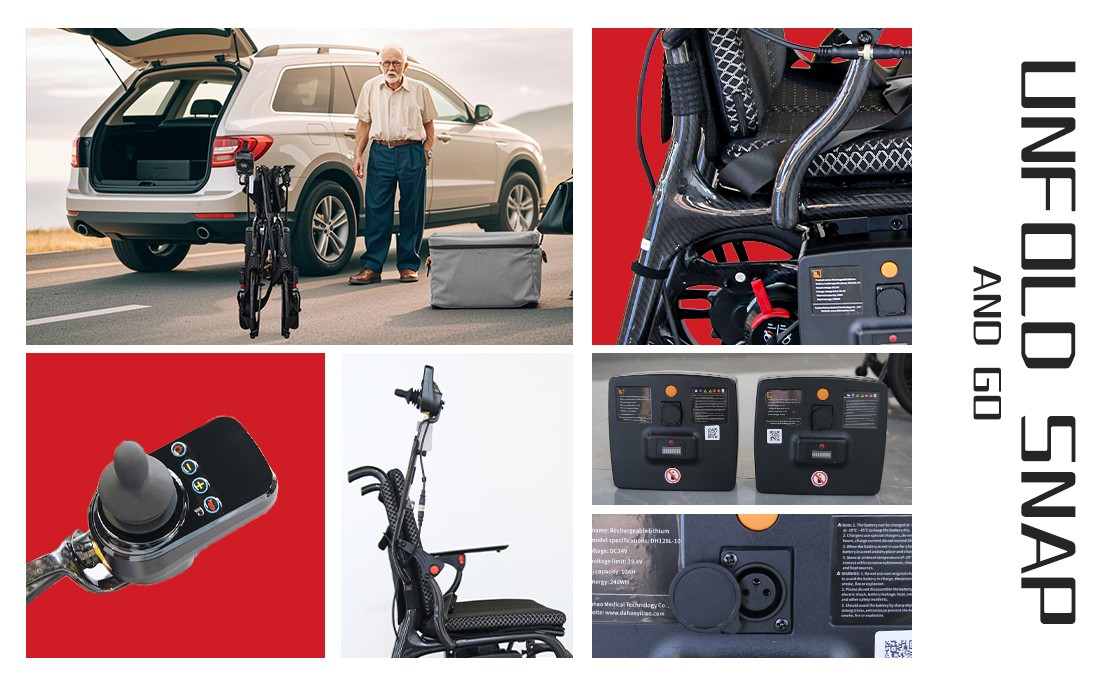
Taken as a whole, the core advantages primarily include:
•Lighter weight;
•Easier folding;
•Greater ease of loading into a vehicle;
•Simpler handling and carrying;
•Better suitability for frequent movement;
•Greater adaptability to complex travel itineraries.
Collectively, these characteristics explain why carbon fiber folding wheelchairs are generally better suited for travel environments.
What benefits can buyers expect when purchasing a carbon fiber electric wheelchair?
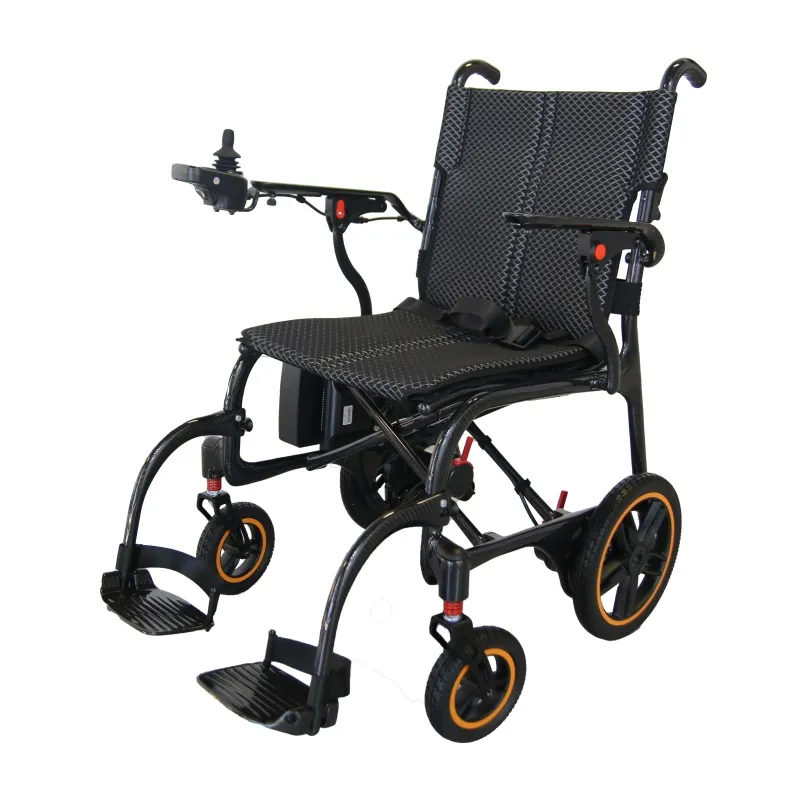
Buyers who choose a carbon fiber electric wheelchair will immediately gain significant advantages in terms of portability, performance, and brand differentiation. As a product supplied by Daho Medical—a professional Chinese manufacturer and factory supplier—this carbon fiber wheelchair not only achieves an ultra-light overall weight (weighing approximately 13.5 kg with the battery included, and just 12 kg without) but also maintains exceptional load-bearing capacity and durability—qualities that are highly appealing to both purchasing managers and retail buyers alike.