

Among many assistive walking devices, the four-wheeled rollator is widely used by many elderly people, those undergoing rehabilitation, and users with weak balance due to its stability, comfort, and convenience.
However, many people who have purchased a four-wheeled rollator walker are unclear about "the correct way to use it for walking." Incorrect use not only fails to utilize the device's benefits but can also increase the risk of falls.
This blog post will provide a comprehensive explanation of "the correct way to use a four-wheeled rollator for walking." It includes usage steps, key posture points, common operational errors, and safety details to help you truly master the correct way to walk with a four-wheeled rollator.
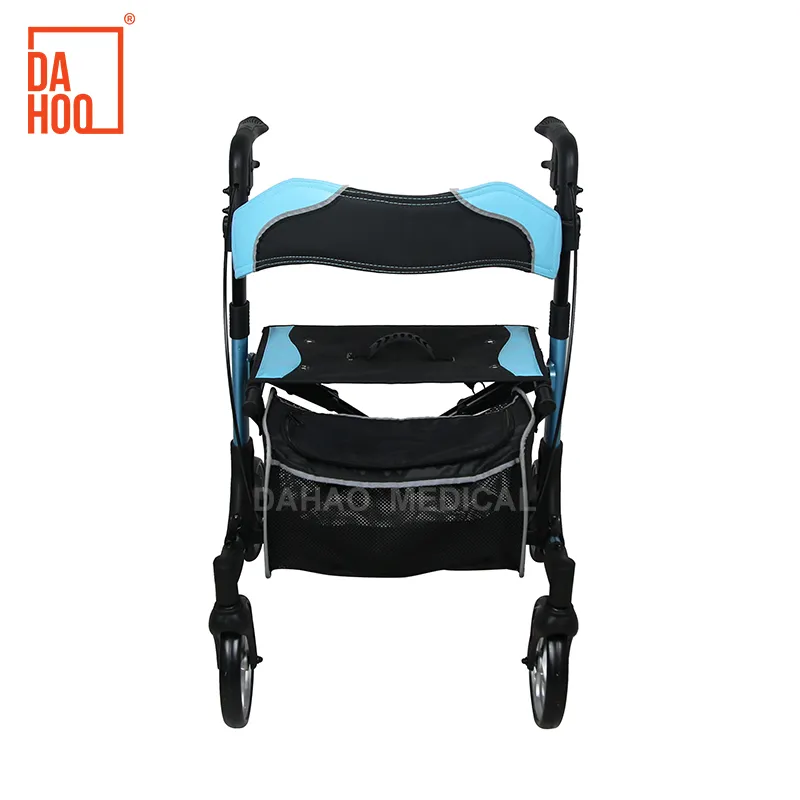
What preparation steps should you take before using a four-wheeled rollator for walking?
Preparation is crucial before officially using a four-wheeled rollator for walking. It directly determines whether your posture is stable, your gait is natural, and the device functions optimally during walking.
1. Adjust the Handrail Height of the Four-Wheeled Rollator
Correct handrail height is essential for using a four-wheeled rollator walker. Stand upright with your arms hanging naturally at your sides, elbows slightly bent at approximately 15°–20°. Adjust the handrails to wrist height.
Handrails that are too high can cause:
• Shoulder shrugging
• Arm fatigue
• Limited forward lean
Handrails that are too low can cause:
• Excessive spinal curvature
• Unnatural gait
• Increased risk of falls
2. Check the Braking Function of the Four-Wheeled Rollator
The braking system is one of the biggest differences between a four-wheeled rollator walker and a regular walking frame. Before use, ensure:
• The handbrake depresses and releases smoothly
• The parking brake (locks down) functions properly
• The wheels turn smoothly without wobbling
3. Ensure Stable Standing Posture
The user should stand with feet shoulder-width apart, maintaining a natural balance. The four-wheeled rollator walker should be positioned in front of your body, but not excessively far away.
4. Familiarize yourself with the weight and pushing resistance of the device
Different materials result in slightly different weights for four-wheeled rollators. Gently push the vehicle to feel the sliding resistance and ensure it's neither too light nor too heavy when walking.
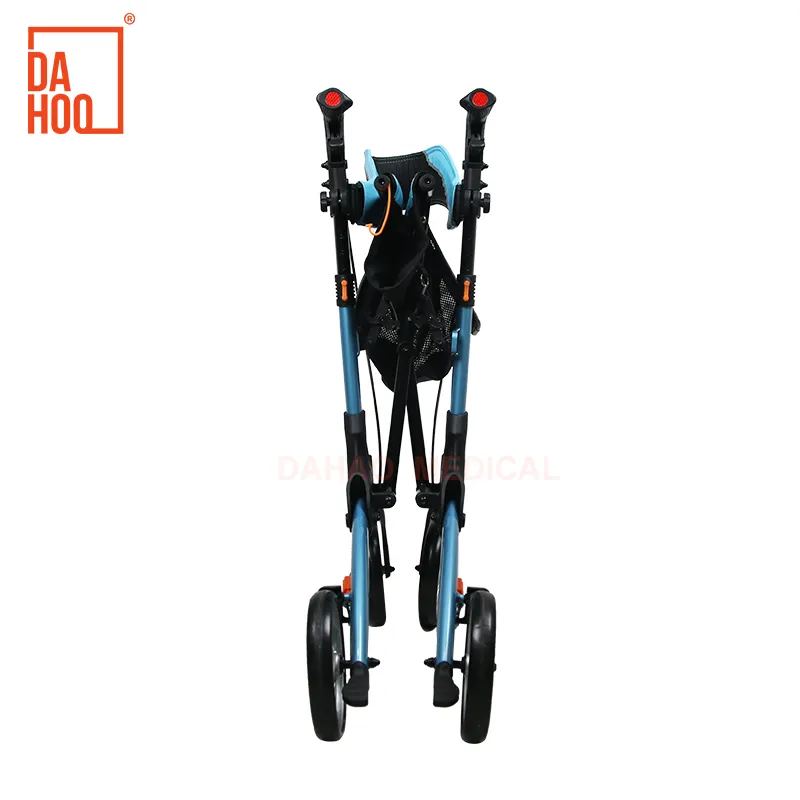
How should you position the four-wheeled rollator while walking?
To answer the question, "What is the correct way to walk using a four-wheeled rollator?", one of the most crucial details is the relationship between the rollator walker and your body.
1. The four-wheeled rollator should not be too close or too far from your body
The correct distance is—the rollator walker should be slightly in front of your body, about an arm's length away, not touching your legs, and not so far that you need to reach out to touch the handlebars.
Too close:
• Risk of bumping your toes
• Reduced stride length
• Uncoordinated walking
Too far:
• Forced forward lean
• Instability
• Increased risk of falling
2. Maintain a direct facing direction of the four-wheeled rollator
Your body should always face the direction the four-wheeled rollator is moving. Do not lean to one side or push it at an angle.
3. Let the walker "lead," not "drag" you
You should let the four-wheeled rollator walker push forward naturally. Do not lean your body against the handlebars or lean excessively forward.

How should your gait be coordinated when walking with a four-wheeled rollator?
Correct gait coordination is one of the most important technical details when using a four-wheeled rollator. Many people experience fatigue or balance problems due to uncoordinated gait.
1. Push the bike first, then step – but don't push too far
The correct sequence is:
1) Push the bike forward slightly.
2) Step with one foot.
3) Step with the other foot.
4) Repeat.
Simply put, "bike first, feet follow."
2. Maintain a normal stride
Stride length should not be too large, nor too small like shuffling steps. Maintaining a natural gait is safer and less strenuous.
3. Keep your feet landing naturally
Land on your heels first, then on the balls of your feet, with a steady gait.
4. Avoid swaying or uneven strides
If you notice uneven strides from left to right, it means you may be leaning to one side, or the handrail height is unbalanced, requiring adjustment.
How should you use your upper body when using a four-wheeled rollator?
Many people mistakenly believe that using a four-wheeled rollator requires a lot of upper body strength, but the correct way is to lightly grip the handrails with both hands to maintain direction and stability, rather than relying on your arms to support your body weight.
1. Relaxed but stable arms
Arms should be naturally bent, not stiff or drooping.
2. Neutral wrist position
Avoid excessive outward or inward bending of the wrists to prevent fatigue or pain.
3. Use core muscles for balance
Use your torso and core muscles to maintain an upright posture, not your arms.
4. Avoid pressing your body against the handrails
If you find yourself leaning too far forward or pressing against the four-wheeled rollator walker:
• The handrail height may be incorrect.
• You may need to improve your standing balance.
How to properly control a four-wheeled rollator when turning?
Turning is one of the most common mistakes many users make because the high maneuverability of the four wheels on a four-wheeled rollator makes steering easy, but also requires extra caution.
1. Slow down
The slower you turn, the safer you are.
2. Evenly distribute arm force
Maintain equal pushing force with both hands; otherwise, you will drift.
3. Body Turns with the Vehicle
When turning, align your body and line of sight simultaneously with the direction of the turn.
4. Reposition the Rollator After Turning
After turning, ensure the four-wheeled rollator is once again directly in front of you.
What are some important techniques for using a four-wheeled rollator uphill or downhill?
Slopes are the most challenging terrains to navigate when using any mobility aid. Correct techniques are as follows:
Uphill Techniques:
• Lean slightly forward
• Slow down the pushing speed
• Hold the handlebars firmly
• Avoid stopping in the middle of the slope
Downhill Techniques:
• Lean slightly back
• Use the brakes to control speed
• Maintain short, steady strides
• Never let the vehicle roll downhill
How should the brakes be used correctly for safety?
There are two types of brakes on a four-wheeled rollator walker – temporary braking and parking braking.
1. Temporary Braking (Light Pressure)
Used for slowing down, stopping, and controlling speed when going downhill.
2. Parking Brake (Press Lock)
When you need to:
• Sit in the seat attached to the four-wheeled rollator walker
• Stop to rest
• Wait for a traffic light
• Bend over to retrieve something
You must lock the parking brake.

What are some common mistakes when using a four-wheeled rollator?
Mistake 1: Leaning too far forward
This makes you dependent on the rollator and detrimental to balance.
Mistake 2: Taking too large or too small steps
This can cause instability or excessive fatigue.
Mistake 3: Not maintaining a controlled speed
Especially when going downhill, not controlling your speed is dangerous.
Mistake 4: Adjusting the handrail height arbitrarily
Incorrect height can lead to fatigue and posture problems.
How to assess whether you are using a four-wheeled rollator correctly?
You can determine if you are using it correctly by checking the following points:
• Is your body upright and natural when walking?
• Can you easily control the direction?
• Do you avoid hitting the front wheel?
• Do you experience lower back pain or wrist fatigue?
• Can you push it stably without relying on your upper body weight?
If most of the above answers are "yes," then you have mastered the correct method.
Why is using a four-wheeled rollator correctly so important?
The main reasons include:
• Improved walking stability
• Reduced risk of falls
• Improved posture
• Increased walking efficiency
• Protected joints, avoiding unnecessary strain
• Enhanced user independence and confidence
Correct usage not only makes a four-wheeled rollator walker a safety tool but also an important assistive device to help you maintain your mobility.
Do you offer customized manufacturing services?
Yes, Dahao Medical provides comprehensive OEM and ODM services for customers who require customized medical equipment. As a flexible manufacturer and factory, we work closely with clients to develop products that match their brand identity and market requirements. From design adjustments to packaging and labeling, we support every stage of customization. Our experienced R&D team ensures that all customized solutions maintain high quality standards.