

Among walking aids, the 4-wheel rollator is one of the most popular mobility aids for the elderly, rehabilitation users, and people with mobility issues. Many people see a seat on a 4-wheel rollator and assume it can be used as a walking aid or to be pushed around while seated. However, this is a dangerous misconception.
Can you sit and walk using a 4-wheel rollator walker?
The answer is no.
The 4-wheel rollator is designed to provide support and balance assistance for walking, not as a push seat, and certainly not as a replacement for a wheelchair.
The seat on a 4-wheel rollator walker is only for temporary rest and lacks the structural strength, braking function, center of gravity design, and safety features required for sustained seated movement. If a user moves while seated on a 4-wheel rollator, it may not only damage the device but also significantly increase the risk of falls, rollovers, and injuries.
This article will comprehensively explain why you cannot sit and walk using a 4-wheel rollator, why using it as a wheelchair is dangerous, and how to use a 4-wheel rollator correctly and safely. It will also clarify that if a user truly needs to "move while seated," they should choose a wheelchair instead of a 4-wheel rollator walker.
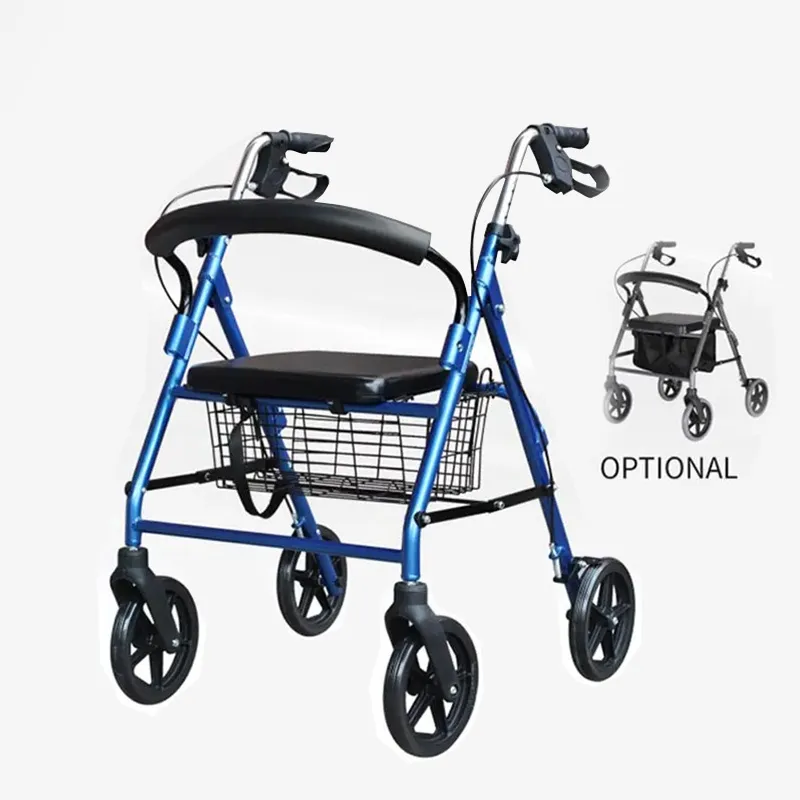
What is the design purpose of a 4-wheel rollator?
Why can't you move while seated?
To understand why you can't use a 4-wheel rollator while seated, you must first understand its design intent.
1. A 4-wheel rollator is a "walking aid," not a means of transportation
A 4-wheel rollator walker belongs to the "walking aid" category, and its core functions are:
• Providing balance support while walking
• Reducing the risk of falls due to gait instability
• Helping users improve walking stability
• Providing a temporary resting seat when fatigued
It is not a replacement for walking, and it does not have the seat support function of a wheelchair.
2. The seat is designed for rest only, not for moving or carrying heavy loads
The seats in 4-wheel rollators are typically lightweight, designed to:
• Provide short breaks
• Prevent user fatigue from prolonged standing
• Help users temporarily recover energy while walking
But it is absolutely not designed for "sitting and gliding" or "being pushed around."
The reasons are as follows:
• The seat has limited weight-bearing capacity
• The seat's fixed position is unsuitable for use as a mobile chair
• The bottom structure is not a load-bearing frame
• The wheels under the seat are not designed for pushing or carrying heavy loads.
Any use beyond its intended purpose will create safety hazards.
3. A 4-wheel rollator walker is not a wheelchair
Wheelchairs possess the following characteristics:
• Low center of gravity and high stability
• Designed specifically for seated mobility
• Axles, frame, and wheels are all load-bearing structures
• Equipped with safety devices such as brakes, pedals, and armrests
• Allows for prolonged seated postures
• Rear wheel structure accommodates both pushing and self-propelled movement.
A 4-wheel rollator completely lacks these characteristics and therefore cannot replace a wheelchair.
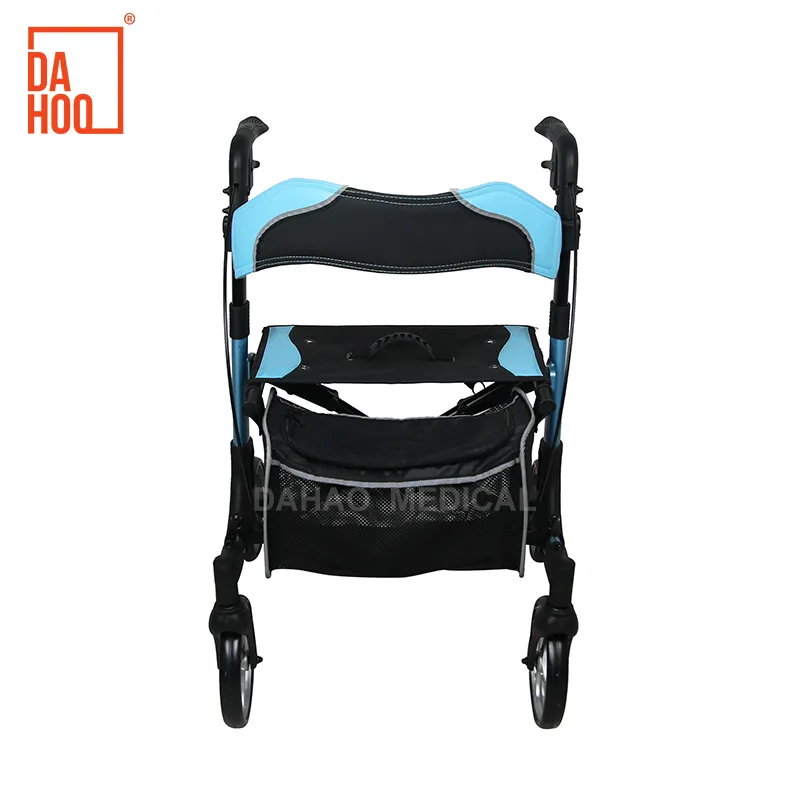
What serious safety risks are associated with using a 4-wheel rollator while seated?
Many people are unaware that being pushed or moving a 4-wheel rollator while seated is not only unsafe but can also lead to extremely serious accidents.
1. High risk of tipping over – High center of gravity makes it very easy to tip over
The center of gravity of a 4-wheel rollator walker is designed for standing users.
When a user is seated:
• The center of gravity rises significantly.
• The center of gravity shifts forward or backward.
• Even slight instability can lead to a rollover.
This is especially dangerous in the following situations:
• On slopes
• On uneven ground
• Crossing thresholds
• On wet, slippery surfaces
• When turning or stopping suddenly
The risk of injury is extremely high if a rollover occurs.
2. Brakes cannot provide sufficient braking power
The brakes of a 4-wheel rollator walker are designed for "slowing down and stopping while walking," not for braking heavy seated loads.
If moving while seated:
• The brakes may not be able to stop completely
• The brake cable may be overstretched
• Rapid movement may cause brake failure
• Sudden braking cannot counteract inertia, leading to a forward rollover
Therefore, gliding while seated is an extremely dangerous activity.
3. Incorrect Thrust Direction Leads to Equipment Deformation
When someone pushes the 4-wheel rollator walker:
• The thrust comes from behind the seat
• The force is transmitted through the lightweight frame
• The bottom support is not designed to withstand thrust
• Prolonged pushing can damage the structure, loosen screws, and cause folding failure
Slight deformation may cause wobbling; severe deformation may even lead to breakage.
4. Lack of Footrests Causes Foot "Dragging" Danger
Wheelchairs have footrests, but 4-wheel rollator walkers do not.
When moving while seated:
• Toes may trip on the ground
• They may get caught in the front wheels
• This could lead to ankle sprains
• There is even a risk of fractures
This is a danger that many users have not considered.
5. Heavy burden for caregivers to push, difficult to control direction
The 4-wheel rollator walker lacks:
• Caregiver handle
• Stable pushing structure
• Reasonable fulcrum
• Design of rear pushing wheels
Therefore, it is extremely difficult for caregivers to control the direction, especially:
• Uphill
• Downhill
• Turning
• Passing through doorways or narrow spaces
A single unstable push can lead to a serious accident.

Why do some users mistakenly believe that they can use the 4-wheel rollator while seated?
Many misconceptions stem from incorrect understanding of the device's appearance, name, and usage.
1. "It has wheels and a seat, so I should be able to push it while seated, right?"
This is a very common misconception.
Wheels ≠ Mobility
A seat ≠ Pushing
The wheels of the 4-wheel rollator walker are designed for "propelling while standing," not for supporting seated movement.
2. "It looks a bit like a wheelchair"
The 4-wheel rollator walker does resemble a lightweight wheelchair in appearance, leading some users to misunderstand its purpose. However, the two have vastly different structures, and misuse can lead to accidents.
3. "In supermarkets, someone pushes a shopping cart, and you can sit on it."
Shopping carts are not medical devices, but this is a common example of misuse.
Medical devices must adhere to strict safety standards, and dangerous behavior is not permitted.
4. Lack of understanding of the instructions and incorrect operation
Most 4-wheel rollator walker instruction manuals state: "Do not move while sitting."
However, many users do not read them carefully, leading to misuse.
What is the seat of a 4-wheel rollator actually for?
To avoid misuse, we must understand the correct purpose of its seat.
✔ Proper Use:
• To sit down and rest temporarily when tired from walking
• To pause briefly and adjust breathing
• To stop briefly on flat ground
• To use while waiting for others
✘ Incorrect Use (Strictly Prohibited):
• To slide while seated
• To be pushed by others
• To use as a chair for extended periods
• To use as a means of transportation
• To bear weight exceeding safe limits
• To move while seated downhill
• To move while seated on uneven ground
Any of the above situations poses a significant danger.
If you cannot use a 4-wheel rollator while seated, how can you use it safely?
The following are important principles for the correct use of a 4-wheel rollator walker:
1. Always maintain a standing posture while pushing
The 4-wheel rollator walker must be used while:
• The user is standing
• Holding the handles with both hands
• Alternating between feet
2. Only sit down to rest when stationary
Before sitting down, you must:
• Come to a complete stop
• Ensure you are on a flat surface
• Ensure both feet are firmly on the ground
Only then can you sit down for a short rest.
3. Never allow caregivers to push the user
Even pushing them a short distance is dangerous.
Caregivers should not use a 4-wheel rollator walker to move the user.
4. Follow the instruction manual
Almost all brands of 4-wheel rollator walkers clearly state in their instruction manuals:
Do not move the user while seated.
5. Use on flat ground; do not sit while going up or down slopes
The steeper the slope, the higher the risk.

What if the user needs to move while seated?
This is the root cause of many people's misuse of 4-wheel rollator walkers:
They believe that a 4-wheel rollator walker can simultaneously meet both "walking" and "seated" needs.
In fact, if the user needs to move while seated, a wheelchair should be considered.
✔ Wheelchair Features
• Designed specifically for seated mobility
• Sturdy, safe frame
• Stable four-wheel structure
• Rear wheel movement control
• Equipped with safety features such as brakes, foot pedals, and armrests
• Suitable for prolonged sitting
• Suitable for mobility and nursing care
Wheelchairs and 4-wheel rollator walkers are completely different categories of equipment with different uses.
✓ Simple identification
• Can stand and walk → Use a 4-wheel rollator walker
• Must be seated for mobility → Use a wheelchair
• Both required → Use each device separately, do not mix them
What industries does Dahao Medical serve?
Dahao Medical is proud to supply products to a wide range of industries, including healthcare, rehabilitation, and home care. Our high-quality products, such as Electric Wheelchairs and Transfer Chairs, are designed to improve the quality of life for patients and caregivers. We work closely with hospitals, clinics, care facilities, and home care providers, offering customized solutions and reliable products.