

In the nursing and rehabilitation field, lift transfer chairs are crucial devices for assisting people with limited mobility in transfers, such as from bed to wheelchair, from wheelchair to sofa, and from chair to bathroom. More and more families and care facilities want to know: Can users push lift transfer chairs themselves?
This question seems simple, but it truly involves:
• Structural features of the lift transfer chair
• User's physical capabilities
• Safety and stability
• Operator's posture during lifting and lowering
• Applicable scenarios for the equipment design
This means that whether one can "push it themselves" depends not only on individual physical ability but also on whether the lift transfer chair's structural design supports self-propulsion.
This article will provide an in-depth analysis of this topic from a professional perspective, helping you systematically understand the operational characteristics of lift transfer chairs and determine whether it is suitable for you to push it yourself.
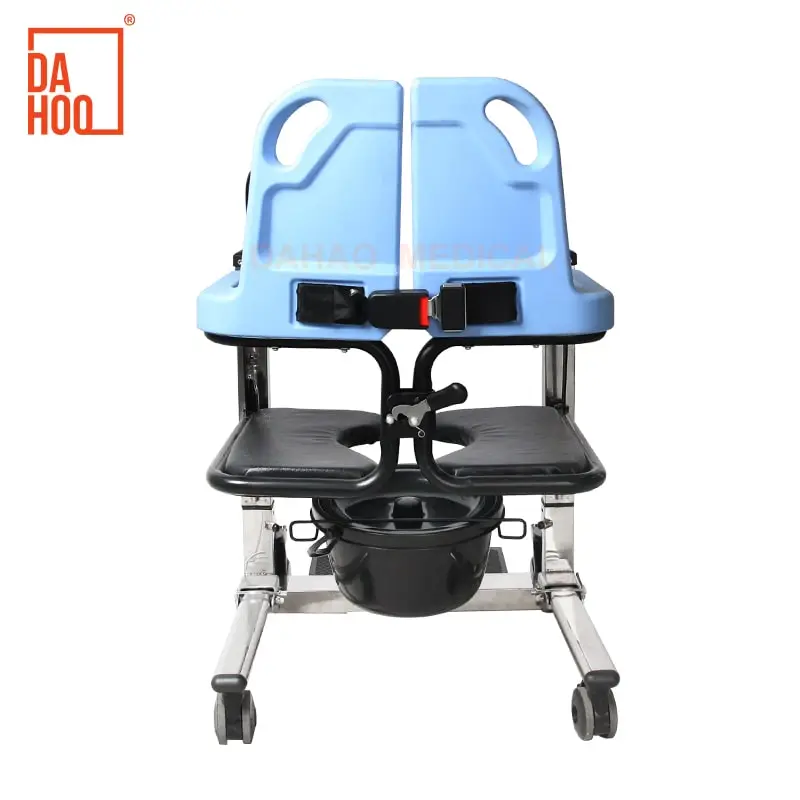
Why would someone want to push a lift transfer chair themselves?
Although the primary function of a lift transfer chair is to provide transfer assistance for caregivers, many users ask: Can I push it myself?
The reasons for this idea include:
• A desire to reduce dependence on others
• The belief that moving while seated is more convenient
• The misconception that lift transfer chairs are the same as wheelchairs
• A desire to increase autonomy and freedom of movement
However, lift transfer chairs differ from wheelchairs; their design goal is transfer, not autonomous movement. Therefore, whether a user can propel themselves requires analysis from multiple perspectives, including structure, safety, and mechanics.
Is a lift transfer chair designed for user self-propelled movement?
The answer is usually: No.
The core purpose of the lift transfer chair's structural design is to:
• Allow caregivers to operate the device
• Maintain stability during lifting
• Achieve safe vertical lifting
• Complete the transfer from one device to another
Lift transfer chairs are not mobility aids and do not meet the requirements for autonomous propulsion:
• Rear wheel design
• Handwheels (only found in wheelchairs)
• Central center of gravity layout
Therefore, the vast majority of lift transfer chairs are not suitable for user self-propelled movement.
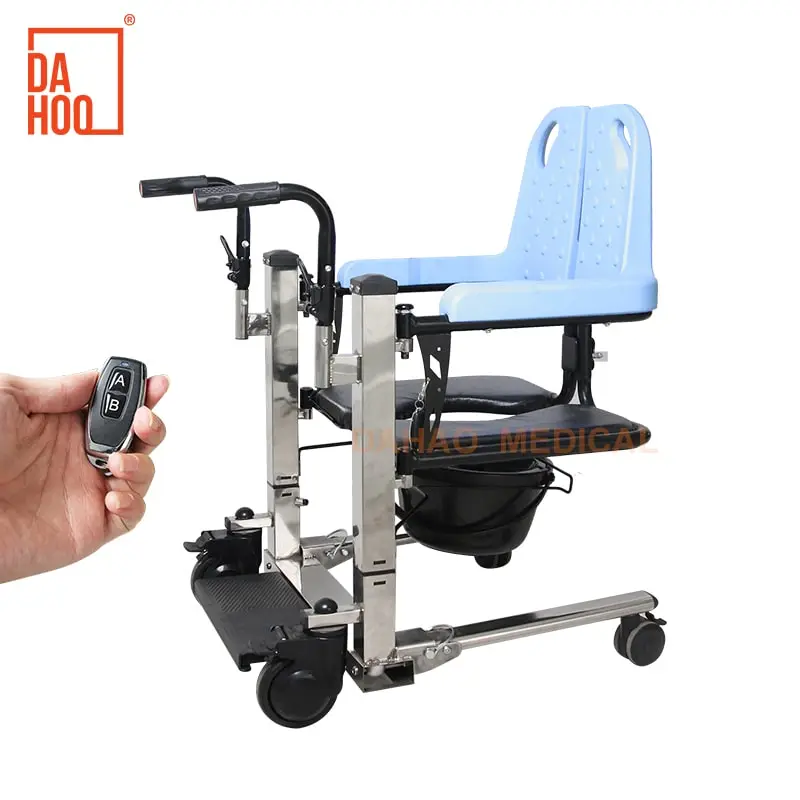
Does the structure of a lift transfer chair allow the user to exert force to move it?
To answer this question, we must understand the structural characteristics of lift transfer chairs.
Lift transfer chairs typically feature:
• Four small casters (usually 3–5 inches)
• Multi-link lifting mechanism
• Framed seat
• Caregiver-specific push handle
• Foot support structure
• Open seat design for transfer
These characteristics determine that:
1. Small casters are not suitable for user-assisted pushing
They do not provide sufficient rolling inertia like the large wheels of a wheelchair.
2. The seat cannot support hand movements
Many lift transfer chairs use open or modular seats that cannot withstand lateral forces.
3. High center of gravity, unsuitable for seated movement
Pushing while seated in a lift transfer chair shifts the center of gravity backward, easily leading to tipping.
4. Push handle behind the user
Only the caregiver can grasp the push handle to control direction.
Therefore, from a structural design perspective, lift transfer chairs are not designed for user-assisted pushing.
In which situations should a user not attempt to push the lift transfer chair themselves?
There are many situations where it is clearly not advisable to attempt to push the lift transfer chair yourself, including but not limited to the following:
1. During lifting and lowering
The structure is in motion during lifting and lowering. Pushing it yourself can lead to:
• Impact
• Instability
• Damage to seals
• Shift in center of gravity
Any external interference can cause danger.
2. Insufficient upper body strength of the user
Users often face:
• Weak muscles
• Limited mobility
• Insufficient balance
making it impossible to complete the pushing action.
3. Uneven ground
Small casters can easily get stuck on carpets, slopes, and gaps, further increasing the risk of tipping over.
4. Confined care environment
Turning corners, navigating doorways, etc., requires caregivers to judge distances; pushing it yourself is not safe.
5. Lift transfer chair structure not locked
If the seat is not fully closed or the casters are not locked, any pushing is dangerous.
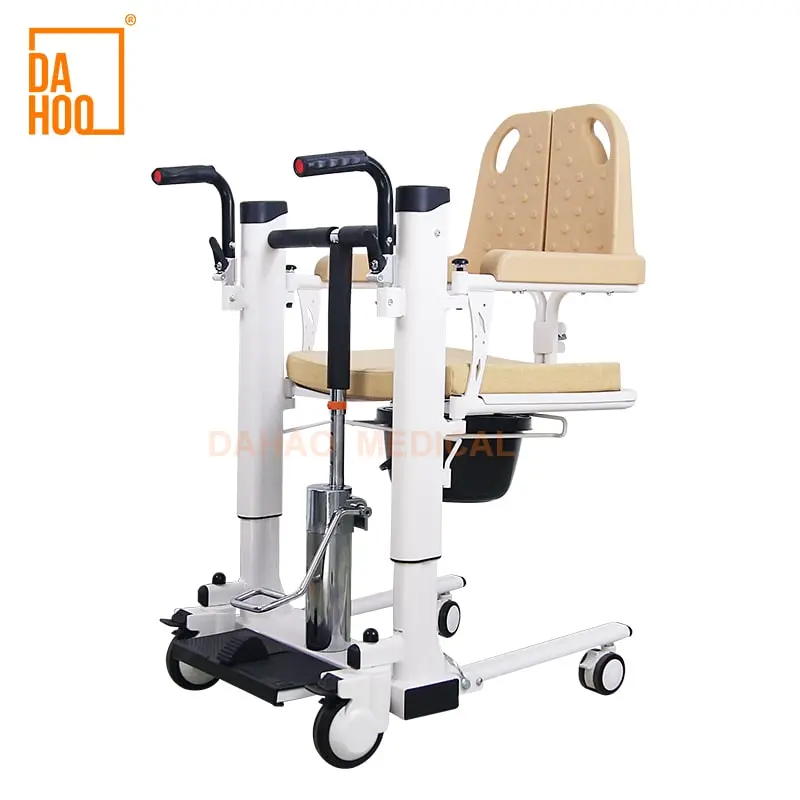
What are the risks if a user forcibly pushes the lift transfer chair themselves?
Forcibly pushing a lift transfer chair can have serious consequences, including:
1. Risk of tipping backward
Because the pusher is at the back of the chair, if the user attempts to pull forward or push themselves, it will create a backward torque, causing the chair to tip over.
2. Caster misalignment leading to loss of control
The small casters can quickly misalign due to uneven force, causing sudden swerving and making it difficult to control the direction.
3. Seat structure causing the user to slip
Open-back chairs, when subjected to lateral forces, may cause:
• Slipping
• Instability
• Asymmetrical force
Once a slip occurs, the lift transfer chair cannot provide effective protection.
4. Damage to the lifting mechanism
The lifting mechanism is not designed to withstand the lateral force generated by pushing.
This may lead to:
• Jamming
• Pivot deformation
• Damage to the hydraulic structure (if hydraulic)
5. Inability for caregivers to intervene promptly
If the user attempts to push the chair themselves, there may be no one to stop or catch them in time if a danger occurs.
What physical abilities are required to move a lift transfer chair?
To move a lift transfer chair, at least the following are required:
1. Sufficient upper body strength
This strength must be able to:
• Push the device
• Overcome friction
• Maintain stability when encountering resistance
Users typically lack sufficient strength.
2. Core stability
Pushing requires engaging the lower back and core muscles; otherwise, it's easy to lean forward or backward.
3. Hand muscle control
The casters frequently change direction, requiring continuous fine-tuning.
4. Ability to judge distance and direction
Users must be able to observe their surroundings and adjust their orientation, which is very difficult for those with mobility impairments.
Summary
Most lift transfer chair users cannot meet these requirements, therefore, self-movement is not recommended.
What design features of a lift transfer chair prevent the user from moving it independently?
The essential design purpose of a lift transfer chair is for caregivers to operate, not the user.
The following structural design features clearly indicate that the device is unsuitable for self-propelled movement:
1. Inaccessibility to the control center
The push handle is located at the back of the device, out of the user's reach.
2. Small casters
Small casters are suitable for short-distance transfers, but not for long-distance or autonomous movement.
3. Open seating
Some lift transfer chairs use a U-shaped structure to facilitate transfer, which cannot support lateral force application.
4. High center of gravity
In contrast to the low center of gravity and structural stability of wheelchairs, lift transfer chairs have a high center of gravity, making them prone to tipping over.
5. Lack of auxiliary braking system
Users cannot brake or protect themselves independently.
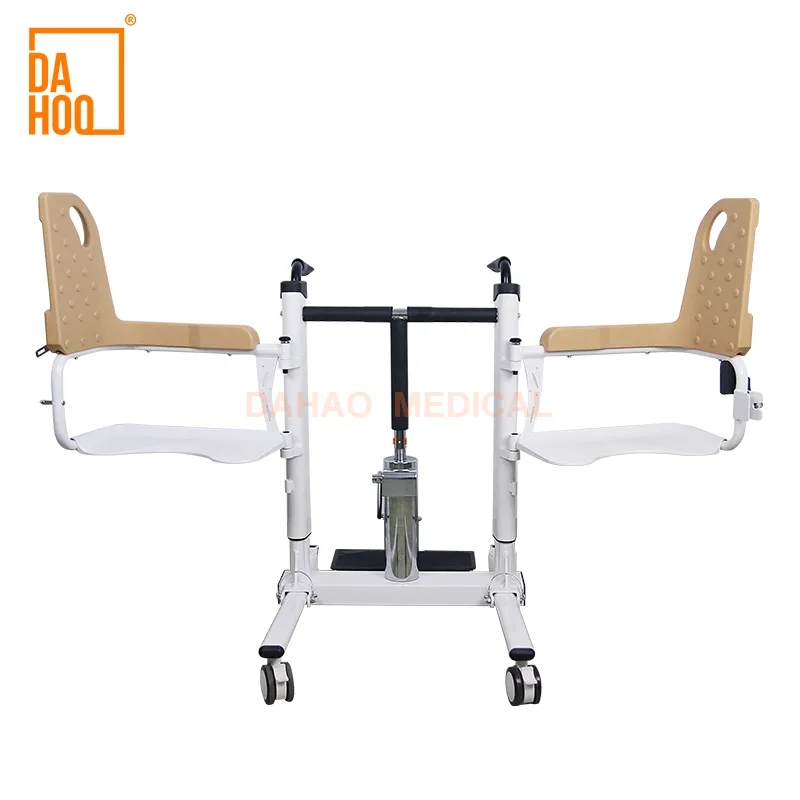
Are there more suitable assistive devices for autonomous user movement?
If a user wishes to move independently, the following devices are more suitable for autonomous operation than a lift transfer chair:
1. Manual Wheelchair
• Self-propelled
• Equipped with large wheels and rims
• Stable structure
• Designed for independent mobility
2. Electric Wheelchair
• Suitable for users with insufficient upper limb strength
• Self-controlled direction and speed
• High safety
3. Electric Mobility Scooter
Suitable for people with insufficient upper limb strength who need to move long distances.
A lift transfer chair is not a tool for independent mobility; a wheelchair is the appropriate choice for users who want to move themselves.
What industries do your products serve?
Our products are widely used in healthcare, rehabilitation centers, elderly care facilities, and home care environments. As a professional manufacturer and supplier, Dahao Medical focuses on delivering high-quality solutions for patient mobility and daily care. Our equipment supports both medical institutions and home users, making it suitable for wholesale purchasing and retail sales.