

4-wheel rollators, as a common mobility aid, are widely popular for their portability, flexibility, and ease of use both indoors and outdoors. However, the question of whether 4-wheel rollators are prone to tipping over remains one of the most pressing concerns for users, families, and caregivers.
Under correct operating conditions, 4-wheel rollator walkers can provide adequate support and assistance for movement. However, incorrect use, excessive weight-bearing, insufficient balance, or unfavorable environmental conditions can significantly increase the risk of tipping over.
This article will comprehensively analyze:
• Are 4-wheel rollators prone to tipping over?
• Why do they tip over?
• Which actions are most likely to cause loss of balance?
• How to reduce risks in daily use?
• Are 4-wheel rollator walkers less stable than other mobility aids?
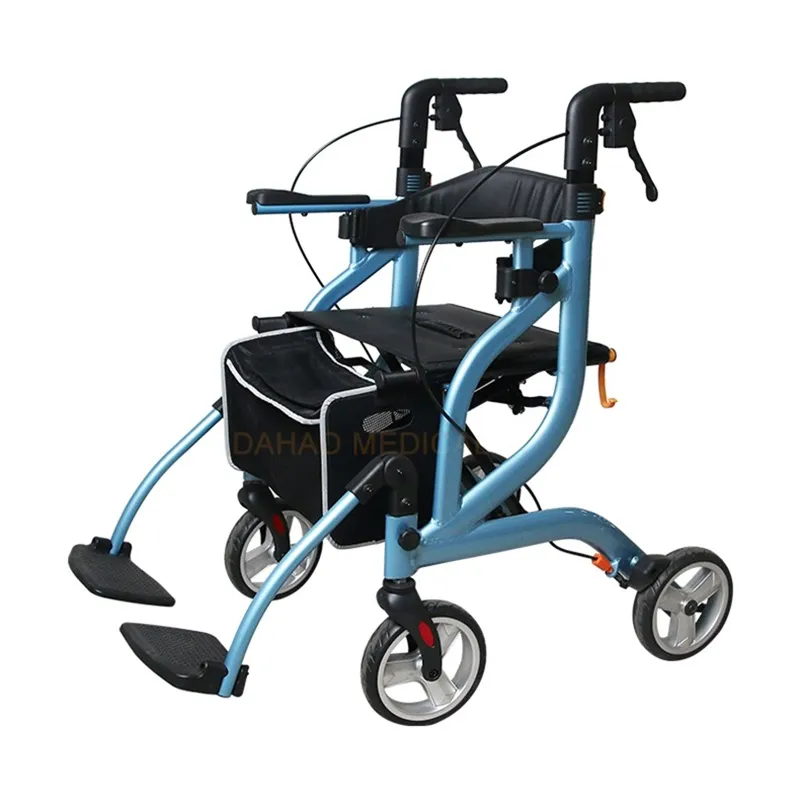
Are 4-wheel rollators really prone to tipping over?
The answer to "Are 4-wheel rollators prone to tipping over?" is not a simple "yes" or "no".
The key is that stability depends on the user's physical condition, the environment in which it's used, and whether it's operated correctly.
Generally, the stability of a 4-wheel rollator is affected by the following factors:
Structure:
• Lightweight construction makes it more susceptible to external forces.
• Larger wheel diameters facilitate pushing but also make it easier to accelerate on slopes.
• Designed for assisting walking, not for carrying heavy loads or being pushed while seated.
User Condition:
• Poor balance
• Insufficient arm strength
• Leaning too far forward
• Lack of concentration
These all increase the risk of tipping over.
Usage:
• Hanging too many shopping bags
• Placing heavy objects on the handlebars
• Moving while seated
• Not braking downhill
• Incorrect turning
These incorrect operations can cause a loss of balance, leading to the 4-wheel rollator walker tipping over.
Therefore, it can be summarized as follows:
A 4-wheel rollator itself is not inherently "easy to tip over," but if used incorrectly, with improper loads, or if the user's physical condition is inadequate, it can become prone to tipping over.
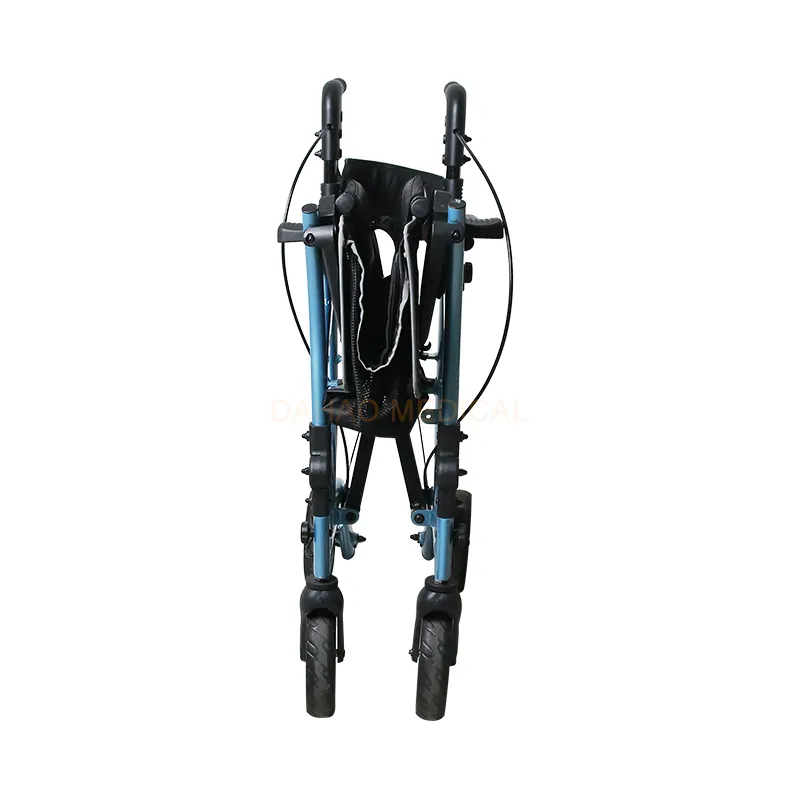
Why do 4-wheel rollators tip over? What are the structural and operational risks?
To more comprehensively answer the question "Is a 4-wheel rollator walker prone to tipping over?", it's essential to analyze its tipping mechanism in depth.
Under what circumstances is a 4-wheel rollator most likely to lose balance?
The following are several common scenarios that help understand its structural characteristics and risk points.
1. Excessive forward leaning leading to a tipping over
Many users unconsciously lean forward, pressing their upper body weight towards the front of the 4-wheel rollator walker.
This creates two dangers:
• Shift of center of gravity to the front wheel
• Increased acceleration
If the ground is uneven or the wheel is obstructed, a tipping over is likely.
2. Hanging heavy objects on the handlebars
This is one of the most common causes of tipping over.
When shopping bags, water bottles, or purses are hung in front of the 4-wheel rollator—
• Changes the original center of gravity
• Increases "forward leaning force"
• Significantly increases the risk of a tipping over
Especially noticeable when going uphill or downhill.
3. User's lack of stamina and inability to maintain balance
4-wheel rollator walkers rely on the user's balance.
If the user:
• Has weak limbs
• Is tired
• Illness
• Has an unsteady gait
is prone to tipping over due to uncoordinated movements.
4. Using on slopes
Slopes are one of the most dangerous scenarios for 4-wheel rollators:
• Easily accelerates downhill
• Easily tipps backward uphill
• The risk is even higher if braking is not timely.
This is why it's important to keep the brakes partially engaged when going downhill to prevent the vehicle from sliding too quickly.
5. Uneven surfaces causing wheel jamming
The following surfaces are most likely to cause a 4-wheel rollator walker to get stuck, leading to a side or forward tipping:
• Thresholds
• Carpet edges
• Gravel
• Brick seams
• Potholes
When the wheels are stuck and the body is still moving forward, the risk of tipping over is very high.
6. Turning too fast
A 4-wheel rollator has four wheels, but unlike a wheelchair, it doesn't have a stable low center of gravity.
Turning too quickly can cause:
• Instability
• Lateral tilt
• Wheel slippage
This can lead to a rollover.
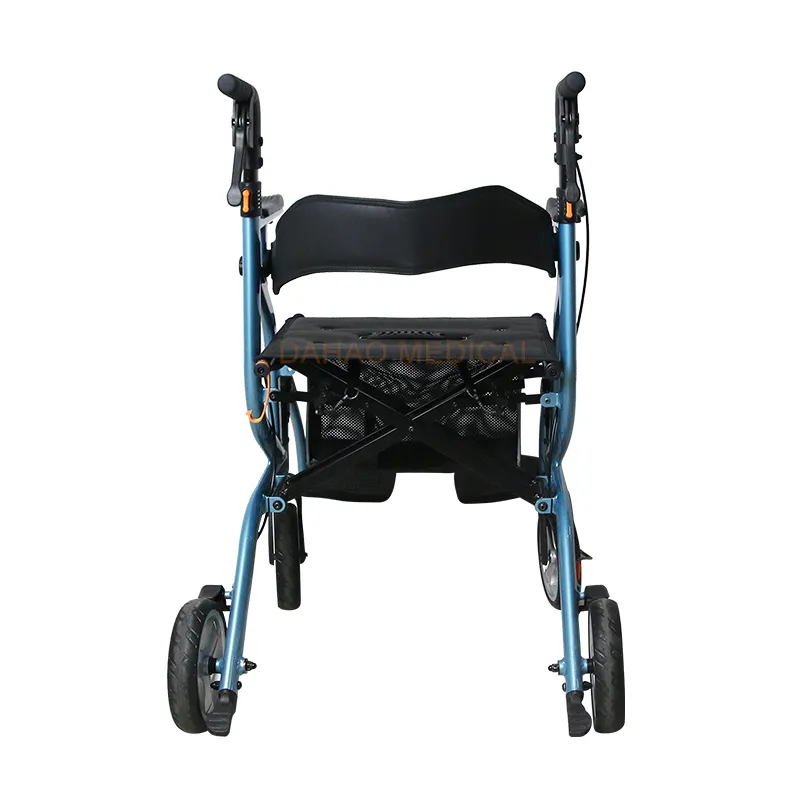
Does overloading make a 4-wheel rollator more prone to tipping over?
This is an important factor that many users often overlook.
The answer is:
Yes, overloading significantly increases the risk of a 4-wheel rollator walker tipping over.
Why does carrying items make a 4-wheel rollator unstable?
• Shifts the center of gravity from the user's body to the vehicle
• Increases forward tilting pressure
• Affects steering control
• Causes brake failure or uneven braking
Especially when users hang bags on the handlebars, the weight is concentrated forward, increasing pressure on the front wheel, which is particularly dangerous downhill.
What is the correct way to load items?
• Place items in the basket or bag under the seat
• Do not hang them on the handlebars
• Do not exceed the manufacturer's weight limit
• Distribute weight as evenly as possible, avoiding favoring one side.
Does improper use make a 4-wheel rollator appear prone to tipping over?
Many people mistakenly believe that 4-wheel rollators are prone to tipping over, but the actual reasons are often not related to the device itself, but rather:
1. Inadequate physical condition of the user
If:
• Poor balance
• Insufficient hand and leg strength
• Unstable walking speed
• Dragging gait
all these significantly increase the risk of tipping over.
2. Lack of proper user instruction
To use a 4-wheel rollator walker safely, the following skills need to be learned:
• How to control the brakes
• How to turn
• How to walk on a slope
• How to sit and stand up
• How to adjust the height
Many people use it without learning these techniques.
3. Mistaking the 4-wheel rollator for a "mobile seat"
This is extremely dangerous.
The 4-wheel rollator seat is for temporary rest; it should not be sat on while moving, and it should never be pushed by someone else.
What misconceptions lead users to believe that 4-wheel rollators are not tipping over?
Some common misconceptions need to be corrected.
1. "More wheels mean more stability"
The stability of a 4-wheel rollator walker depends on:
• The operator's grip
• Sufficient balance
• Appropriate load
• A level surface
It's not true that "more wheels mean it won't tip over."
2. "Can be used as a shopping cart"
Hanging a large number of shopping bags in front creates a very high risk of tipping forward.
3. "It's okay to sit and walk while someone pushes me"
A 4-wheel rollator is not a wheelchair; it doesn't have a pushable structure and lacks anti-tipping devices.
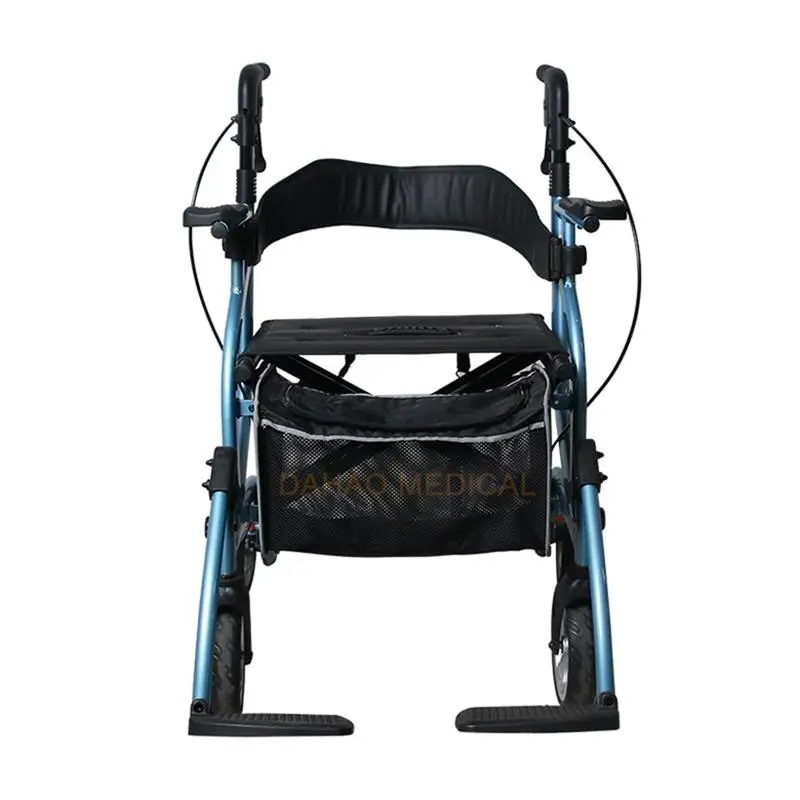
How to avoid tipping over a 4-wheel rollator? — Practical Safety Guide
Since 4-wheel rollators pose a tipping risk, how can they be used safely?
The following tips can effectively reduce the risk:
1. Adjust the height appropriately before use
The handlebar height should allow the user to grip the handlebars with relaxed arms, without hunching over or shrugging their shoulders.
2. Do not hang excessively heavy items on the handlebars
This must be avoided.
3. Only increase speed on level ground
Slow down on uneven ground.
4. Apply the brakes gently when going downhill
Prevent the scooter from accelerating and sliding.
5. Do not turn sharply
Keep going slowly and maintain control of the direction.
6. Always fully lock the brakes when sitting down
Otherwise, you may slide backward.
7. Stand up and sit down steadily
Keep your body close to the seat; do not sit too far away.
8. Not recommended for those with insufficient hand strength
Because they will not be able to control the brakes.
Who is more likely to tip over when using a 4-wheel rollator?
The risk of tipping over increases if any of the following conditions are met.
• Poor balance
• Insufficient lower limb strength
• Weak hand muscles, unable to grip the brakes steadily
• Cognitive impairment, unable to understand safe usage instructions
• Poor eyesight, unable to judge ground conditions
• Easily fatigued
• Slow reaction time
These users should exercise more caution and consider other, more stable mobility aids if necessary.
Is a 4-wheel rollator more prone to tipping over compared to other mobility aids?
To answer this question, a fair comparison is needed:
1. Compared to a cane
• A 4-wheel rollator is more stable
• But more complex to operate, requiring more coordination
2. Compared to a wheelchair
• A 4-wheel rollator walker is easier to move, but more prone to accelerating out of control
• A wheelchair is more stable, but requires more physical effort
3. Compared to a wheelchair
• Wheelchairs are almost never prone to tipping over due to gait instability
• Safer for people with poor balance
Therefore, if the user cannot maintain a stable gait or control the device, a wheelchair is often safer than a 4-wheel rollator.
Are 4-wheel rollators prone to tipping over?
In summary: A 4-wheel rollator is safe when used correctly, with appropriate load, and when the user has a certain level of balance. However, it is very easy to tip over if used improperly, with excessive load, or if the user is in poor physical condition.
The core reasons for 4-wheel rollator tipping over include:
• Hanging too many items disrupts balance
• Leaning forward excessively
• Insufficient hand strength
• Going downhill too fast
• Uneven ground causing wheels to jam
• Turning too fast
• Poor balance of the user
Therefore, the safety of a 4-wheel rollator depends not only on its structural design but also on how it is used and the user's physical condition.