

As electric wheelchairs evolve toward being lightweight, portable, and multifunctional, carbon fiber materials are increasingly being used for their frames. Foldable carbon fiber electric wheelchairs, in particular, offer reduced overall weight and a compact profile for transport and storage when folded, making them highly appealing to users who frequently travel by car or need to transport their chairs.
However, a common question arises during the purchasing process: does adding a folding mechanism compromise the frame's stability? Some argue that fixed frames offer greater structural integrity, whereas foldable designs—incorporating hinges, pivot points, and locking mechanisms—might be more prone to wobbling. In reality, this view is not entirely accurate. The folding mechanism itself does not necessarily compromise stability; rather, stability is determined by factors such as the design of the folding structure, the locking method, frame rigidity, the vehicle's center of gravity, track width, wheelbase, and dynamic control systems.
For a well-engineered foldable carbon fiber power wheelchair, the folded and operational (unfolded) states represent two distinct modes of function. While the frame is designed to change shape during folding, once unfolded and locked, the folding joints must form a secure, load-bearing connection that restores a stable path for load distribution across the frame. Therefore, assessing the stability of a power wheelchair requires looking beyond the mere ability to fold; the critical factor is whether it locks securely and maintains sufficient structural rigidity when unfolded.
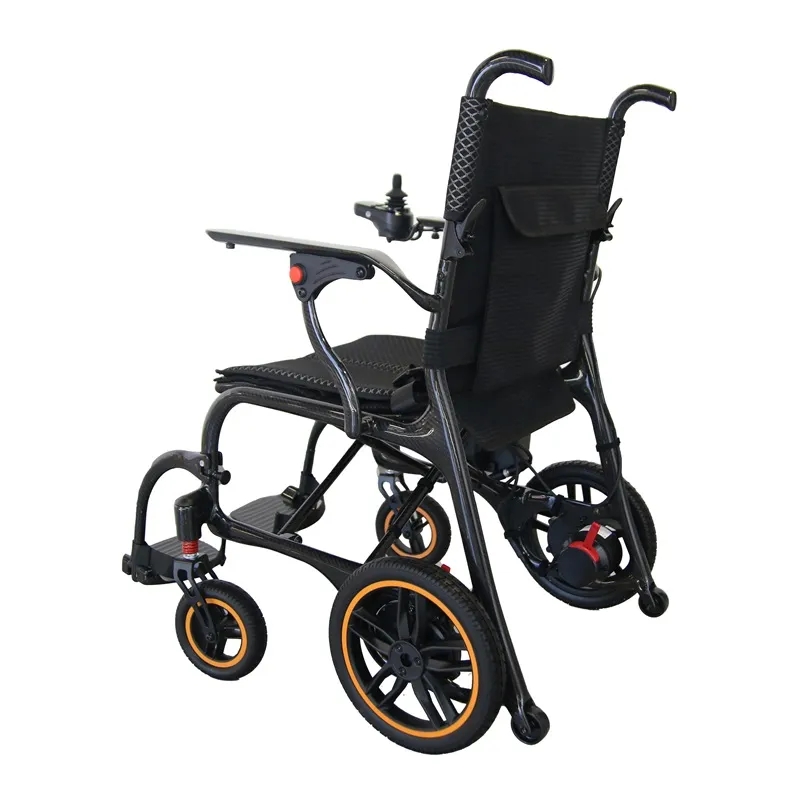
Why do users often worry about folding mechanisms?
The frames of traditional fixed electric wheelchairs lack obvious moving joints, giving them a visually solid, "single-piece" appearance. In contrast, foldable carbon fiber electric wheelchairs require hinges, pivot points, locking pins, or other folding components. Since these parts must move during the folding process, users may naturally wonder if these areas are more prone to becoming loose.
This concern is not unfounded, as folding mechanisms are indeed critical structural junctions within the wheelchair. An unreasonable structural design, imprecise connectors, or significant play developing in the locking mechanism after prolonged use can all compromise frame rigidity. However, this does not mean that all folding electric wheelchairs suffer from this issue.
Well-engineered folding designs generally adhere to a fundamental principle: they must allow for movement during folding but ensure secure, reliable fixation when unfolded. In other words, while the folding mechanism’s primary function is to alter the frame's configuration, the locking mechanism, positioning components, and the main frame structure collectively bear the user's weight and operational loads during normal driving.
The ISO 7176 series of standards does not use "foldability" as the sole criterion for assessing wheelchair stability; instead, it evaluates stability based on static and dynamic performance, as well as structural strength and fatigue resistance. For instance, ISO 7176-1 covers static stability testing, ISO 7176-2 addresses the dynamic stability of electric wheelchairs, and ISO 7176-8 deals with static, impact, and fatigue strength testing.
Center of Gravity is the Primary Factor Affecting Stability
When determining the stability of an electric wheelchair, the center of gravity is a more critical factor than the folding mechanism.
An electric wheelchair and its occupant function as a single unit; the line of action of the combined weight must remain within the support area defined by the wheels. When the wheelchair navigates slopes, turns sharply, or accelerates and decelerates, the position of the overall center of gravity directly influences stability margins in both the longitudinal (front-to-back) and lateral (side-to-side) directions.
For example, if a power wheelchair has a narrow track width and concentrates heavy components—such as the battery and seat—at a high position, it may lack stability even without a folding mechanism. Conversely, a well-designed foldable carbon-fiber power wheelchair can maintain excellent stability despite its folding frame, provided the center of gravity, track width, and wheelbase are properly balanced.
Therefore, when evaluating a foldable carbon fiber wheelchair, one should not focus solely on the presence of a folding mechanism; factors such as drive wheel placement, battery layout, seat height, user posture, and the distance between the front and rear wheels must also be considered.
Generally speaking, a lower overall center of gravity and a well-optimized support area contribute to greater stability. However, a lower center of gravity is not always better; factors such as seat height, legroom, ground clearance, and ease of entry and exit must also be considered holistically.

The core of a wheelchair folding mechanism is not just "foldability," but "secure locking."
The stability of a foldable carbon fiber electric wheelchair depends largely on the design of the locking mechanism once unfolded.
A well-engineered folding mechanism must account for the interplay between hinges, pivot shafts, locking pins, locating surfaces, and connectors. Once unfolded, the frame's integrity should not rely solely on friction; instead, a reliable connection should be established through positive mechanical locking and positioning structures.
For instance, while the folding hinge facilitates the folding motion, locating surfaces and locking components bear the primary loads when the chair is in use. This design ensures that the hinge does not have to withstand impacts and bending moments from all directions in isolation; instead, loads are distributed across the main frame via multiple structural components.
Furthermore, the placement of the folding joint is critical. If the folding mechanism is located in a primary load-bearing area of the frame, that section requires local reinforcement; otherwise, significant elastic deformation may occur, even if the locking mechanism remains secure.
Consequently, for manufacturers, incorporating a folding structure is not merely a matter of adding a hinge to the frame; it requires a complete redesign of the frame's load-bearing paths.
How do carbon fiber frames achieve a balance between lightweight construction and stability?
A key reason for the growing interest in carbon fiber electric wheelchairs is the material's high specific strength and specific stiffness, which enable lightweight designs without compromising performance.
Traditional electric wheelchairs, which utilize metal frames, motors, and batteries, often weigh between 20 and 30 kg—or even more. Lightweight electric wheelchairs can further reduce total weight through the use of carbon fiber frames, optimized power systems, and structural design improvements. Actual weight is influenced by factors such as battery capacity, motor configuration, frame size, and load-bearing capacity; therefore, a product's quality cannot be judged solely by a single weight figure. For users who frequently transport the device, reducing the overall weight by even a few kilograms can significantly improve the experience of getting in and out of the chair and stowing it away. The advantage of carbon fiber goes beyond mere lightness; crucially, by varying ply orientation, cross-sectional design, and local reinforcement, the material can be engineered to bear loads specifically along the required axes.
For instance, areas such as the folding hinge, drive wheel mounting points, and seat-bearing zones can be selectively reinforced, avoiding the need to simply add more material to the entire frame. This approach achieves a more optimal balance between weight, rigidity, and stability.
Critical Design Focus on the Folding Mechanism and Carbon Fiber Connection Points
For foldable carbon fiber electric wheelchairs, the connection between the folding mechanism and the carbon fiber frame is a critical technical aspect.
Carbon fiber behaves differently under load than conventional metals; therefore, folding structures from traditional aluminum alloy or steel wheelchairs cannot simply be replicated on a carbon fiber frame. If loads from bolts, pivot shafts, or locking mechanisms are concentrated on a small area of the carbon fiber, it can lead to localized stress concentrations. Consequently, solutions such as metal inserts, local reinforcement, and structures designed for effective load distribution are required.
When designing carbon fiber electric wheelchairs, professional manufacturers must carefully analyze bending, shear, and tensile/compressive loads at the folding points. Structural optimization is used to ensure loads are gradually transferred to the main frame rather than concentrating at a single connection point.
This is also a key criterion for evaluating the quality of a foldable carbon fiber electric wheelchair. Consumers should look beyond the mere use of carbon fiber and consider the design of folding joints, locking mechanisms, and relevant test results.
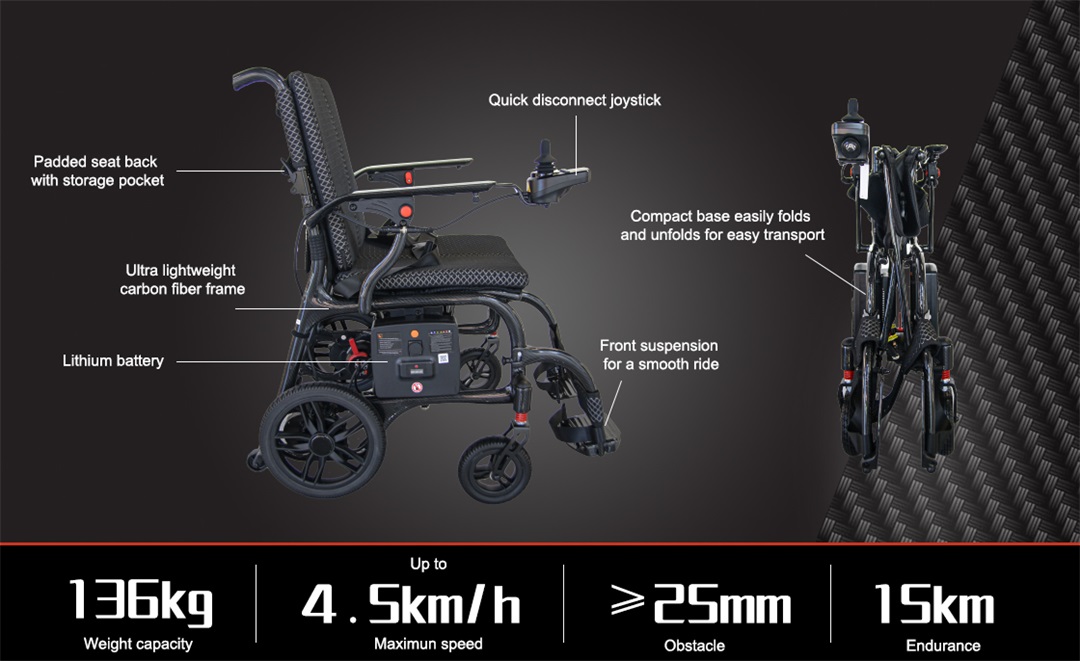
Track Width, Wheelbase, and Wheel Layout Also Affect Stability
In addition to the folding mechanism and materials, wheel layout is a crucial factor determining the stability of an electric wheelchair.
Track width determines the vehicle's lateral support span, while the wheelbase influences longitudinal stability and steering performance. Generally, increasing the support span enhances stability margins; however, this also increases the vehicle's overall dimensions, which may impact maneuverability in indoor spaces and ease of transport. Therefore, the design of electric wheelchairs cannot simply aim for "wider track width for greater stability" or "longer wheelbase for greater safety"; instead, a balance must be struck based on the user's intended usage scenarios.
For instance, power wheelchairs intended primarily for indoor use must account for doorway widths, clearance between furniture, and turning radii; conversely, those designed for outdoor use require greater focus on wheel size, ground clearance, climbing ability, and dynamic stability.
ISO 7176-5 specifies measurement methods for dimensions, mass, and operating space; consequently, the overall dimensions and mass of the vehicle are critical parameters in the engineering design process.
Why do some foldable power wheelchairs wobble?
If an electric wheelchair exhibits noticeable wobbling after being unfolded, the issue cannot simply be attributed to the "folding mechanism."
Common causes include excessive clearance in locking components, pivot point wear, loose bolts, insufficient precision in positioning mechanisms, and inadequate local frame rigidity. Additionally, issues with the front wheel assembly, hub bearings, or tire condition can also create a sensation of instability for the user.
Therefore, it is important to distinguish the source of the problem.
If there is significant looseness at the folding joint itself, the locking pins, pivot points, and connectors should be inspected; if the frame undergoes significant overall deformation, the frame's rigidity and load-bearing design need to be evaluated; if only a single wheel wobbles, the issue may lie with the hub, bearings, or front wheel assembly.
For foldable carbon fiber wheelchairs subjected to long-term use, particular attention should be paid to wear in the folding mechanism. Once fully unfolded, the locking mechanism should engage completely, with no noticeable or abnormal gaps.
How can professional testing ensure the stability of foldable carbon fiber wheelchairs?
To truly reassure users, judging by appearance alone is insufficient. Professional manufacturers should conduct stability and strength verification starting from the design phase.
The first step is static stability testing, which verifies the vehicle's tipping characteristics across various directions and operating states. ISO 7176-1 serves as a key standard for such testing.
The second step involves dynamic stability testing. Electric wheelchairs undergo acceleration, deceleration, and turning during actual operation; therefore, stability in a static state does not guarantee equal stability during actual driving. ISO 7176-2 establishes specific test methods for the dynamic stability of power wheelchairs, covering models with a rated maximum speed of up to 15 km/h.
Next are strength and fatigue tests. Folding mechanisms must withstand repeated unfolding and folding cycles, making the structural integrity after long-term use crucial. ISO 7176-8 outlines testing requirements for static, impact, and fatigue strength in wheelchairs.
From a manufacturing perspective, an ideal testing process should encompass structural design verification, prototype testing, folding cycle testing, static and dynamic stability testing, and fatigue testing of critical components, rather than merely verifying stability during a new product's initial use.
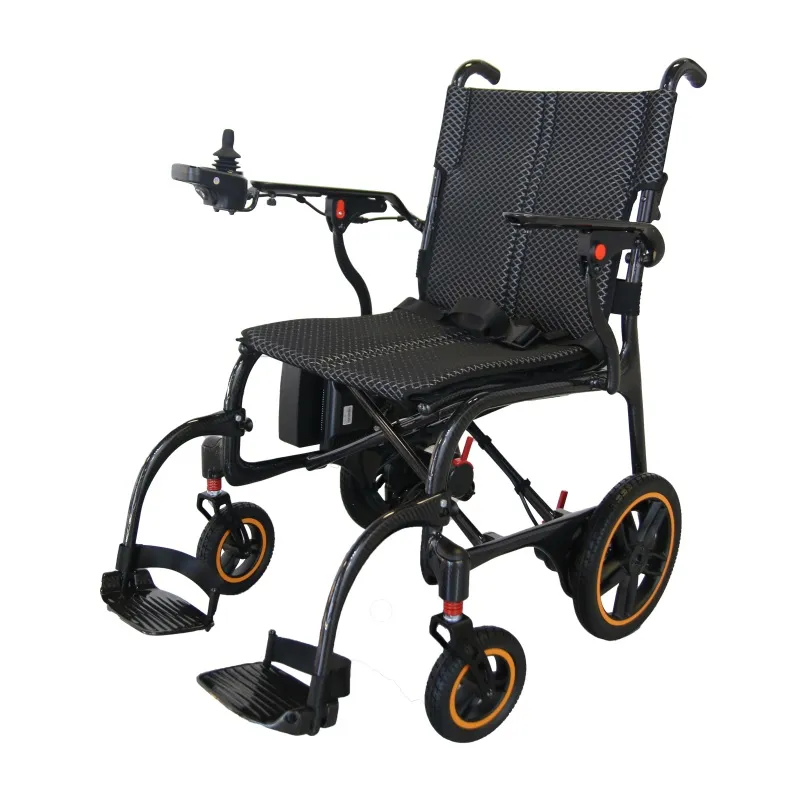
FAQ
Q1: Are foldable carbon fiber wheelchairs necessarily less stable than fixed-frame models?
Not necessarily. Stability depends primarily on the vehicle's center of gravity, track width, wheelbase, wheel configuration, frame rigidity, and the folding/locking mechanism, rather than the mere presence of a folding function.
Q2: What aspects of the folding mechanism require the most attention?
Key areas of focus include the reliability of the locking mechanism after unfolding, positioning accuracy, the strength of connecting parts, and the development of clearances (play) after long-term use. A qualified folding mechanism must operate smoothly during folding and lock securely when unfolded.
Q3: Why are carbon fiber electric wheelchairs suitable for lightweight designs?
Carbon fiber offers high specific strength and specific stiffness. With proper structural design, it can reduce frame weight while maintaining excellent structural performance, making it ideal for electric wheelchairs that require frequent lifting and folding.
Q4: How can one determine if a foldable carbon fiber wheelchair is stable?
One should examine the design of the center of gravity, track width, wheelbase, load-bearing capacity, and the folding/locking mechanism, as well as whether relevant tests—such as static stability, dynamic stability, impact, and fatigue tests—have been conducted.
Q5: Will a foldable electric wheelchair become loose after long-term use?
Any mechanical connection structure is susceptible to wear over prolonged use; therefore, the folding hinge, locking mechanism, and bolts require regular inspection. If noticeable wobbling occurs or the lock fails to engage properly, the unit should be repaired immediately and must not continue to be used.
