

A lot of individuals consider assistive walking devices as the sign of not being able to walk, which may cause mental discomfort to people with mobility limitations or seniors thinking about using walking aids. However, nowadays, the view of rehabilitation doctors is that the use of correct walking aids is not a mark showing that one's abilities get worse gradually, but a smart strategy to prevent accidents, promote mobility, and lead a better quality of life. Four-wheeled wheelchairs are mobility devices that have gained a considerable popularity recently.
To summarize, why do people opt for four-wheeled rollators?
Why can't a walking cane or a walking stick, for instance, be chosen instead?
A wheelchair is yet another possibility, for instance?
Matters of four-wheeled walking devices are situated between independent walking on one side and depending totally on a wheelchair on the other. Most patients are not walking at an inability level, still, they feel less stable when walking, weaker legs, they get tired more easily, or can't stand for lengthy stretches of time. For these users, four-wheel walker is an effective support helping them to have their walking independently for part of time.
As countries get more elderly people in the population, demand for mobility aids is also going up. According to the WHO, the population of people 60 years or older across the world will grow very fast, and with it, muscle strength will decrease, balance will decline, and number of diseases will increase. At the same time, falls are becoming a major health hazard that seniors are facing. Thus, assistive walking devices such as four-wheeled wheelchairs, manual wheelchairs, and powered wheelchairs are changing from the medical supplies they initially were, to devices that help people keep their independence.
Not only do four-wheeled rollators assist in walking, the really significant part is that they also enable the users to trust in themselves that they can go outside.
Suppose an elderly woman who used to rarely go out because of the walking distance or walking instability concerns of hers could now get out shopping or do other errand-related tasks much more independently with the aid of a four-wheeled walking device. It's exactly this aspect which has been making more and more people to take to four-wheeled rollators.
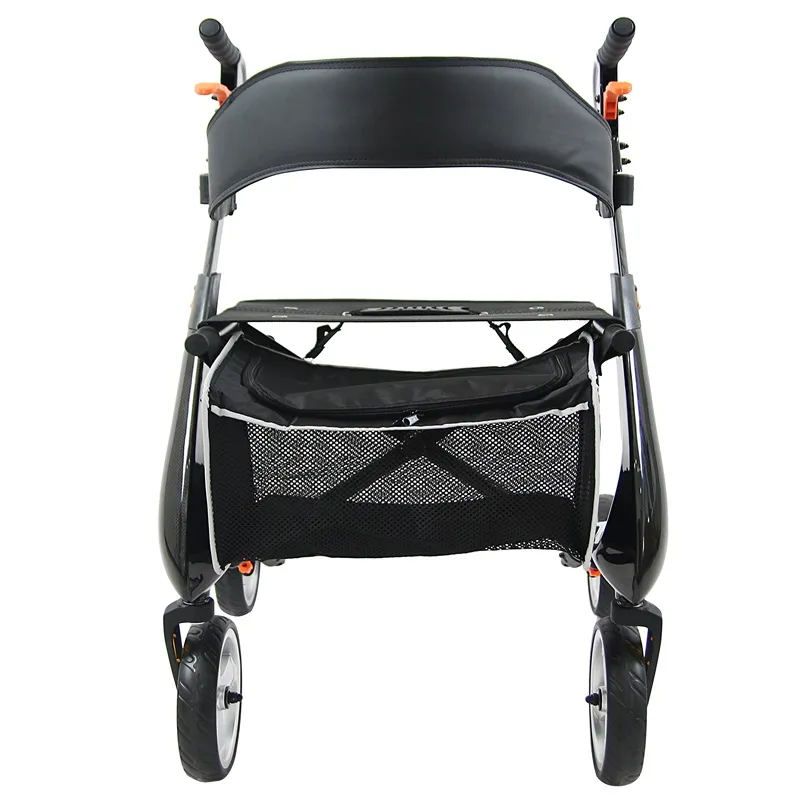
What is a four-wheeled rollator?
A four-wheeled rollator is a kind of mobility aid consisting mainly of four wheels, a handle, a braking mechanism, and usually also a seat. Its main function is to assist people with mobility reduction in enhancing their gait stability and lessening the load on their legs.
A wheel rolling type of four-wheeled walking assistant, compared with other assistive aids such us a cane of walking stick. Its benefit is the possibility of going forward without lifting the device and the fact that walking becomes rolling. Regular aids such as sticks and crutches are characterized by providing a high degree of support, but in practice, every step needs taking down and lifting of the device again. Therefore, elderly and people having arm injuries might find it very demanding since they need to make a physical effort with their arms to move each of the aids. Four-wheeled walking bike having wheels is a better alternative.
Normally, a four-wheeled walker consists of:
The frame is what is considered to be the structural basis of a walker with four wheels. In recent times, lots of models on the market have adopted use of aluminum alloy, guaranteeing durability while lowering the overall weight and thus facilitating handling by users including seniors or persons with mobility disabilities.
Four wheeled structure is one of the characteristics that makes four-wheeled wheelchairs different compared to other walking aids. A single-legged cane will always offer support at one point only thus limiting the balance of a user significantly. Meanwhile the four-wheeled structure allows much greater area of contact and hence better balance. Different varieties of models might adopt different tire sizes, for example, bigger tires are usually recommended for outdoor uses since their bigger contact surface helps reduce vibrations and provides better stability. However smaller sizes tires will be more handy if space is an issue so they are often the preferred ones for the inside or narrow passageways.
Apart from that, both the handles and braking system are also two important parts for a four-wheeled walker. Handles are for steering whereas the brakes are used to reduce speed.
In addition, many four-wheeled walkers feature a seat which folds away as well as a shopping bag space underneath. So you can just relax on the seat while you wait for a bus or go shopping whereas the carrying bag adds to the convenience factor of a wheelchair that you can also use as a life assistance device.
Why do some people need four-wheeled walking aids?
1. Limited mobility, but still wanting to be self-sufficient
A lot of people using four-wheeled walking devices are not entirely unable to walk; however, their condition doesn't allow them to walk smoothly for long stretches of time after their younger days.
With age, muscle strength gradually weakens, particularly the leg muscles and balance, which is reflected in their walking abilities from day to day. For example, an elderly person might hardly feel like walking even just a few steps on the flat ground inside the house, but upon reaching to a shopping center, an open park, or a hospital that is a bit out of the way, the person might easily tire just because the distance has increased.
In such cases, a four wheeled walker is an excellent solution. The users may still move on their legs and thus be independent rather than relying on others and wheelchairs altogether. Such method leads to more activity and helps maintain functional abilities in daily living.
Many senior citizens will not need "replacing walking," most important thing is rather "enabling me to take outdoor walks." Four-wheeled walking aids cater to exactly this kind of need.
2. Better Balance and Fewer Falls
The biggest danger for seniors and the people who are not able to move freely is a fall. The major issue is not being unable to walk anymore, but falling while changing direction, standing, going up or down hills or when feeling tired.
A four-wheeled walking aid allows the person greater stability during the walk by providing a larger contact area with the ground and by having four wheels. When the users start to unbalance themselves, they can find support through the handles and so the chances of sudden balance loss are minimized.
Nevertheless, it is crucial to keep in mind that four-wheeled walking aids cannot eliminate the possibility of falling totally. They are auxiliary tools and not absolute guarantees that you will be safe. It is also important to adjust the height of your walking aid properly, make sure you know how to engage the brakes properly, and always stick to the rules of proper usage.
3. Joint and Leg Pressure Relief
Much of the time the reason behind getting a four-wheeled walking aid for people, especially those in later stages of life, is due to joint pains or the other conditions that affect walking comfort. These might be problems with knee joints (such as osteoarthritis), hip issues, etc.
In general, such individuals are not crippled, but the very effort to take a stroll makes them feel pain in joints or tiredness. Persisting in walking is not a very effective option for these people because it only reduces the amount and the quality of their physical activity.
Better yet, four-wheeled walking aid can offload a bit of the weight and thus make walking much easier for the users. Taking that to the example, the users can maintain a safe footing with the help of the walking device outside without their legs bearing much weight.
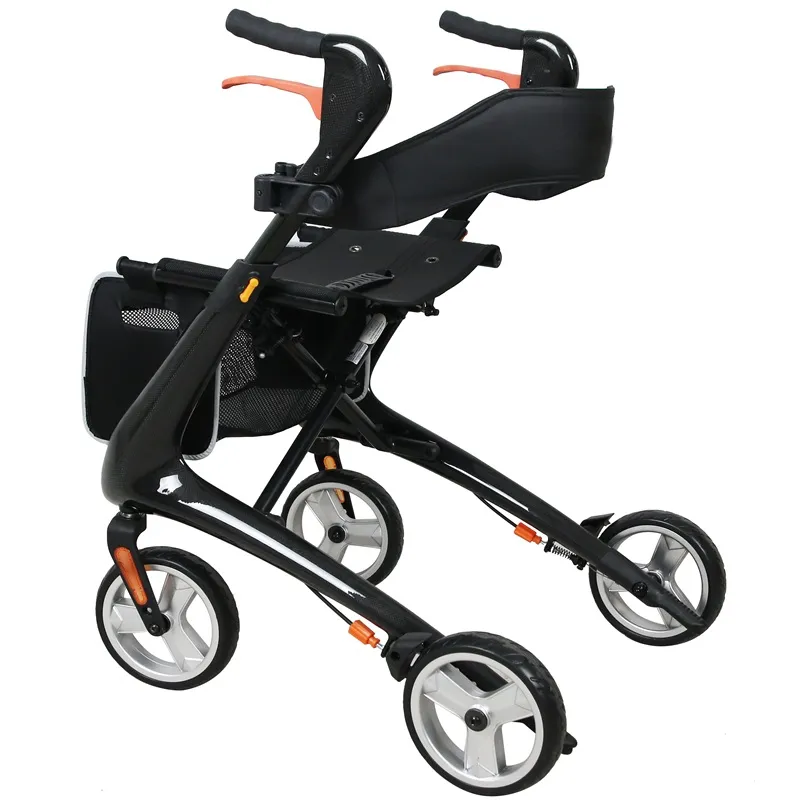
What category of people would be appropriate users of a four-wheeled walking aid?
1. Elderly people make up the majority of users
It is not only that the elderly is the largest group of the users of the four-wheeled walking devices, their usage is also quite natural and understandable. One might expect the physical condition of a person to deteriorate with age but that doesn’t mean the person must stop being socially active or live at home for long periods.
A majority of the elderly population that is physically limited to some extent still wants to enjoy the pleasures of everyday life. That is probably why a lot of them find a four-wheeled walking aid handy for going to buy groceries from the market or taking their walk in the park, etc.
Compared to always depending on the care of the children, the four-wheeled walker empowers the elderly more independently at a pace and to an extent that is safe for them.
2. Patients during their recovery
The use of a four-wheeled walking aid may be necessary not only by a few elderly people but also by a patient after surgery or a sickness recovery period. Examples are the following:
• The period of healing from a broken bone;
• Post-operative care of a joint;
• Rehab after stroke;
• Muscle strengthening phase.
Getting a person back to her/his mobility is, on most occasions, a matter of gradual increasing one’s activity levels with the support of the walking aid, not suddenly walking as a healthy person. A four-wheeled walker may very well be an effective assistive device during that period, which is just enough time to build up one’s confidence with walking while being able to maintain the safety standards.
3. People with poor balance
Apart from not having adequate walking muscles, some folks have an inherent problem with their balance during movement. Their walking is off as they are trying to put together a walk but without success.
A great number of patients with brain-related diseases and the patients whose coordination is affected can very much benefit from having one extra source of support besides their feet.
To this group in particular, a four-wheeled walker offers the greatest benefit as against using just a set of crutches.
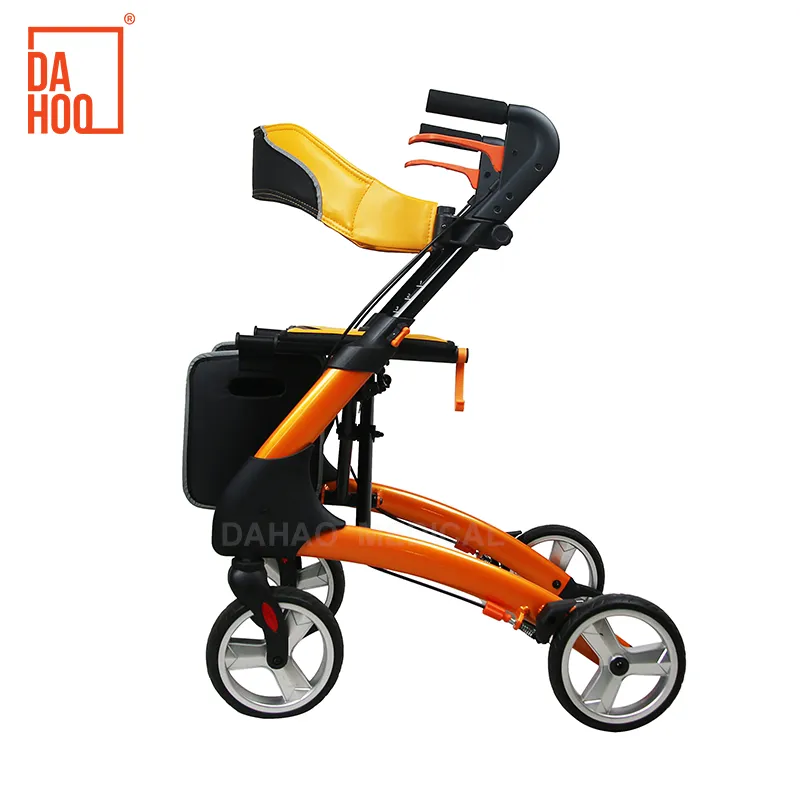
What makes a 4-wheeled walker different from other devices for mobility?
1. Contrast between four-wheel walker and crutches
The main strength of crutches is their lightness and portability that suit people with just some difficulty in movement.
Yet, crutches mainly require one or two arms for support, thus making it a very unstable option if a person lacks physical balance.
Four-wheel mobility devices offer four-point support system that ensures a broader range of stability for the user. Besides, there are models with a seat that makes such mobility devices much more practical for people who are up all day.
2. Variance between four-wheeled walking assistive devices and normal walking aids
Standard walking aids usually have no wheels or just two wheels. Thus, they are much more stable but also significantly slower.
On the contrary, four-wheel walking aids use wheels to move so that there is less exertion from the user which is also good news for the people need to get around the places regularly.
Still, when it comes to support, the wheelchair might be best option for those users who cannot keep their own weight off the floor.
3. Dissimilarity between four-wheeled walkers and wheels of the wheelchair
Wheels are primarily for people who cannot walk or must sit and do not walk at all.
In contrast, four-wheeled walking aids aim to help a user's capability of standing and walking remain the same while using the device.
In other words, when a patient can still stand and move but not very well or can't go far without assistance then, a four-wheeled walking aid is definitely a good pick;
If however, the patient is completely unable to stand or move by him/herself then wheel chairs, manual or electrical one, would probably be the only solution to the issue.
Are there some things to be careful about while using a four-wheeled mobility device?
Correct usage of the four-wheeler walker device is important; if not done so, it may be not only ineffective but also a risk for safety.
First, make sure the height is set to you perfectly. The height of the handlebar should be proportional to your body. If it's too short, you will end up with a hunched spine; if it's too high, you might injure your shoulder.
Second, acquaint yourself to the use of the brakes. On a slope, an undulating ground or when you prepare for a seated rest, you must make sure your brakes have got in a secure position.
Third, perform your visual checks from time to time. The things to look at here are wheel wear, effectiveness of the brakes, the integrity of the frame of the device, and stability of the seat. Also, you may find it useful to get your walking frames serviced regularly by a qualified professional to make sure the walker is in good condition.
Moreover, the environment of operation matters much.
In fact, although it may be that different four-wheel mobility walkers have been designed to cope with both indoors and outdoors use conditions equally well, one should still be cautious when using them on icy or very slick surfaces, on roads which are heavily undulating and even on steep inclines.
How should one identify what model of four-wheeler walker suits them best?
Choose a four-wheeled walker based on what you really need and only as a secondary factor consider the price.
1st, check the load capacity. Four-wheel walkers come in different sizes. Some might suit the person weighing up to about 100 kg, some would be able to carry up to 250+ kg, pick the one that has maximum weight you are.
2nd, weigh down the thing (no pun intended). If your lifestyle allows for such a situation that every now and then, you have to carry your mobility device to the basement and store it up in the trunk, go for a lighter version.
3rd, think about the wheels. If it is for outside walking then wheels of larger diameter with good off-road capability are suitable and if indoors use, then smaller more flexible ones?
4th, decide on the chair. If the user is easily tired or needs continuous travel, a walking aid that combines the four-wheel function and a seat would be convenient as such.
5th, look into the fold mechanism. Folding types of four-wheeled walkers would work well for those living in small places like apartments where a large item would not fit, or for those on the move who would need to carry their aids in the bags/boxes.
FAQ
1. When should I use a four-wheeled walking aid?
When a person can still stand and walk, but has problems such as decreased balance, insufficient leg strength, easy fatigue, or limited walking distance, a four-wheeled walking aid can be considered.
2. Can a four-wheeled walking aid replace a wheelchair?
No, it cannot completely replace one. Four-wheeled walking aids are suitable for people who can still walk independently, while wheelchairs are more suitable for people who cannot walk independently or need to move while seated.
3. Is it safe for the elderly to use four-wheeled walking aids?
When properly selected and used, a four-wheeled walking aid can improve walking stability. However, users still need to pay attention to height adjustment, braking operation, and road conditions.
4. Can a four-wheeled walking aid be used outdoors?
Yes. Many four-wheeled walking aids are designed for both indoor and outdoor use, but when using them outdoors, attention should be paid to tire size, frame strength, and off-road capability.
5. How should I choose between a four-wheeled walking aid and an electric wheelchair?
If the user can still walk independently but only needs assistance, a four-wheeled walking aid is usually more suitable; if the user cannot stand for extended periods or needs to rely entirely on the device for movement, an electric wheelchair may be more suitable.
