

As the world's population is getting older, walking devices have become a necessity which more and more elderly people, rehabilitation centers, and healthcare places rely on. In many ways, rollator walkers have been the core walking aids helping people who can walk on their feet regain walking. The problem in the use of rollers, however, is slowly being realized: traditional wheeled rollers are stable but not suitable for long-term mobility of many users. Many of them still have some strength of walking but their problems are mainly with balance loss, weak leg strength, or fatigue. So they end up using wheeled rollator walkers as being "safe but inconvenient."
Most newcomers to mobility aids pick up stability as the key feature. Thus, they buy the wheeled rollator walkers, which as they have no wheels, are more stable, so users can go along with their feet while using hands to support. With usage over time, senior citizens feel they have to repeat the movement of "picking up the device -- moving forward -- putting it down -- stepping" over and over again. Wheelless walking aids work well for short walks but to seniors who have to go about home, take walks in the neighborhood, shopping, or get their medical tests done every week, this means a substantial addition to the workload on their arms and their shoulders.
On the top of that, the needs of the elderly population these days are not only about "falling down," or the lack of ability, of that, but about keeping up their abilities of living independently, while staying safe. Quite a number of them are not entirely unable to walk but choose not to participate outdoors because of the physical wear and tear, the loss of balance, or fearfulness. If a mobility aid is just giving support but not facilitating the widening of the range of one's movements, then it will not be able to fulfill today's demands for caregiving and rehabilitation for the elderly.
Such a situation is one of the reasons that 4-WHeeled Rollator is more often being seen as the assistive mobile product which is actually practical. It can not only move naturally and easily but rest if tired. So this device does not only aid walking but also makes it possible for older people to live life independently again. 4-Wheeled Rollators are a great improvement. Unlike wheelless walkers.
Medical professionals have always classified four-wheeled walkers as appropriate when a person has some walking ability but requires some help to maintain balance and also gets tired easily, whereas traditional walkers are more suitable for patients who need a high level of support and only a partial bearing of their body's weight. By reducing the number of times that users have to pick up the device, four-wheeled walkers make movement closer to a natural walking gait, while the seating function covers the need to rest when doing long-distance activities.
Then what is the benefit of the 4-Wheeled Rollator walker when it is against wheelless ones? What is the reason why there is a trend in families to go the 4-Wheeled Rollers way? Besides which physical factors of people should be considered in choosing the appropriate model?
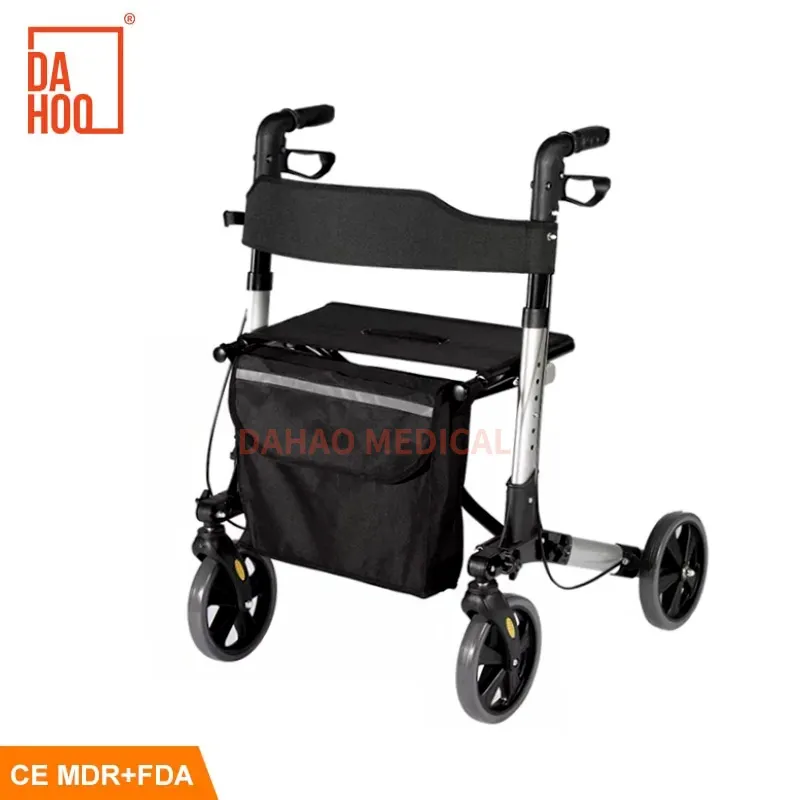
The Real Problem Faced by Wheelless Walkers: The Contradiction Between Stability and Convenience
Traditional wheelless walkers have long been one of the most common products in the field of mobility assistance. They use a four-legged support structure, with rubber feet contacting the ground to provide users with high stability. For individuals who have just undergone surgery, whose legs cannot fully bear weight, or who severely lack balance, this design offers significant advantages.
However, as user scenarios shift from "short-term rehabilitation assistance" to "long-term daily living assistance," some shortcomings of wheelless walking aids are becoming apparent.
First, mobility efficiency is lower. The biggest advantage of wheelless walking aids is stability, but stability also means slower movement. Each step forward requires moving the walking aid first. This requires a certain level of upper limb strength and coordination, which can lead to fatigue for some elderly users over extended periods.
For example, a 70-year-old who needs to move around the house daily, go to the kitchen, bathroom, or downstairs would need to lift the entire frame each time using a traditional wheelless walking aid. Although the device may only weigh around 5kg to 8kg, hundreds of repetitive movements daily would still increase stress on the shoulders, wrists, and back.
Second, wheelless walking aids limit range of motion. Many elderly users of wheelless walking aids are only willing to move short distances within their homes because they worry about not having a place to rest if they walk further. Once the user exceeds their endurance limit, fatigue and even loss of balance can easily occur.
Third, wheelless walking aids lack practical functions. Modern elderly users not only need to "walk steadily" but also need "convenience in daily life." For example, they need to carry items when shopping, rest while walking in the park, and sit down briefly while waiting in line at the hospital—needs that traditional wheelless walking aids struggle to meet.
Therefore, the industry's development direction has gradually shifted from simply improving stability to a comprehensive balance of stability, mobility, and comfort.
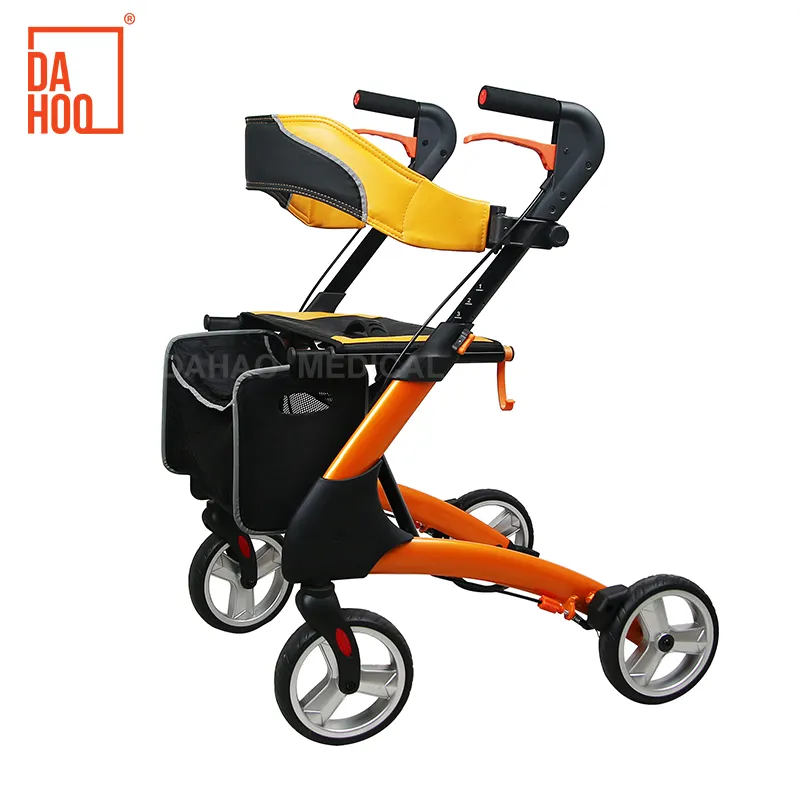
What reasons have made the 4-Wheeled Rollator a popular alternative to wheelless walking aids?
One of the greatest changes in the 4-Wheeled Rollator walker is that it enables the user to walk without having to push up and down the same spot but rather move along.
The traditional wheelless walking aids are mostly designed so the user can lift and push them while the 4-Wheeled Rollator just rolls. With holding the handles it's only necessary to change the direction with the body and there is no need to repeatedly lift a whole apparatus.
That arrangement has several benefits.
One, the rolling walker facilitates a more natural walk for the users. Due to the continuous movements of the device without the need to stop and allow the walker to readjust the user's gait becomes smooth and uninterrupted.
This capability of the rolling walker can be very important to users of the product who still have some degree of mobility such that the assistance they need is limited to ensuring safety.
The 4-Wheeled Rollator can easily be taken to quite a bit of distance because of the third big plus. Besides walking, several products can be stopped, locked, and their brakes released allowing users to get the rest they need just standing there.
To give an example, an elderly person using a 4-Wheeled Rollator walker as the only means of transport at a community outing simply puts the break on and rests when their legs get tired half-way around, without the need to look for a chair nearby or go back home. This kind of flexibility increases the user's self-confidence to go out and about.
Another thing the rolling walkers can do is hold small things. Most models are so designed that carrying bags, baskets for food shopping are the norm, and even some small storage compartments for water, medicines, phones, and other necessities. That way the seniors can do their everyday chores in a more self-reliant manner, without a third party.
Fruitfully, the 4-Wheeled Rollator walker can not only help the user walk easily in the right direction but also help them manage daily routines better without any problems in their daily life.
Who might benefit most from using 4-Wheeled Rollator?
When it comes to selecting a walking aid, the key factor should not be the choice of a product with the most features but instead the one that is the perfect for the user's physical characteristics.
As a rule of thumb, 4-Wheeled Rollator walker cater mostly for the following categories of people:
First, those individuals who can remain standing independently but have reduced balance.
Many seniors with a fair degree of their legs strength have become less physically stable by losing muscles, slowing down reaction time and losing their strength in coordination. They are at greater risk of falling when turning, starting to walk again, or navigating through a complex area. A 4-Wheeled Rollator can provide an additional hand to keep standing safely while walking.
Secondly, the people who have an insufficient capacity for walking.
A few seniors do not require the help as such but still find it hard to do much by foot. They may be able to move about normally at home, but after continuous walks of a few hundred meters only they feel very tired. For that type of user a 4-Wheeled Rollator with an integrated seat is a good match.
Thirdly, rehabilitation users of the device.
Knee and hip patients, for example, will have to be very cautious, and slowly build up their walking and moving capacity during the healing process. The 4-Wheeled Rollator may enable users to stay in motion without over-straining their recovery process through moderate activity.
And then, users who want to continue living autonomously as they become older. Oftentimes, what an older adult is primarily afraid of is to totally lose their self-sufficiency as well as independence and to get locked up completely to a home environment. The 4-Wheeled Rollator helps seniors to carry out their shopping, walking, getting together with fellow friends etc., independently and therefore enjoy life.
It goes without saying, 4-Wheeled Rollator walker may be a good option for most users but definitely not all. If someone has major difficulties with balance, trouble in managing his center of gravity, or needs considerable assistance regarding the support the device provides, traditional walking aids such as a crutch or a wheelchair may be the appropriate choice. The reason being that four-wheeled walkers require the capability of a user to control and use a braking properly with the wheel system.
What are the core advantages of the 4-Wheeled Rollator compared to ordinary walking aids?
1. Reduced arm strain and increased comfort
Traditional wheelless walkers require constant lifting, which is not ideal for people with insufficient upper limb strength.
The 4-Wheeled Rollator walker, with its rolling wheels, significantly reduces pushing resistance. Users only need to control direction and don't need to bear the weight generated by repeatedly lifting the device.
For people with arthritis, shoulder pain, or decreased muscle strength, this design is more suitable for long-term use.
2. Provides Rest Function, Enhancing Mobility
The seat is a key feature that distinguishes the 4-Wheeled Rollator walker from ordinary walking aids.
Many elderly people reduce their outdoor activities not because they are completely unable to walk, but because they are unsure when they will tire.
The 4-Wheeled Rollator provides a readily available resting spot, encouraging users to engage in outdoor activities more readily.
3. Improves Independence
Modern aging concepts increasingly emphasize "active living."
A good 4-Wheeled Rollator can help users:
Go shopping at the supermarket independently;
Take walks in the community independently;
Go to the hospital independently;
Complete daily activities independently.
This independence is also crucial for improving the mental health of the elderly.
4. More Suitable for Mixed Indoor and Outdoor Environments
While wheelless walking aids are primarily suitable for indoor environments, the 4-Wheeled Rollator, depending on wheel diameter and structural design, can be used in more settings such as homes, communities, parks, and shopping malls.
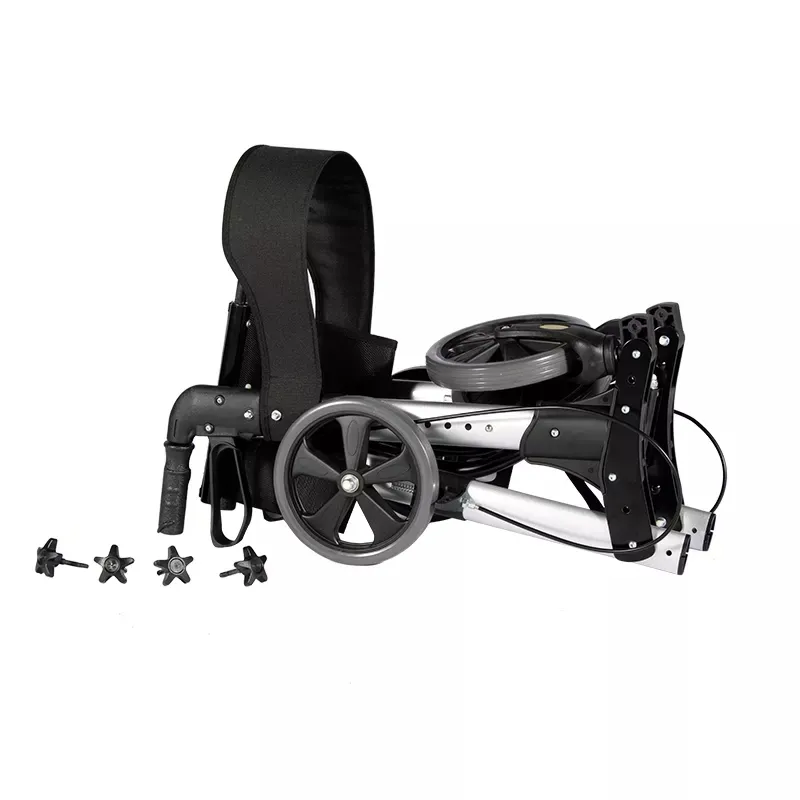
What are the safety measures which one should follow while using a 4-Wheeled Rollator?
Undoubtedly, the 4-Wheeled Rollator helps a lot with mobility. Yet, knowing how to use it properly is of utmost importance.
The first thing to do is changing the height according the individual’s height needs. Handrails that are too high will strain one's shoulders, whereas handrails that are too low can lead to a bad posture.
The next thing that one should be careful with is locking the brakes if they are planning to sit down. It is because the 4-Wheeled Rollator can roll a little even when one just is settling in, provided that the brakes are not engaged.
In case it is an easy downhill slope where one needs to push the device, then they should never speed up as doing so will make wheel rotation so fast that it becomes very unlikely that the user will be able to take over in case of any incident.
Lastly, it is the time when you should do all your necessary and regular checkup:
checking the tires for wear;
making sure that the brakes are not sticking;
inspecting the frame's connection points;
checking the folding mechanism.
If you perform maintenance of a rollator walker, it will last for several years, which can also be a way you save money!
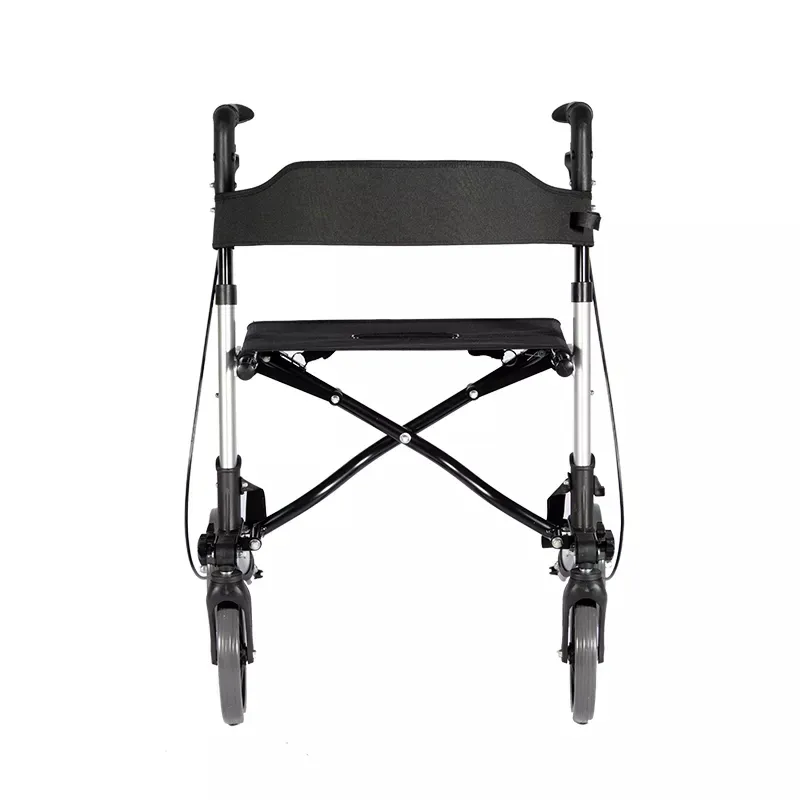
FAQ: Frequently Asked Questions about the 4-Wheeled Rollator
Q1: Is the 4-Wheeled Rollator better than a wheelless walking aid?
Both are suitable for different users. Wheelless walking aids offer greater stability and are suitable for people who need stronger support; the 4-Wheeled Rollator is easier to move and is suitable for people who still have some walking ability but need assistance and balance support.
Q2: Is the 4-Wheeled Rollator safe for the elderly?
After correctly selecting the model and learning how to operate the brakes, the 4-Wheeled Rollator can improve mobility safety. However, users need to have a certain level of control and be mindful of its use on slopes and complex terrain.
Q3: How much weight can the 4-Wheeled Rollator support?
The standard model typically supports approximately 100kg to 150kg, while the reinforced model can support over 180kg. The specific weight to choose depends on the user's weight and the environment in which it will be used.
Q4: Is the 4-Wheeled Rollator suitable for outdoor use?
Yes. With a larger wheel diameter and a stable frame, it can be used in communities, parks, shopping malls, and other similar environments.
Q5: Why do many elderly people switch from wheeled walkers to 4-Wheeled Rollators?
The main reason is that the 4-Wheeled Rollator walker better meets their long-term living needs. It reduces fatigue from lifting the device while providing seating, storage, and mobility, allowing the elderly to maintain more independent mobility.
Q6: Can the 4-Wheeled Rollator replace a wheelchair?
It cannot completely replace one. The 4-Wheeled Rollator walker is suitable for people who can walk independently but require assistance. A wheelchair may be more suitable if the user is unable to stand independently, cannot control their balance, or needs to move while seated for extended periods.