

As electric wheelchairs evolve to be lighter, more portable and suitable for travel, the question "How heavy is a carbon electric wheelchair?" has become a primary concern for many consumers, rehabilitation staff, distributors, and medical equipment buyers. On one hand, it could look like a straightforward matter about how heavy something is but on the other hand, to someone who needs to use an electric wheelchair regularly, this question really gets to the heart of the matter. The weight of the wheelchair influences the way of going and coming in, how much is stored, how it moves, travels, airport transfers, and daily care of the wheelchair. The point here is that traditional steel or aluminum alloy electric wheelchairs can easily weight a few kilograms. That is probably why having a carbon fiber electric wheelchair with a light weight as much as possible yet still sufficient for load-bearing and structurally stable is indeed a solution that can resolve the longstanding portability vs. load-bearing dilemma.
Nevertheless, the market is flooded with advertisement "extremely light electric wheelchairs," "carbon fiber power wheelchairs," and "travel electric wheelchairs," and it is the way of weight calculation where one finds some differences across different brands. Some products publish the weight without taking the battery into account, some include the battery, and still others do a separate weighing of removable batteries, pedals, and controllers. If a consumer only focuses on a figure such as "under 20kg" or even the "10kg," and does not ask for further clarification as to whether it means bare weight or actual working weight, expectations during purchase and transport, may become out of balance. Consequently, making an assessment that a carbon fiber electric wheelchair is really a light one should not be done by merely looking at the picture of a number on the brochure; rather, it is a multifunctional process where one has to evaluate the frame material, battery weight, drive system, folding, load capacity, and size in general.
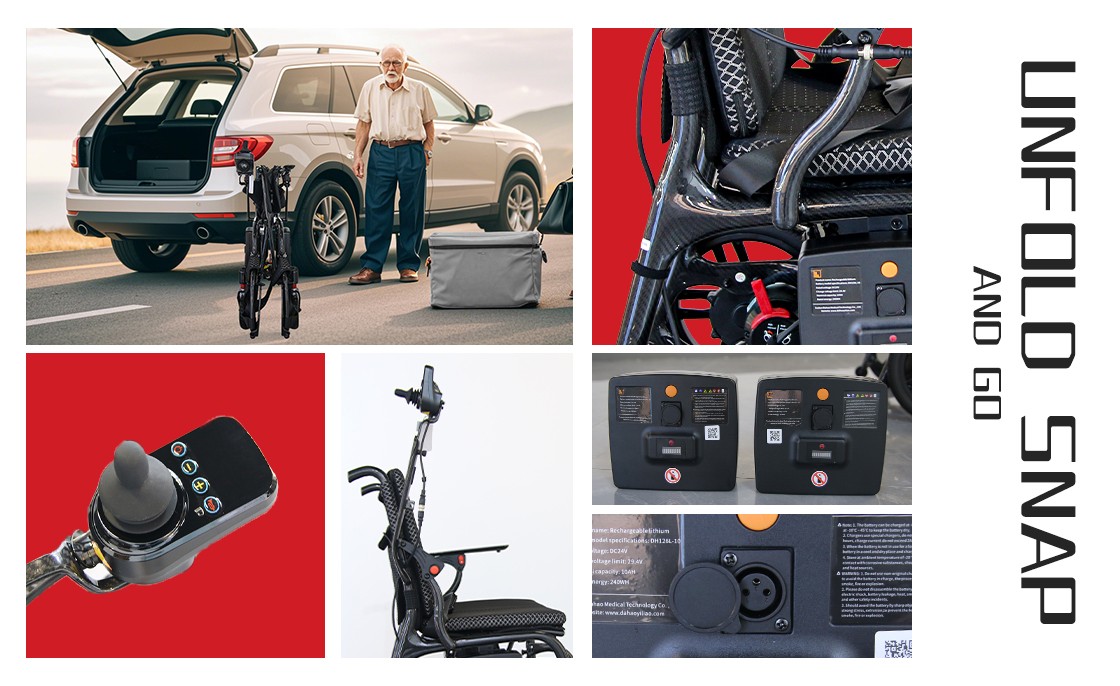
For instance, Dahao Medical® Ultra-light Carbon Fiber Folding Power Wheelchair (DH01126) uses a strong carbon fiber frame, and the net weight of this wheelchairs is about 13.5kg, including the battery. Maximum load capacity of the wheelchair is approximately 136kg, or 300 pounds. This basically means this carbon fiber wheelchair doesn’t decrease the body weight simply by removing structural components but continues to have a higher load capacity without a drastic increase in the overall weight.
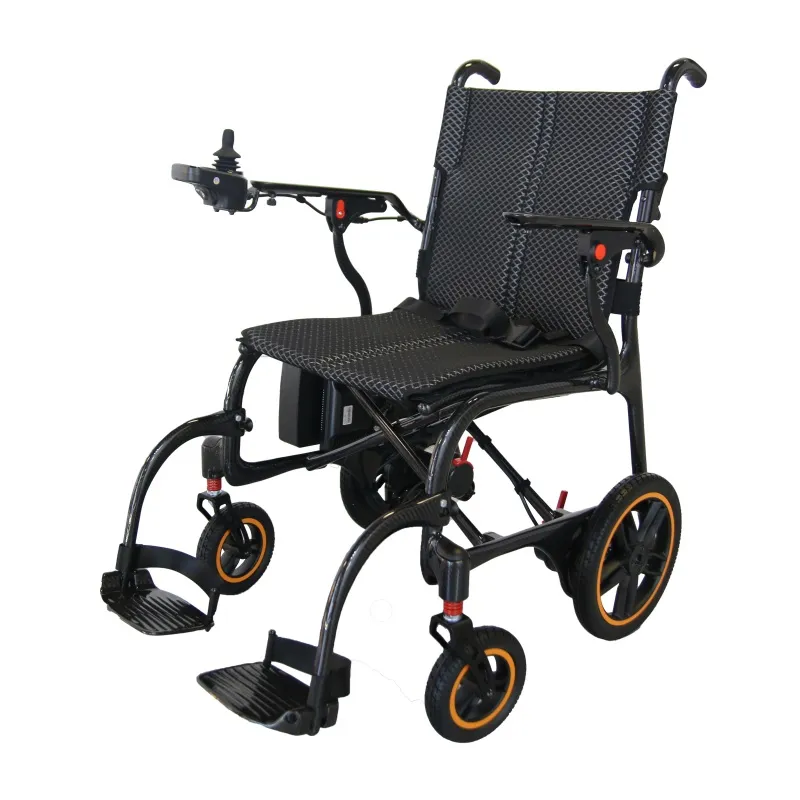
Why is the "light weight" of carbon electric wheelchairs getting more attention in the market?
In the past, when electric wheelchairs were bought, consumers would focus first on the motor, battery, and range, as well as load, without paying attention to weight. The reason was that electric wheelchairs were primarily seen as a tool to get around indoors, and, if outside, as a means to cover a short distance; and therefore a slight increase in weight was tolerated. But with the rising older population, increasing demand for home care, and a significant increase in the requirement for accessible travel, the contexts in which electric wheelchairs will be useful have changed completely. These days, in addition to using at home, hospitals, care homes, or on community streets, more and more users also desire to be able to stow their wheelchair into car trunks, take them on trains for their travels, and even take them with them for air travel.
That is when weight becomes more than just "a characteristic" but the major aspect of a product's user experience. For example, if an electric wheelchair is 35kg or even heavier 40kg, no matter how great its motor or battery power is, the user is likely to find it physically difficult to lift the product into a trunk by themselves. So for the very elderly, people with impairments, and those needing full-time assistance, the help of the family, their caregivers, or drivers is, in fact, required to get the wheelchair into a car. A wheelchair weighing up to 15kg should still be very manageable to transport, even though minor handling skills might still be required.
This is the reason why carbon fiber power wheelchairs get more and more market exposure every year. Thanks to a very high strength-to-weight ratio in the materials used to make carbon fiber, designers get great flexibility in reducing weight without compromising structural integrity.
If we look at the frame of electric wheelchair, in fact, it is this structural body that is primarily responsible for reducing the weight of the whole. In the case of carbon fiber as the core loadbearing structure and together with other lightweight components such as battery packs, motor units, wheel sets, and folding mechanisms, it is very possible to make products with a style different from the conventional heavy-duty electric wheelchairs.
Nevertheless, what needs clarifying is that lighter doesn't mean lighter-only. A really great carbon fiber-powered chair must be one that is light-weight yet strong enough. In other words, the product must have good load-carrying, rigid structure, and stable frame, while being able to run the distance without needing very high driving force, as well as being a comfortable wheelchair. In short, if the light is such that the load capability, the braking effectiveness, and the life expectancy of the frame are given to be poor, then this lightness is actually a failure and does not help the real user.
How heavy is a carbon fiber electric wheelchair?
This is the most direct question for consumers. The Dahao Medical® DH01126 carbon fiber folding electric wheelchair weighs 13.5kg (including the battery). This data is crucial because many "ultralight electric wheelchairs" on the market don't include the battery in their weight claims, and the battery is a significant contributor to the overall weight of an electric wheelchair.
13.5kg is roughly equivalent to the weight of a heavy suitcase or a medium-sized travel bag. From a practical handling perspective, 13.5kg is significantly different from traditional electric wheelchairs weighing over 30kg. For users who frequently need to put their wheelchairs in their car trunks, reducing the overall weight reduces the burden of transport; for frequent travelers, the compact folding size further reduces transport space requirements.
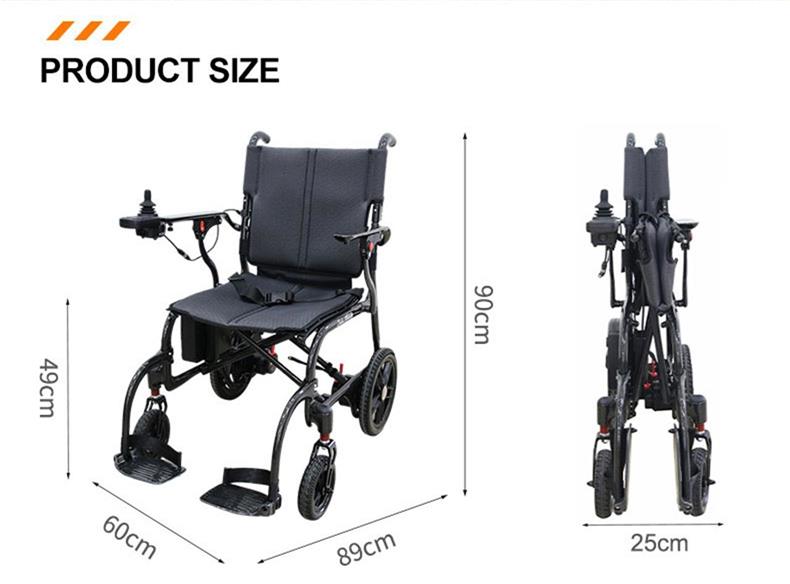
The Dahao Medical® carbon fiber folding electric wheelchair folds to approximately 63cm in length, 25cm in width, and 71cm in height. The official product description also provides folded dimensions of approximately 19×7.5×21.3 inches. When unfolded, it measures approximately 89cm in length, 60cm in width, and 90cm in height, with a seat width of approximately 41cm and a seat depth of approximately 40cm.
These data show that lightweighting of carbon fiber electric wheelchairs is not simply about reducing materials, but rather a combination of folding structure, drive system, and overall vehicle layout. A vehicle weighing 13.5kg with folding capability offers significantly higher value for travel scenarios compared to a lighter product that cannot fold effectively or has an inconveniently removable battery.
If a buyer asks, "How heavy is a carbon electric wheelchair?", a fixed answer is not possible. The weight of products on the market is influenced by frame materials, battery specifications, motor, wheel set, seat structure, folding mechanism, and safety features. For products truly designed for travel and portability, 13kg to 20kg is a very noteworthy lightweight range, but ultimately, comparisons should be made based on the consistent criteria of "whether or not the battery is included."
How much weight can a carbon fiber power wheelchair carry?
The Dahao Medical® DH01126 carbon fiber folding electric wheelchair has a maximum load capacity of 136kg, or approximately 300lb.
For the average adult, a rated load capacity of 136kg covers a fairly wide range of users. However, in actual procurement, it's important to note that "maximum load capacity" and "recommended long-term working load" are not entirely the same concept. Maximum load capacity usually means the upper limit the product can withstand under the conditions specified by the manufacturer. Long-term use also requires consideration of road conditions, slope, frequent inclines and declines, threshold crossings, user movements, and the weight of personal belongings.
For example, if a user weighs 90kg and carries approximately 5kg of personal belongings, the total load is approximately 95kg, which still has a significant margin compared to the rated load of 136kg. For users whose weight is close to the rated upper limit, the actual usage environment should be considered more carefully, as the dynamic impact from outdoor surfaces can be significantly higher than the static load on a flat indoor floor.
Therefore, when purchasing a carbon fiber electric wheelchair, one should not simply ask "what is the maximum weight capacity?" but also clarify how the manufacturer defines the rated load capacity, whether it includes personal belongings, the applicable slopes, the recommended road surfaces, and the product's range and handling performance under different load conditions.
Why can carbon fiber achieve both lightweight and high load-bearing capacity?
The true value of carbon fiber material lies in its combination of high strength and low density. Traditional steel boasts high strength and excellent machinability, but also has a relatively high density. Aluminum alloys offer further weight reduction and are therefore widely used in lightweight wheelchairs and electric travel wheelchairs. Carbon fiber composites provide another path to lightweight design.
For carbon fiber power wheelchairs, the frame is not simply a "frame"; it must bear the user's weight while simultaneously handling the motor's driving force, braking loads, road impacts, and structural changes during folding and unfolding. Therefore, the frame design must consider both static and dynamic loads.
Dahao Medical® uses carbon fiber as the frame material in its DH01126 product, combined with a folding structure design. This product utilizes high-strength carbon fiber, balancing lightweight and strength, and enhances transport convenience through a one-click folding structure.
This type of design is particularly suitable for travel scenarios because users truly need a "mobile electric wheelchair," not just a "driving electric wheelchair." If the product can be easily folded, stored in a vehicle, and transported conveniently, the use of electric wheelchairs will expand from homes and communities to airports, hotels, tourist attractions, train stations, and long-distance travel.
Lightweight Doesn't Mean Sacrificed Electric Performance
Many people, seeing a weight of 13.5kg, might worry: Is the motor power of such a lightweight carbon fiber power wheelchair low? Is the range short? Can it be used on slopes?
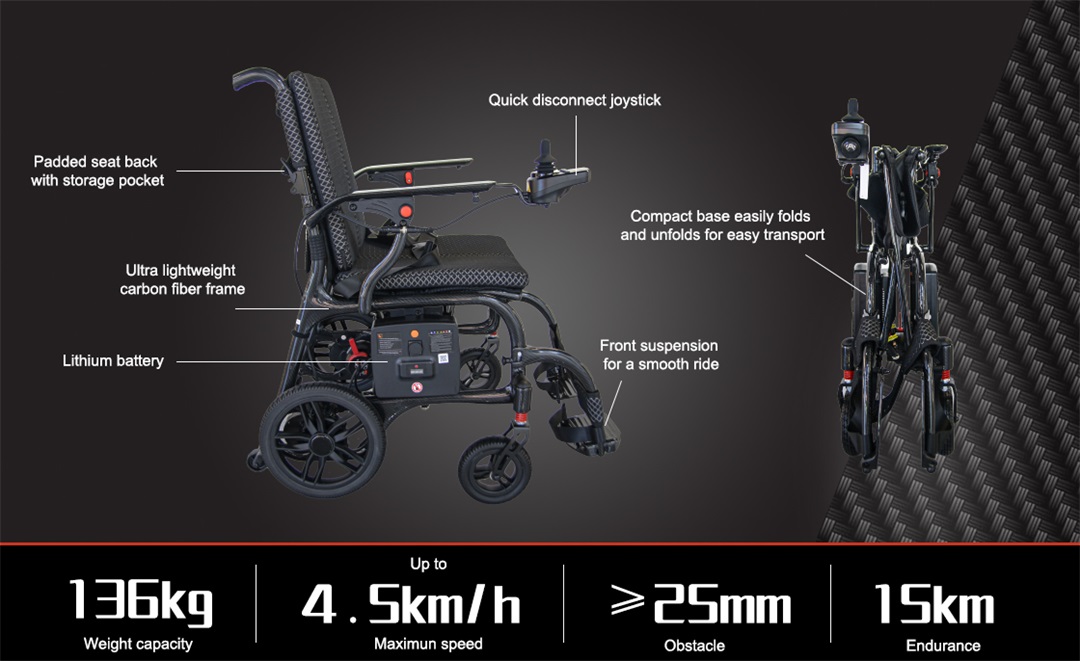
In reality, the electric performance of lightweight products needs to be judged in conjunction with specific configurations. The DH01126 uses two 150W brushless motors, a dual-motor drive system, with a maximum speed of 4.5km/h, a maximum range of approximately 15km, a climbing ability of ≥3°, and an traverse capability of ≥25mm. Its primary purpose is not to replace heavy-duty outdoor off-road electric wheelchairs, but rather to solve mobility issues in urban roads, indoor environments, airports, hotels, shopping malls, and regular outdoor roads.
The DH01126 carbon fiber folding electric wheelchair features approximately 6.5-inch front wheels and 12-inch rear wheels, along with a front suspension system, providing a smoother riding experience during travel. For lightweight electric wheelchairs, the larger rear wheels combined with the suspension design help improve comfort when traversing small, uneven surfaces, which is especially important for travel use.
Therefore, consumers cannot simply assume that "the higher the motor power, the better." If the product is primarily used for travel, then weight, folding size, maneuverability, battery, battery life, and ease of transport often need to be balanced comprehensively.
What makes carbon fiber power wheelchairs a good fit for travel?
Travel is one of the most significant application scenarios for carbon fiber power wheelchairs. The main limitation of traditional electric wheelchairs is the high weight and the large size of the product. When users travel by car, the wheelchair has to be lifted into the trunk; when they take a airplane, they have to handle issues like air travel battery regulations, equipment transport, and so on.
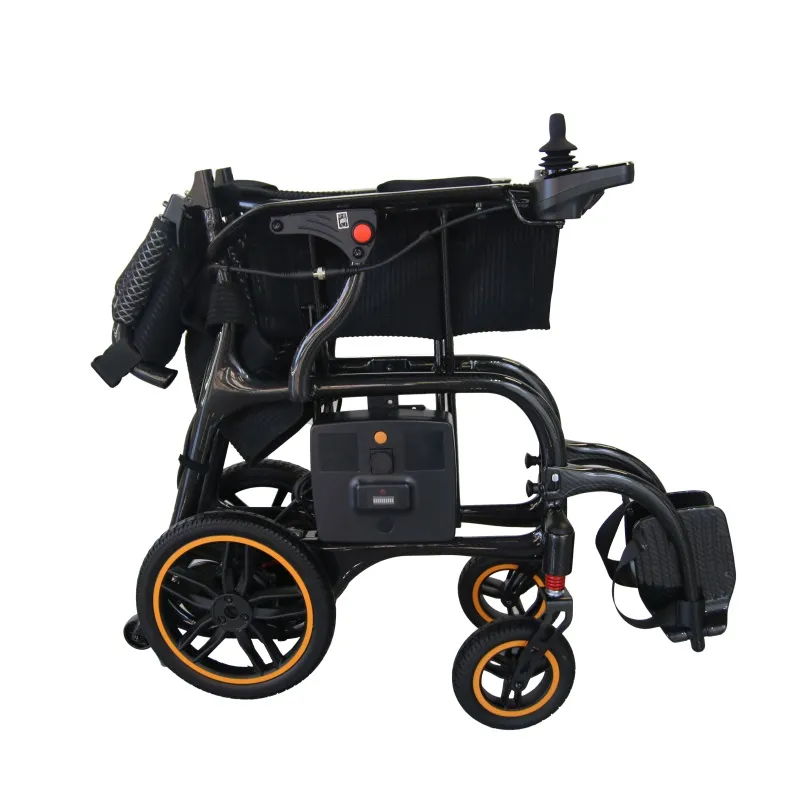
DH01126 carbon fiber electric wheelchair is obviously a portable-design product. This is achieved through folding of the product, which upon folding, takes about 63cm × 25cm × 71cm. Its features, like the ability to fold and place in the trunk of a car, imply that it does not only address the issue of "low weight" but also "small space occupancy."
More, the product comes with features such as a detachable joystick, USB charging, freewheel mechanism that allows manual operation, the seat storage area, and an adjustable seat belt. In conclusion, these feature-packed design concepts reveal that at the heart of superior quality travelers' carbon electric wheelchairs is the integration of the core features such as "light + foldable + powered + manual + travelling" as a whole.
On an airport runway, however, it may be necessary that electric wheelchair and Lithium battery transportation must be in conformity with both the airline and the regulations of your destination country/region. A product page of the airline-compliant lithium battery does not guarantee full compliance of the battery's capacity, removable nature, packing, boarding procedures, and handling as to be confirmed from the airline before the flight.
To travel by air without much difficulty simply based on a feature like "airline-compliant" would be wrong as there could be variations with what different airlines are using as their handling policies.
Where lie the main differences between carbon fiber power wheelchairs and aluminum alloy electric wheelchairs?
For users seeking a lightweight electric wheelchair, carbon fiber and aluminum alloy are the two most preferred materials. Besides that, different models of lightweight electric wheelchairs with various materials and structures are also on sale in the series of the company. The DH01101 one, for instance, uses an airplane-grade aluminum alloy frame of an official weight about 21 kg with a folding, multi-mode operation, brushless 300W motor, range around 32km as its features.
On the contrary, the DH01126 is a carbon fiber wheelchair with an official weight of around 13.5 kg excluding battery. Due to various features and product lines these two models cannot be fully compatible to each other and, therefore, it is not fair to say one type is better than the other just because they are made from different materials.
The choice of manufacturing material, such as aluminum alloy or carbon fiber, usually reflects the priorities of the designers and the nature of the final product. Aluminum alloy is relatively easy to process, offers a controlled cost-to-value ratio and has a well-established production and maintenance industry behind it. Meanwhile, carbon fiber is better suited for the kinds of products that require both super-lightweight and the ability to travel easily, and, consequently it is also able to provide the high-end portable experience to the user.
For the buyers, choosing the right material is all about matching to their needs and understanding the different strengths and weaknesses of the material through the lens of the target market. If the target users prioritize price and everyday use most, a lightweight aluminum alloy wheelchair would probably offer a more cost-effective solution overall.
If they are mainly concerned about weight, travel convenience, product design aesthetics, and the whole thing of being able to travel with a top-class portable product without hassle, then carbon fiber power wheelchairs would usually be a better fit.
Why choose Dahao Medical® as a good manufacturing partner for carbon fiber power wheelchairs?
A carbon fiber power wheelchair from the manufacturer's point of view is no way the same as the metal versions, just changing the material type does not suffice. The design of the carbon fiber part of the chair is only one factor in the whole equation which includes the processing of the composite material, the electrical system, the lithium battery, the motor, the controller, the folding mechanism as well as the medical device quality system. Hence, it is a vital requirement to ensure that the factory has both the designing capability and the capacity to produce the parts.
Establisher in 2008, Dahao Medical® is a manufacturer that focuses on medical mobility and care equipment including electric wheelchairs, transfer chairs, medical beds, nursing beds, walking carts, and electric patient transfer machines.
The company's factory floor is about 80,000 square meters while the research and engineering team is about 30 members.
We export products to more than 100 countries and regions and also OEM, ODM, and custom services are supported.
Dahao Medical®'s products and systems from the standpoint of certification and quality management are certified, or accredited such as ISO 13485:2016, CE MDR, FDA 510K, TÜV, BV, and SGS etc. This is a big issue for medical and healthcare equipment buyers internationally that electric wheelchairs are not a type of household goods. The chair's frame structural safety, electrical safety, battery and medical device compliance should all be elements of product development and quality assurance programs.
FAQ: Common Questions about Carbon Fiber Electric Wheelchairs
1. How much does a carbon electric wheelchair typically weigh?
This varies considerably between products. It's important to note whether the battery is included. The Dahao Medical® DH01126 carbon fiber electric wheelchair weighs approximately 13.5kg, and this weight includes the battery, making it a very lightweight folding electric wheelchair.
2. What is the maximum load capacity of the Dahao Medical® carbon electric wheelchair?
The DH01126 carbon fiber electric wheelchair has a maximum load capacity of 136kg, or approximately 300lb. In actual use, in addition to the user's weight, factors such as carried items, road surface, and slope should also be considered. Therefore, it is not recommended to use the rated load limit as the daily usage target for extended periods.
3. Is a carbon fiber electric wheelchair suitable for travel?
Yes, especially models with a folding structure designed for portability. The DH01126 carbon electric wheelchair features a folding design, with folded dimensions of approximately 63cm × 25cm × 71cm. The official description positions it as a travel-oriented, portable carbon electric wheelchair.
4. Can a carbon fiber electric wheelchair fit in a car trunk?
The DH01126 carbon fiber electric wheelchair's folding structure and weight of approximately 13.5kg (including battery) make it clearly suitable for car transport. However, trunk dimensions vary significantly between different car models, so the folded dimensions should be checked against the car's trunk opening and internal space before purchasing.
5. Are carbon fiber power wheelchairs better than aluminum alloy electric wheelchairs?
It's not a simple matter of judgment. Carbon fiber is generally better suited for those seeking high strength, lightweight construction, and a premium portable experience, while aluminum alloy products have advantages in manufacturing costs, processing convenience, and overall cost-effectiveness. Dahao Medical® offers both carbon fiber and aluminum alloy lightweight electric wheelchairs, allowing for selection of the appropriate product line based on target market and user needs.
6. Can overseas distributors purchase carbon fiber power wheelchairs from Dahao Medical®?
Further discussions can be held regarding OEM, ODM, and bulk purchasing collaborations. For overseas brands and distributors, they can discuss specific product solutions with manufacturers based on factors such as user weight, battery life requirements, folding size, color, configuration, and compliance requirements in their target market, rather than simply purchasing a single product.