

The world health landscape is gradually shifting along with people getting older, particularly, health care for the elderly has also gone through significant changes. In the old days, many people thought aging people became less physically active with mobility decline and thus should rest and be inactive for the purpose of preventing falls and other injuries. However, nowadays both rehabilitation medicine and the study of aging and exercise have repeatedly and more strongly indicated that a sedentary lifestyle is not the optimal way of protecting body, that it could in fact promote muscle deterioration, a major reduction in balance, and even more limitations on movement.
In fact, the correct issue we should ask is "How can elderly people who have been physically weakened continue safe exercizes?" The issue of whether the elderly should exercise is actually the least question in comparison.
This has not been an uncommon situation for quite a number of people, a family member of the elderly, for instance, may be a regular helper to their old parent. There could be a case in which the old parent has not become so disabled after all to walking, just the leg muscles have deteriorated, there may still be pain with the knees, the back, or there is a kind of gait that is not stable, or simply the old person is feeling tired after the slightest effort. These are situations that could still allow for a walk in the park, an engagement in a social event of the community, or going to the neighborhood store for shopping, but the fear of falling makes it more or less a matter of time that the older person will be staying at home. The physical decline, therefore, is a result of inactivity, and this has a way of feeding itself by making the body weaker the longer the person is staying indoors. The more you don't walk, the less walk you can make, this is how the cycle keeps running.
Moderate exercise, according to the WHO research, is very important to keep the elderly person's functional capacity. It's not merely good for the elderly but necessary too, as exercising on a regular basis, like walking, helps with the heart and breath, increases the blood circulation, and helps to maintain strong legs and good balance. But, given the physical decline, the elderly may no longer be able to do a long walk, go for a run, or any other kind of high-intensive sport; they may find an assistive device that is risk minimizer and confidence increaser as their main need.
The four-wheeled rollator was a very useful kind of aid that was developed to fulfill such needs. Compared to other assistive devices or walking tools like a cane, a stick, or a traditional crutch, the four-wheeled rollator offers users better balance and walking support, mostly through wheel support. Moreover, a four-wheeled rollator walker usually consists of a handbrake, a small seat which allows the user to have a rest during walks, a side pocket (usually for groceries), and adjustable height handles. An elderly person could thus continue to be independent while also gaining a level of protection that is quite higher.
Is it therefore a good form of exercise to walk on the support of the four wheeled rollator?
Yes, the answer is definitely 'yes'. However, the key is to understand that it should be recognized a device is only a part of the process, not a substitute of the natural human movement. Rather, the rollator is only there to provide the necessary support the aged when their capabilities start to be physically reduced to such an extent that they still, to an extent, physically can perform movements to be used for walking exercises but with a high probability that the exercises could be unsafe or cause them to fall.
Using the rollator correctly will allow seniors to do more daily activity, gain better control of their life (i.e., independence), and reduce the possibility of falls.
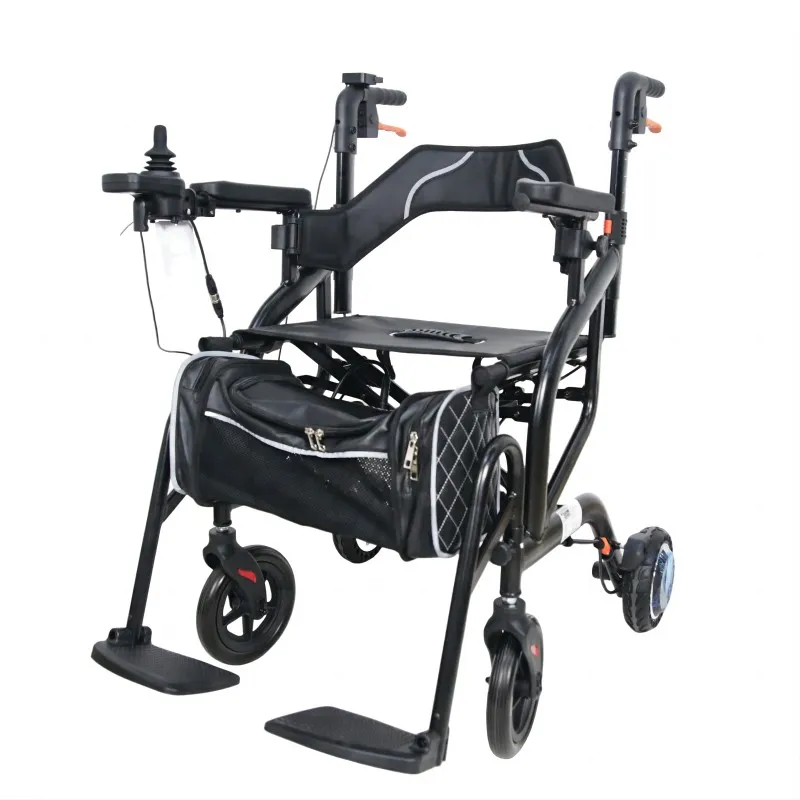
Do older people have to do walking exercises only on a two-wheeled rollator?
Walking is one of the most important physical functions that human beings can perform. It involves the power of muscles, the degree to which joints can move freely, the coordination of the nervous system and the body, as well as balance.
With the passage of time, our muscle mass is being reduced bit by bit.
This is even particularly true of leg muscles that are the very first ones to be affected by the aging process and are of the utmost importance to be able to stand straight, walk or take flights of stairs.
In fact, what makes most people move around difficult, is not because of total absence of movement, instead, it's usually that their physical stability has been significantly reduced. Some people, for instance, can easily cope with walking on flat ground but the walking becomes fatigued after a very short distance; while on the other hand another person with comparatively good leg strength, yet, he or she easily loses balance when making turn, walking direction change, or crossing the uneven surface. The fact that some people were afraid of their past falls and have developed a fear of a similar situation again is why they are voluntarily and steadily reducing their activities.
In the absence of timely interventions or if such cases are not taken care of properly and continued in the future, the effects are devastating and really bad. Physical activity, inactivity to be precise will lead to further decline in muscle mass, decreased capacity of joints, and reduced coordination, resulting in more dependence from the old adult on others.
So, how important is the four-wheeled rollator for elderly persons? Actually, by using the rollator walker, the senior can break the cycle mentioned.
The rollator serves to give a solid support when walking and thereby, makes it possible for the elderly to walk around in environments that have low-risk factors. As an example, a senior gentleman who earlier could manage only half of the kilometer without the rollator walker, was always reluctant to go out due to possible tiredness or a fall but after getting this rollator, little by little his capability to go out and walk doubled and more so. Such an increase in physical activity level by itself is already counted as an exercise.
Additionally, the use of a four-wheeled rollator is very helpful to the elderly in gaining a certain level of freedom that they otherwise would not have and that would require, more probably, the support or assistance given by a family member on a constant or regular basis.
For many old people, to decide on a movement of theirs, to choose direction of movement, and knowing when to stop are of great importance in not only preserving their sense of self-worth but in achieving mental stability as well.
Consequently, one of the main things we learn is that a senior doesn't need the use of the rollator for walking merely as a way to replace other activities like "doing exercise". On the contrary, the senior person is able to start again with exercising activities which they could not do at all before safely and, thanks to the rollator, they are given this opportunity to exercise safely and comfortably again.
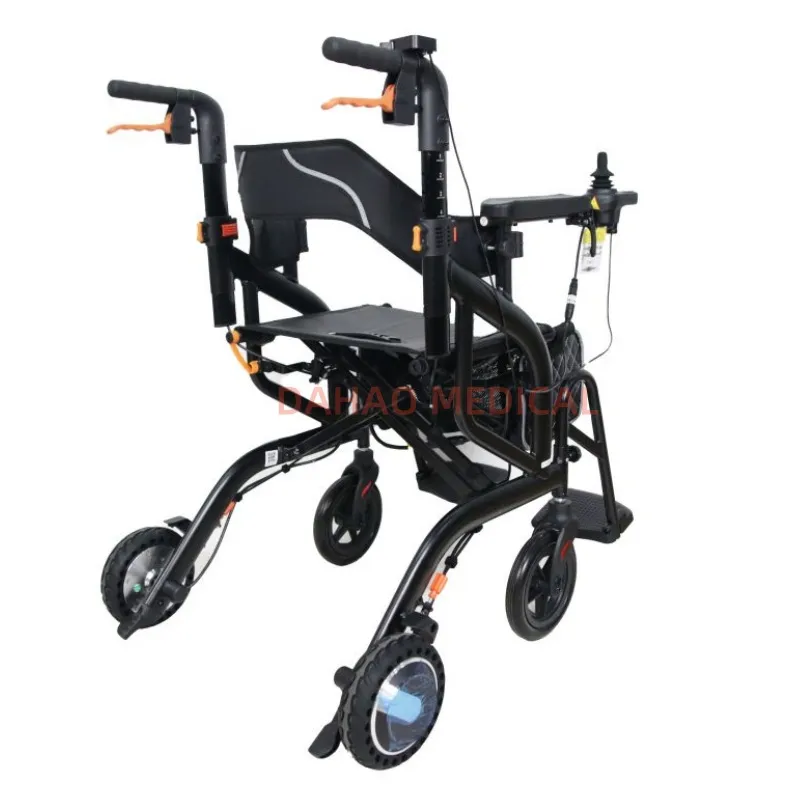
Will using a four-wheeled rollator really be an exercise?
Many mistakenly think that with assistive devices, one does not exercise.
There is a wrong belief that using a four-wheeled rollator walker will not bring about any exercising. However, exercising is not about the tools one uses but whether the body is engaged in physical activity. As in: persons with brace for the knee can train the legs, and people on poles for trekking can still hiking without any problem.
One of the benefits of using the rolling walker is the opportunity created for a prolonged session of physical activity. When you look at the older people who have limited body functions the most obvious physical problem may not necessarily be the loss of mobility but rather the loss of stamina, i.e., not being able to keep moving for long. Rollator provides a form of support that takes away stress from the legs and lower back thus prolonging their capacity to do various things for a much longer period of time.
Another benefit that this type of wheelchair can provide is increased stability of the gait. Some elders are found to be swaying or making short strides due to poor balance. Through the correct positioning by the use of the rollator walker these persons may even manage to be in a more or less the same position and therefore eliminate the compensation movements brought about by the imbalance.
The third benefit is the rollator walker provides a form of security to the physical activity itself. In order to prevent the fear of falls many seniors stop being physically active, such as going on walks, shopping, or even community activities with their friends and family. Therefore these people will more readily join in on walks, for example if they can depend upon their assistive devices such as reliable four-wheeled walking frames.
From the rehabilitation angle, being engaged in moderate physical activity regularly is generally more helpful in sustaining the physiological functions of the body than a complete rest for a long time.
To that end, a four-wheeled rollator is actually a device to assist the elderly to be in a state of movement continuously.
Who can use four-wheeled rollator walker?
We cannot say that every senior requires the use of the four-wheeled walker, but the following groups can definitely make the best use of it:
First, seniors who have weak legs but are still able to walk by themselves. Generally those elderly who do not show any muscle weakness in their legs but still feel that the legs are the last muscles getting tired. For such seniors a rollator walker would give extra support so that they still keep themselves fit through everyday activities.
Second, seniors recovering from the surgeries. A rollator walker may help people who have some limited leg movements only, to take their first steps without causing too much pain and then gradually increasing the distance as advised by the rehabilitation specialist when they reach this stage.
Third, elders who have balance disorder. Some older people not only experience loss of coordination but they are also not entirely dependent on their legs. This might pose serious problems especially when you get out of your bed and move around. Therefore, they will be able to do all their daily movements safely if they use a rollator to support.
Society, however, often neglect the fact that a senior can be in excellent condition yet still very cautious about the falls. A four-wheel walking aid would make them do physical exercises more frequently even when a fall has not occurred yet.
Nonetheless seniors who have difficulty in standing or even moving around independently, who have no hand movement control capability, or who need to be in bed or have someone take care of everything, are best served by wheelchairs or other mobility aids.
How to Choose a Suitable Four-Wheeled rollator for the Elderly?
Deciding on the right four-wheeled rollator walker isn't just about looking at the price or style; your choice should be based on the senior's body features and the area where they'll be using it.
First and foremost, look at how steady the frame is. Most four-wheeled rolling frames are manufactured from metal alloys like aluminum alloy or even pure alloy. Metal alloy rollator frame is light, convenient to carry, and preferred if you're a family that often moves stuff, while steel structures can handle more stress, which is great for taller folks.
As per industry standards, the weight tolerance of four-wheeled rollators in the market should be no less than 100kg, no more than 150kg. Of course, different kinds of products have their weight limit range different. So, if you're picking a four-wheeled rollator as a mobility aid for your grandparent, just think about their figure and also leave some buffer room for the safety margin.
Second, look the wheel size of the rollator. Wheel diameter largely determines if the rollator walker will be easy enough to handle by the user and to move around in the environment where it is to be used. In contrast, smaller wheel sizes are better if someone wants very high mobility indoors, whereas larger wheels help rollator be more stable on paved roads, uneven ground, or gravel.
The main user of the rollator is the person himself/herself if the rollator walker is at home. Hence, he/she should be the best judge of his/her needs and choose the device that suits him/her best. In case of an elderly person going out often for walks either in a park, the garden, a path or whatever outdoor area it is, it is better to choose four-wheeled rollator which will be very stable on ground.
One last piece of advice is that you have to pay attention whether a rollator walker has a foot brake or not. Many four-wheeled rollators have hand-brake systems, thus the elderly users can regulate their speed or stop the wheels just by pulling the lever. A smooth braking operation is a fundamental criterion for the safety aspect.
Fifth, it's a great idea to think about a seat on the rollator walker. Most four-wheeled rollator walker models are supplied with a removable seat that is convenient to carry, and allows an aged person to sit down during the walk for rest, without carrying any burden. This feature is a blessing, especially if a person has to be out for a long duration, or the person's condition is such that they feel their legs get very fatigue very quickly.
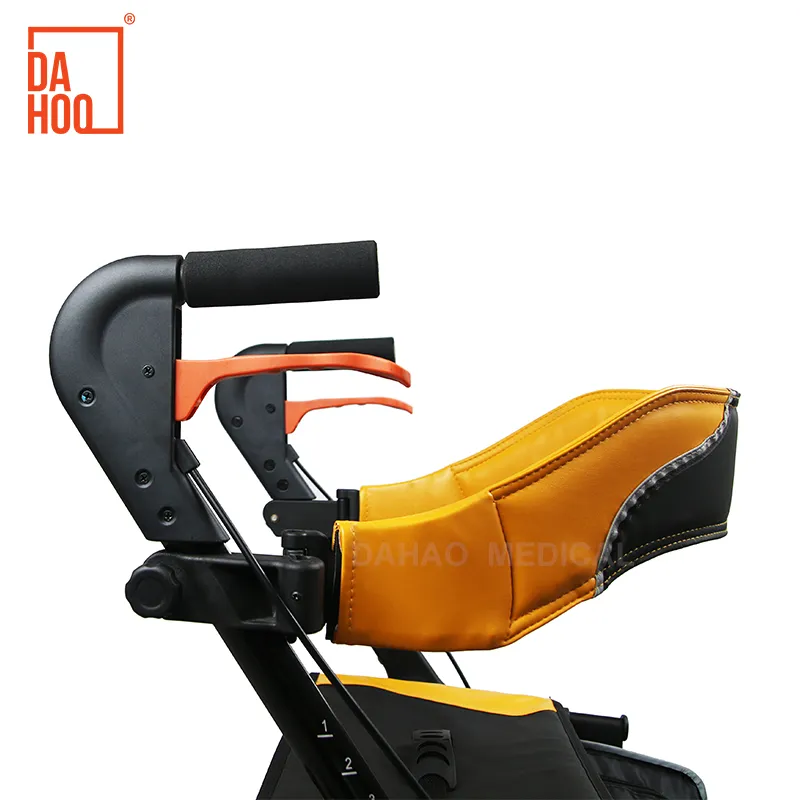
When using a four-wheeled rollator for exercise, correct technique is more important than the device itself
Even with a suitable four-wheeled rollator, incorrect usage can affect its effectiveness.
First, the correct height needs to be adjusted. The rollator's handrails should generally be close to the senior's wrist level. When standing naturally, the senior should hold the handrails with their elbows slightly bent. If the handrails are too low, it will cause the senior to lean forward, increasing pressure on their lower back; if the handrails are too high, it may affect stability and control.
Second, do not rely entirely on the rollator to support your body weight while walking. The correct way is to keep your body upright, lightly grip the handrails, and push the rollator along while taking steps. The rollator primarily provides balance assistance, not as a tool to completely support the senior's body.
Third, a gradual approach to exercise is necessary. Seniors who are chronically inactive are not advised to start with long walks. You can start with 10-15 minutes daily, gradually increasing to 20-30 minutes based on your physical condition.
During exercise, if you experience significant chest tightness, dizziness, severe fatigue, or joint pain, stop immediately and consult a professional.
What precautions should one take for the safety of a four-wheeled rollator user?
Although a four-wheel rollator walker significantly lowers the chance of falling, it still poses some risks. Therefore, one has to be vigilant and careful.
First and foremost, avoid speed in high-risk areas. Examples of high-risk areas may include slippery surfaces, steep hills, soft ground, and places strewn with obstacles, all of which may destabilize the four-wheeled rollator walker.
Secondly, it is vital to check and keep the condition of the equipment good. Prolonged use of the four-wheel rollator walker must be accompanied by regular checking of the state of the wheels, the brakes‘ responsiveness, frame integrity, and whether the folding mechanism is in working order.
Thirdly, when getting off the device to take a break, safety should be of concern. Using a four-wheel rollator walker equipped with a seat means that you should always stop completely and engage the brakes before getting on or off.
Fourthly, it is important to pick a four-wheel rollator with your physical ability in mind. It is common that more functionality of the device equates to higher quality, but the genuine suitable choice that fits best is the one that an elderly person's physical capability and regularity of use, in other words, the personalized product, is made for.
What are the differences and features of a four-wheeled rollator, a cane, and a regular walking aid?
Among assistive walking devices, four-wheeled rollator walkers, canes, and regular walking aids all have their own features.
A cane is a simple and lightweight assistive device for people who need only minimum help. However, a cane‘s main role is to provide single-sided support, which does not help very much with the balance of people who‘s balance skills are decreasing.
Ordinary walking devices, on the other hand, are mostly stable, but due to a feature of having to lift the device after the end of each step, their long-standing walking performance will be lower. Hence, they are better suited for the elderly who need the strongest support.
The four-wheel rollator is the combination of stability of the walking device, and easiness of movement of the walker. Because of the wheels, the elderly person can simply push the device and not have to hold or lift it every time. Thus, such rollator walkers will suit best the elderly who want to keep moving around and not stop.
To put it briefly, canes will suit those who need very little assistance, regular walking aids will suit those who require support in staying upright, and a four-wheel rollator walker will suit the elderly who have to be moving a lot, and will be doing the activity outdoors.

FAQ: Frequently Asked Questions about Using a Four-Wheeled rollator for Exercise
Q1: Does walking with a four-wheeled rollator really improve physical fitness?
Yes. A four-wheeled rollator does not completely replace physical movement; users still need to rely on their own legs to walk, thus helping to maintain muscle strength, balance, and activity levels.
Q2: Will long-term use of a four-wheeled rollator lead to dependence in seniors?
Usually not when used correctly. The purpose of a four-wheeled rollator is to provide safety assistance, not to stop the body from moving. Proper use can actually help seniors maintain more activity.
Q3: How long should one walk with a four-wheeled rollator each day?
There is no single standard; the duration needs to be adjusted based on individual physical condition. Generally, start with 10-15 minutes and gradually increase to 20-30 minutes. If you have a chronic illness, the exercise intensity should be arranged according to your doctor's advice.
Q4: Which elderly people are suitable for a four-wheeled rollator walker?
Suitable for elderly people who can stand and walk independently but experience decreased leg strength, reduced balance, or fatigue.
Q5: Are four-wheeled rollator walkers with seats safe?
A well-designed four-wheeled rollator walker with a seat is safe, but you must ensure the vehicle is stopped and the brakes are locked before sitting down to prevent movement and potential risks.
Q6: How often should a four-wheeled rollator walker be maintained?
Regular inspections are recommended, especially during frequent outdoor use. Pay attention to the tires, brakes, frame connections, and folding mechanism to ensure long-term safety.
