

For patients who are bedridden for extended periods, have reduced mobility, cannot bear weight on their lower limbs, or cannot maintain a stable sitting posture, transferring a patient from bed to chair may seem like a simple nursing action, but it is actually one of the higher-risk routine procedures in hospitals, nursing homes, rehabilitation centers, and home care.
The U.S. Occupational Safety and Health Administration (OSHA) lists patient transfers from bed to chair, from chair to bed, and from toilet to chair as typical high-risk patient handling tasks, noting a close relationship between repeated manual patient handling and musculoskeletal injuries for caregivers. OSHA data shows that in 2017, there were 18,090 cases of off-the-job injuries due to musculoskeletal disorders among nursing assistants, with an incidence rate of 166.3 per 10,000 workers, more than five times the industry average of 30.5.
This is why the modern healthcare industry is increasingly emphasizing the concept of Safe Patient Handling. For patients who cannot stand independently, bear weight independently, or stably cooperate with caregivers during transfers, electric patient lifts have become an important assistive device.
By using electric patient lifts, patient slings, adjustable medical beds, and suitable wheelchairs, most of the vertical lifting load that would otherwise require caregivers can be transferred to mechanical equipment, thus reducing the risk of patient falls and minimizing the physical strain on caregivers from directly lifting the patient.
So, how do you safely transfer a patient from bed to a chair using an electric patient lift? What types of patients are suitable for electric patient lifts? These questions determine whether patient transfers are truly safe, rather than simply "driving the machine over and hoisting the patient up."
Why is the "bed-to-chair transfer" a high-risk step that is easily overlooked in the nursing process?
In many home care scenarios, moving a patient from bed to a wheelchair, sofa, or nursing chair is often considered a matter of just a few minutes. Caregivers might have the patient sit on the edge of the bed, then help them stand up under their armpits, and then transfer them to the chair by rotating their body. If the patient can still stand actively and has good lower limb strength, this method may be applicable after professional assessment; however, for patients who are completely unable to bear weight, have insufficient leg strength, poor balance, or cannot understand nursing instructions, the risks of this manual transfer method increase significantly.
The patient's weight is the first issue.
Assuming the patient weighs 75 kg, the caregiver does not simply bear 75 kg of static weight during the transfer, but rather repeatedly bears dynamic load as the patient gets up, turns, and sits down. If the patient suddenly loses balance, the caregiver may instinctively reach out to "catch" the patient, at which point the lower back and shoulders are easily subjected to very large instantaneous forces.
The second issue is the patient's uncontrollable center of gravity.
Normal people can actively adjust their center of gravity when standing using their ankles, knees, and hips, but some bedridden patients cannot perform this control. When a caregiver helps them stand up from the bedside, the patient may lean forward, backward, or sideways. If the caregiver does not have enough space to adjust their position, the patient may slip.
The third issue is the height of the bed and chair and the spatial relationship between them.
Situations such as an excessively high bed, an unlocked wheelchair, footrests not being moved, and handrails obstructing patient access can all lead to accidents during patient transfer.
Therefore, professional patient transfer is not simply a matter of "strong enough caregivers," but a systematic process requiring patient assessment, equipment selection, environmental preparation, and operational control.
The CDC/NIOSH also points out that patient handling, movement, and repositioning are significant risk factors for occupational musculoskeletal injuries for healthcare workers, and using safe patient handling and movement techniques can help reduce these risks.
This is precisely the important value of electric patient lifters.
How does an electric patient lifter work?
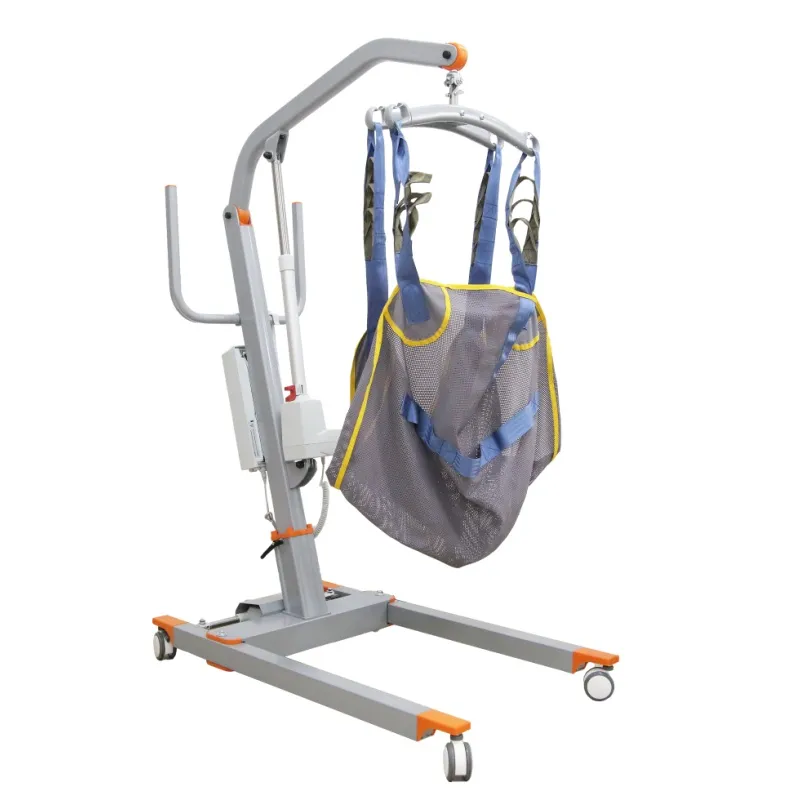
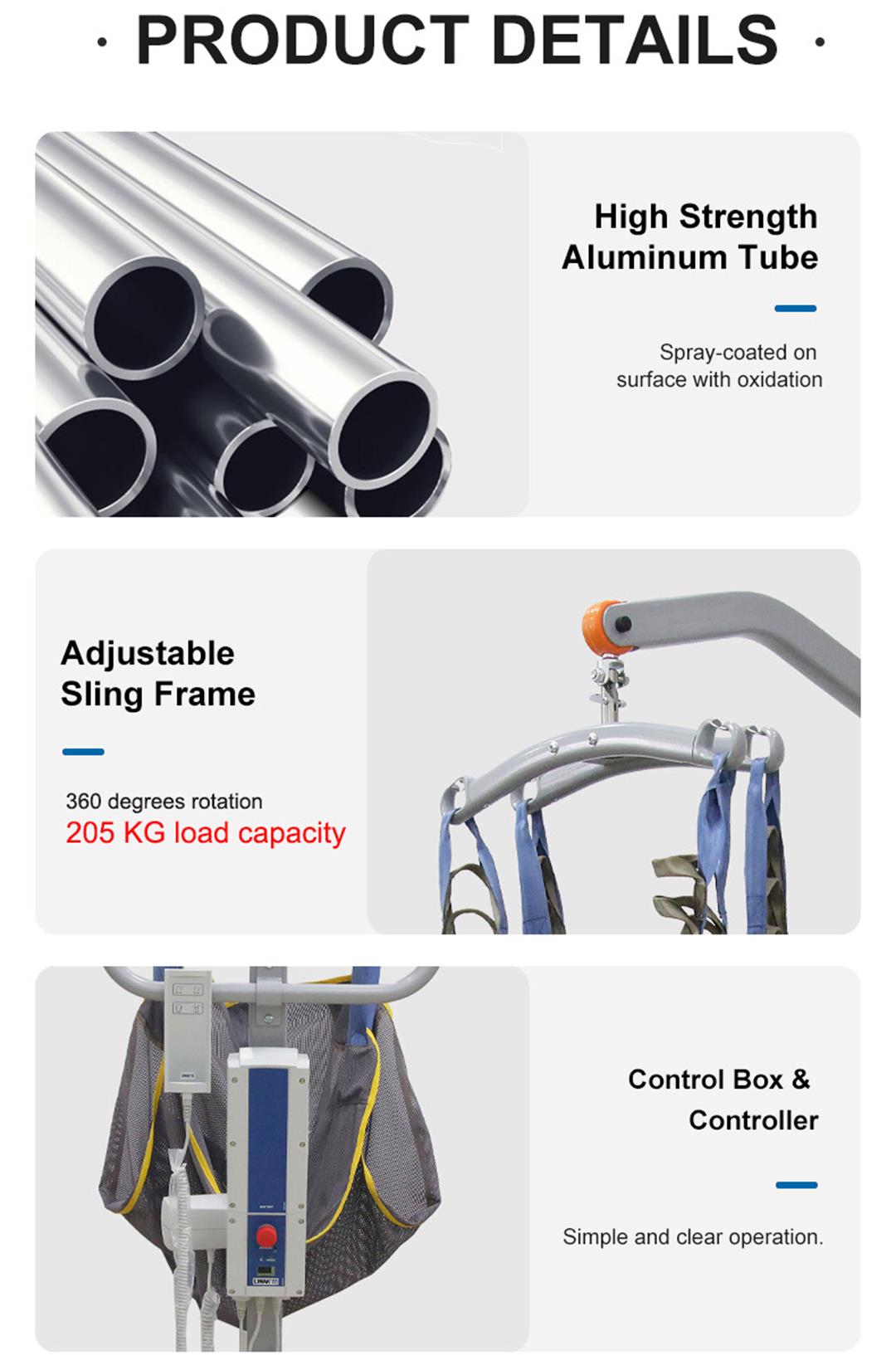
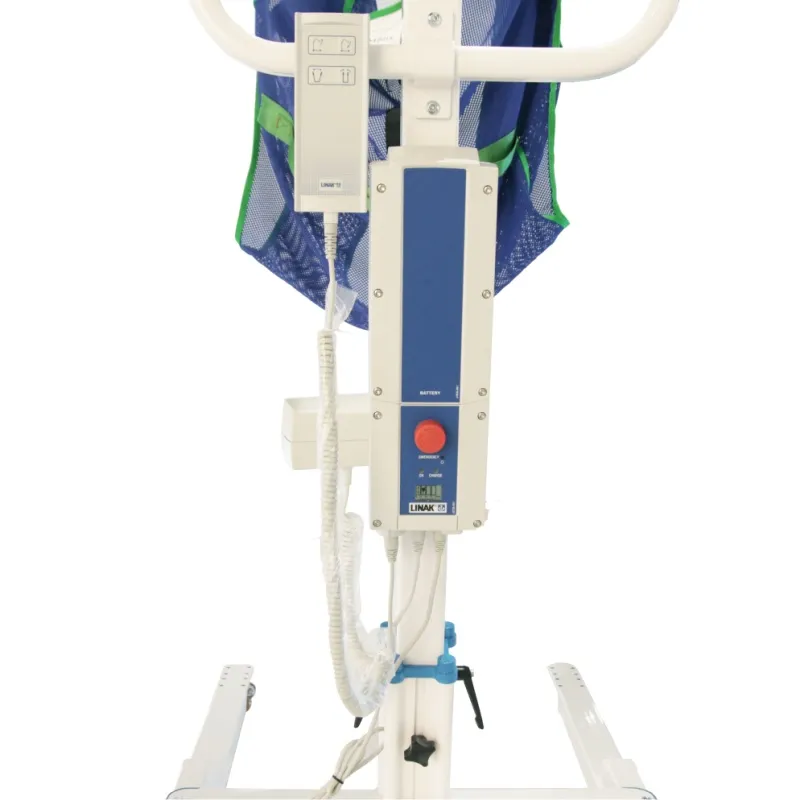
An electric patient lifter typically consists of a base, casters, a column or lifting mechanism, a boom, a sling connection structure, an electric actuator, a battery, a handheld controller, and a patient sling. The structure varies between products; some mobile electric patient lifters use electric push rods for lifting, while others use motors with lead screws and reduction gears.
Its basic working logic is not complicated: First, the patient's body is reliably supported by a patient sling. Then, an electric lifting mechanism slowly lifts the patient from the bed to a suitable height. Next, a movable base transfers the patient to a chair or wheelchair. Finally, the patient is slowly lowered, allowing them to safely sit in the chair.
Compared to manual lifting, the greatest value of an electric patient transfer machine is not simply "getting the patient off the bed," but rather entrusting the most force-intensive vertical lifting action during patient transfer to mechanical equipment.
OSHA data clearly states that patient transport and transfer equipment is an important component of an effective and safe patient transport program, including mobile patient lifts, sitting-to-standing aids, and overhead rail transfer systems.
For patients who cannot bear weight or are heavily dependent on caregivers for transfer, a full-body sling-type electric patient lift is generally more suitable than a simple standing aid. For patients who still have some lower limb weight-bearing capacity, can maintain a sitting posture, can understand instructions, and can cooperate with caregivers, a sit-to-stand type standing transfer machine may be suitable.
Therefore, before choosing a power patient transfer machine, one should not only consider the "maximum weight capacity," but also whether the patient can bear the weight, can sit steadily, can cooperate, requires full-body support, and has any special nursing needs.
Before transferring a patient from bed to chair, a patient assessment must be conducted
A truly safe bed-to-chair transfer does not begin with "starting the transfer machine," but with a patient assessment.
First, confirm the patient's level of consciousness. Is the patient conscious? Can they understand the instructions from nursing staff? Can they maintain basic cooperation? If the patient cannot understand instructions or cannot actively cooperate, then using standing assistive devices that require active patient participation may not be suitable.
Second, assess the patient's lower limb weight-bearing capacity. If the patient can use both legs to bear part of their weight and can maintain a standing posture for a certain period of time, then a sit-to-stand transfer machine may be useful; if the patient cannot bear weight at all, a full-body sling-type power patient transfer machine should usually be considered.
Third, assess the patient's trunk control ability. Some patients, despite weak leg strength, can maintain a stable sitting posture; others may have significant difficulty with trunk control. The range of support required by the sling differs between these two groups.
Patient weight and body size must also be considered. The safe working load of a motorized patient transfer machine is usually indicated by specific values; for example, some devices may be designed for a safe working load of 160 kg, 180 kg, 200 kg, or even higher. However, the specific values must be verified with the device nameplate and the manufacturer's technical documentation. The patient's weight must never exceed the rated load of the transfer machine or sling.
The CDC's patient transport assessment examples also differentiate between patients who are completely unable to bear weight, partially unable to bear weight, and able to participate in the transfer, noting that whole-body mechanical transfer devices are suitable for situations where patients cannot bear weight or cannot maintain balance at the bedside.
Therefore, it cannot be simply assumed that "any motorized patient transfer machine can transfer all patients." The correct approach is to first assess the patient and then select the appropriate equipment.
What should be done in the standard bed-to-chair transfer procedure?
1. Prepare the Environment Before Transfer
Before using the Electric Patient Lifter, caregivers need to clear any obstacles between the bed and chair, ensuring the transfer machine base can smoothly enter the bedside and the chair or wheelchair is in a stable position.
If the transfer target is a wheelchair, the wheelchair brakes should be locked beforehand, and footrests or other objects that might obstruct patient access should be removed, depending on the wheelchair's structure. FDA patient transfer safety recommendations explicitly require that the wheels of wheelchairs, beds, stretchers, or chairs be locked before transferring the patient, and that the weight limit of the transfer machine and slings not be exceeded.
This step is crucial because if the patient has already been lifted off the bed and the wheelchair suddenly moves, caregivers may not be able to stop the relative movement between the patient and the equipment in time.
2. Choose the Appropriate Patient Sling
The sling is one of the core components of the electric patient transfer machine system that comes into direct contact with the patient.
A sling is not simply a matter of "whatever size is best." The patient's body type, weight, trunk control ability, and the specific transfer task will all influence the choice of sling. Common types include full-body slings, universal slings, U-shaped slings, toilet slings, and slings with high head support capacity.
If the patient cannot control their head and torso, special attention needs to be paid to whether the sling provides adequate back and head support; if the patient requires toilet care, a specially designed open sling may be necessary.
The FDA recommends that caregivers receive training on patient transfer machine operation and ensure that the sling is compatible with the specific transfer machine. They should also check the sling for wear, damaged sutures, or other structural problems, and discontinue use if any damage is found.
The sling's rated load capacity must also be matched to the patient's weight. For example, if the sling's maximum load capacity is 200 kg, then even if the electric patient transfer machine itself has a rated load of 250 kg, a patient weighing over 200 kg should not use the sling.
The safe load capacity of a patient transfer system depends on the lowest-capacity critical component in the entire system, not solely on the transfer machine itself.
3. Correctly Place the Sling Under the Patient
If the patient is bedridden, caregivers should follow the sling manufacturer's instructions to place the sling flat under the patient's back and body. Minimize friction and shear force between the patient's skin and the bed surface during this procedure.
This step is especially important for patients with fragile skin, those who are bedridden for extended periods, or those at risk of pressure injuries. The sling should not be visibly twisted, folded, or subjected to excessive localized stress; otherwise, pressure may concentrate in one area of the body after the patient is lifted.
Caregivers also need to ensure the sling is aligned with the patient's body, ensuring one side is not too high and the other too low.
FDA safety guidelines recommend raising the patient approximately 2 inches (about 5 cm) off the bed before actually lifting them to check the sling anchor points, the evenness of the load, and whether the patient tends to slide forward, backward, or tilt.
This "low-height trial lift" is a crucial safety check step.
4. Moving the Electric Patient Lifter to the Bedside
When moving the Electric Patient Lifter to the bedside, adjust the base width and position according to the equipment structure to ensure the boom is positioned above the patient while preventing the base from colliding with the bed frame.
For electric patient lifters with adjustable bases, the base width can be adjusted appropriately based on the available space under the bed. A base that is too narrow may affect the equipment's stability, while a base that is too wide may prevent it from fitting into certain nursing bed structures. Therefore, the product design must balance stability and space adaptability.
The casters of the electric patient lifter must also be in good working order. Avoid rapid pushing and pulling when moving the equipment, especially after the patient has been lifted; move slowly and smoothly.
5. Connecting the Slings and Performing a Low-Level Trial Lift
Connect the connecting rings or fixing points on the slings to the boom or hook structure according to the equipment manual.
This is one of the most crucial steps in the entire transfer process.
All connection points should be checked one by one to ensure there are no omissions, incorrect connections, or improper installations. For hooks with safety locking mechanisms, ensure the locking mechanism is properly engaged.
FDA patient transfer guidelines specifically emphasize that before lifting, ensure the sling loops are securely fastened, check for even weight distribution, and confirm the patient is unlikely to slip out of the sling or tilt forward or backward.
Real-world equipment accidents don't always stem from "machine malfunction." The FDA's Medical Device Adverse Event Database has documented serious incidents where patients slipped from their slings during transfer due to improper sling connection. Therefore, sling connection is a safety-critical operation, not a simple installation step.
6. Raise the patient slowly, not rapidly
After connection, slowly lift the patient from the bed using the handheld controller on the Electric Patient Lifter.
Here, "slowly" and "at the minimum necessary height" are crucial.
The patient does not need to be lifted very high. Typically, it's sufficient for the patient's hips and legs to clear the bed edge, wheelchair armrests, or other obstacles. The FDA recommends that patients be raised only to the height required to complete the transfer, and that patient comfort and any adverse pressure from the slings on the skin be continuously monitored.
The lifting speed should also be kept smooth. For example, if a motorized patient transfer machine has a rated lifting speed of 5 mm/s, it would theoretically take approximately 100 seconds to lift from the lowest position to 500 mm; if another machine has a lifting speed of 10 mm/s, the theoretical time would be approximately 50 seconds. However, the specific lifting speed must be based on the equipment design and manufacturer specifications; control parameters should not be arbitrarily modified in pursuit of "faster transfers."
The core principle of patient transfer equipment is not faster speed, but rather smooth, controllable movement that allows caregivers to monitor the patient's condition in a timely manner.
7. Moving the Patient to a Chair
After the patient leaves the bed, caregivers should slowly move the motorized patient transfer machine to position the patient on the target chair or wheelchair.
During the transfer, the patient should maintain a stable posture, and the slings should not be caught by the bed frame, wheelchair armrests, footrests, or other structures.
Special attention should be paid to the patient's legs and feet. If the patient's feet are already under the slings or their body position is incorrect, the device may collide with the bed, wheelchair, or floor during movement.
FDA guidelines state that before lifting a patient, ensure the patient's arms are in a safe position and that the slings are not obstructed by wheelchair brakes, armrests, or other obstacles.
Therefore, caregivers should not only focus on the patient lift's arms but also observe the patient's entire body and the surrounding environment.
8. Slowly Descend to the Chair or Wheelchair
Once the patient is positioned above the target seat, adjust the electric patient lift's position so that the patient's buttocks are accurately centered on the seat, and then slowly lower them.
A sudden descent should be avoided, especially if the patient's body is not fully aligned with the seat. A sudden descent may cause the patient to slip or assume an abnormal posture.
Disconnect the slings only after the patient is fully seated.
If using a wheelchair, reconfirm the patient's body posture, foot position, and leg support, and ensure the wheelchair remains stable.
What types of patients are best suited for a full-body electric patient lift?
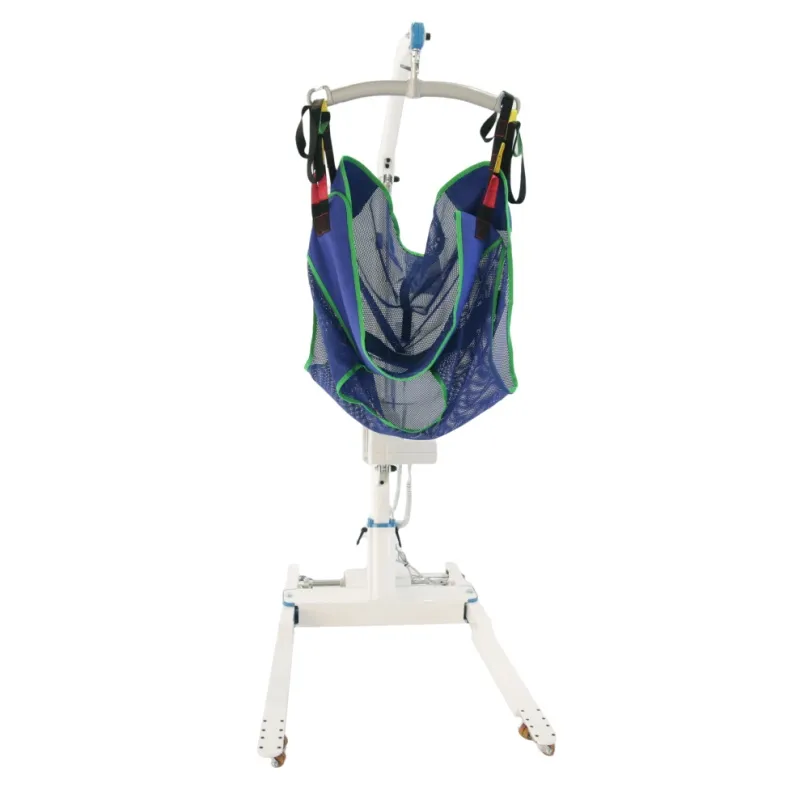
Generally, patients who are completely unable to bear weight, unable to stand independently, unable to maintain a stable sitting posture, and require a significant degree of body support are more likely to need a full-body sling-type electric patient lift.
For example, if a patient is bedridden for an extended period, unable to bear weight on their lower limbs, and unable to stand up independently from the bedside, then forcibly assisting the patient to stand is clearly not an ideal solution. In this case, a full-body sling-type electric patient lift can provide more complete body support.
For heavier patients, high-load-bearing electric patient lifts appropriate for their weight class should be prioritized. Devices with different load ratings are available on the market, such as 150 kg, 180 kg, 200 kg, 250 kg, and even higher, but the actual selection must be based on specific device certifications and the manufacturer's stated safe working load.
For patients requiring head support, the sling design should be a key consideration; for patients requiring frequent toileting, a sling structure suitable for hygiene care can be considered.
However, the choice of equipment should never be based solely on weight. Patient level of consciousness, body proportions, muscle control, skin condition, and cooperation are equally important.
What kind of patients are best suited for sit-to-stand motorized patient transfer machines?
Not all patients require a full-body sling.
Some patients, while unable to walk normally, can still sit steadily and bear some weight on their legs, while also being able to grasp the handles and understand caregiver instructions. These patients may be suitable for sit-to-stand motorized patient transfer machines.
Stand-up assistive transfer machines typically allow patients to gradually transition from a bedside sitting position to a standing or semi-standing position before completing a short transfer.
OSHA's ergonomic guidelines for nursing facilities state that sit-to-stand assistive devices are suitable for patients who bear partial weight, are cooperative, can sit on the bedside, and can bend their hips, knees, and ankles. They can be used for bed-to-chair, chair-to-bed, and transfer scenarios such as toileting and bathing.
This indicates that different patients should use different motorized patient transfer machines.
If a patient is completely unable to bear weight but is misused with a sit-to-stand device, the safety risks increase; conversely, if a patient who can stand actively is always using a large full-body sling, it may reduce their opportunities for independent movement training.
Therefore, professional nursing care is not about "the more powerful the equipment, the better," but rather "the better the equipment matches the patient's needs."
FAQ: Frequently Asked Questions about Transferring a Patient from Bed to Chair Using an Electric Patient Lifter
FAQ 1: Can an electric patient lifter be used if the patient is completely unable to walk?
Yes, but the specific type of equipment needs to be selected based on the patient's condition. Patients who are completely unable to bear weight or cannot maintain a stable sitting posture are generally more suitable for a full-body sling-type electric patient lifter than a sit-to-stand device that requires the patient to stand actively. A professional patient assessment should be conducted before actual use.
FAQ 2: Can a caregiver use an electric patient lifter alone?
It cannot be simply stated in general. Operating procedures may vary depending on the patient, the lifter, and the nursing facility. Some equipment and patient conditions allow for single-person operation by a trained individual, while others require two or more caregivers. Especially for heavier patients, those unable to cooperate, those with poor body control, or those with complex conditions, the required number of personnel should be determined according to the institution's operating procedures and the manufacturer's instructions.
FAQ 3: Is a higher load capacity always better for an electric patient transfer machine?
Not necessarily. The equipment should be selected based on the actual patient weight and usage needs. For example, a patient weighing 80 kg does not necessarily require a 250 kg-class oversized machine. Excessively large equipment may be cumbersome and take up more space. More importantly, the rated load of the equipment, slings, and related accessories must meet the patient's needs.
FAQ 4: Can a patient remain suspended in the air for a long time after being lifted?
Not recommended. Patients should not be suspended in the slings for extended periods. The FDA recommends that patients only remain suspended for the time required to complete the transfer, and that patient comfort, body posture, and sling status be continuously monitored.
FAQ 5: Can an electric patient transfer machine replace caregivers?
No. The Electric Patient Lifter primarily serves for mechanical lifting and assisted movement. Nursing staff still need to be responsible for patient assessment, sling installation, connection checks, equipment control, environmental observation, and patient status monitoring. The equipment is an aid to nursing staff, not a substitute for them.