

Whether in hospitals, nursing homes, rehabilitation centers, or home care settings, assisting patients with limited mobility—such as helping them get out of bed, turn over, transfer, use the toilet, or move to a wheelchair—is a crucial daily task for caregivers. However, traditional methods relying on manual lifting and supporting patients are not only inefficient but also prone to causing lumbar injuries, muscle strain, shoulder and neck pain, and chronic occupational ailments among caregivers.
Data from occupational health studies indicate that the nursing profession is at high risk for musculoskeletal disorders (MSDs), with lower back injuries being the most common occupational health issue. Surveys show that caregivers who frequently handle patients face a significantly higher risk of lumbar injury compared to the general workforce. In some large medical institutions, patient transfer tasks are even a major reason for caregiver absenteeism and turnover. This is particularly true when dealing with heavy patients, paralyzed individuals, post-operative patients, or elderly patients unable to move independently; relying solely on manual strength not only places a heavy physical burden on caregivers but can also compromise patient safety.
It is against this backdrop of industry challenges that electric patient lifters have become an essential component of modern medical care equipment. Utilizing electric motors, mechanical lifting mechanisms, safety sling systems, and smart control technology, these devices enable caregivers to move patients with significantly less physical exertion. This drastically reduces the risk of occupational injuries associated with manual handling while simultaneously improving care efficiency and safety during patient transfers.
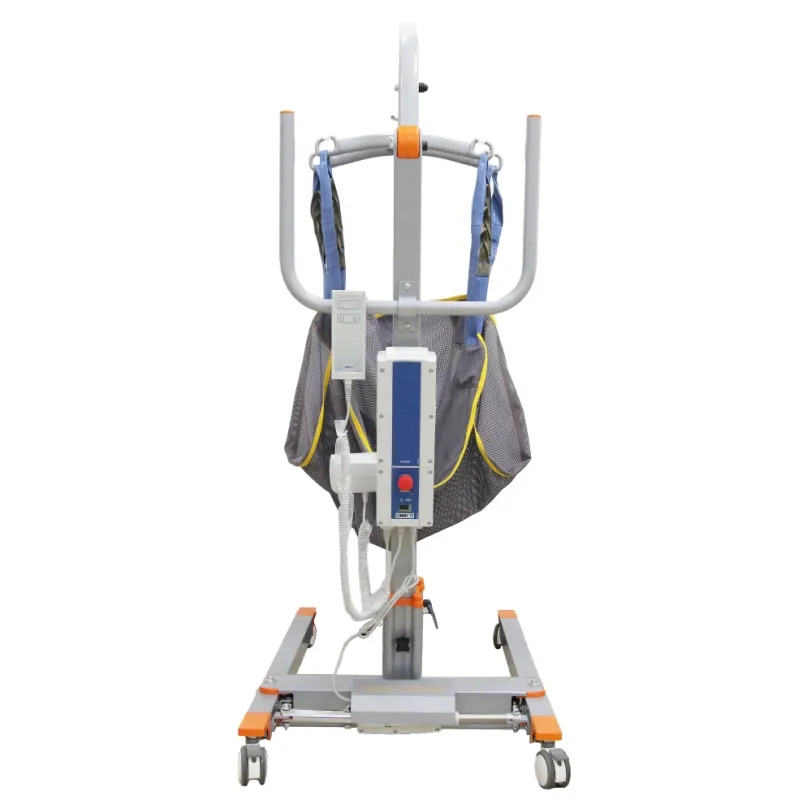
Why Is the Medical Care Industry Prone to Occupational Injuries?
Nursing work is not merely about attending to a patient's daily needs as many might imagine; in reality, caregivers undertake a significant amount of high-intensity physical labor. Patient transfers, movement, and positioning are key areas where occupational injuries occur.
Under traditional care models, when patients need to move from a bed to a wheelchair, from a wheelchair to an examination table, or require repositioning or turning over, caregivers often have to bend, stretch, lift, and sometimes coordinate with others to complete the task. While these actions may appear simple, repetitive performance over the long term places continuous strain on the lumbar spine and joints. The human lumbar spine is already subject to a certain amount of pressure during normal standing; however, when caregivers bend over to lift and move patients while bearing weight, the pressure on the lumbar spine can increase several-fold. If a patient weighs 70 kg or even over 100 kg, it is difficult to completely avoid improper loading, even when two caregivers work together. For instance, when a caregiver bends over at the bedside to lift a patient, the lower back is typically in a flexed position, subjecting the lumbar intervertebral discs to significant compressive force; repeated exposure to this over the long term can lead to issues such as lumbar disc herniation and lumbar muscle strain.
How do electric patient lifters transform traditional manual transfer methods?
The core value of an electric patient lifter lies in using mechanical power to take over the primary load-bearing tasks from the caregiver, shifting the process of patient transfer from "manual lifting" to "equipment-assisted movement."
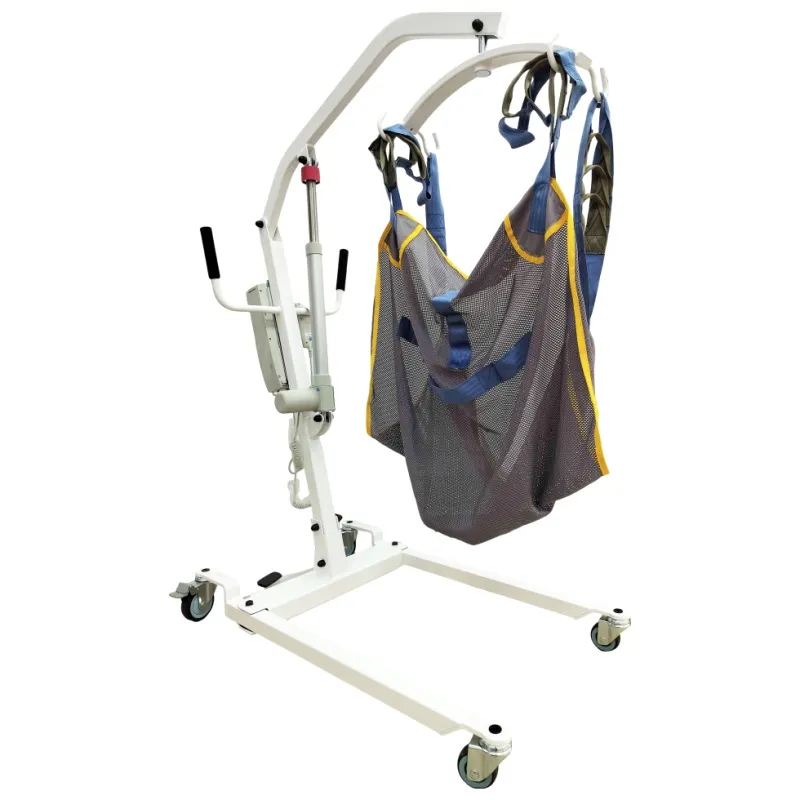
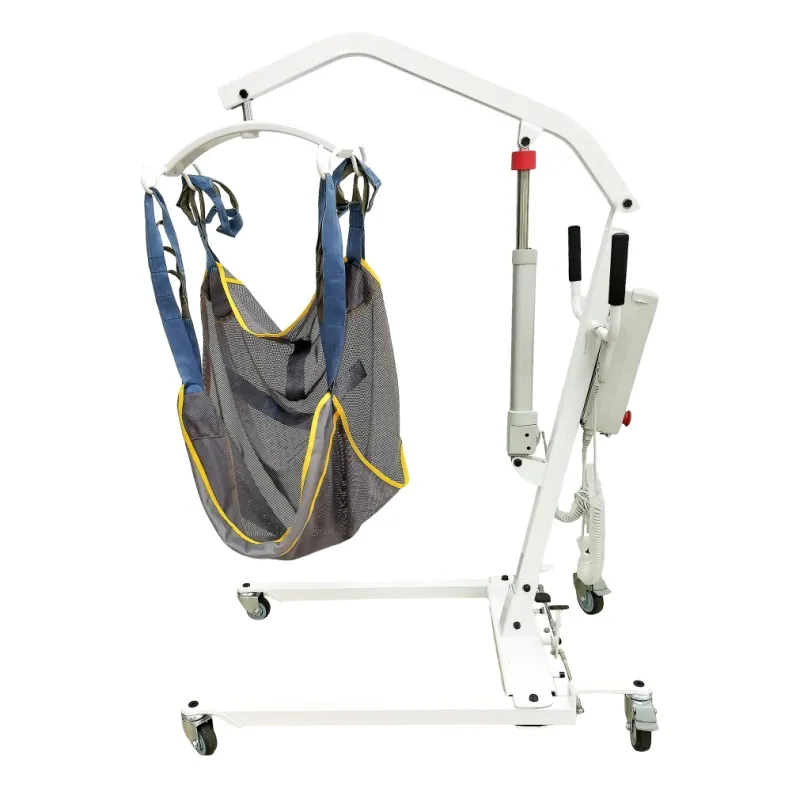
While traditional manual transfer relies primarily on the caregiver's muscular strength, electric patient lifters utilize an electric lifting system, a mobile base structure, and specialized slings to ensure the patient's body weight is borne by the equipment. Caregivers focus on operation, control, and safety assistance rather than directly supporting the patient's weight.
For example, a standard electric patient lifter is typically designed to support a weight range of approximately 150 kg to 250 kg (or more), with some heavy-duty models for critically ill patients capable of supporting over 300 kg. This means caregivers do not need to rely on the strength of their backs and arms to lift patients; instead, they simply press a button to activate the motor and operate the lifting mechanism smoothly.
In practice, the caregiver simply places a suitable transfer sling under the patient, attaches the sling to the lifter's spreader bar, and uses a remote control to manage the lifting and movement. This process minimizes high-risk actions such as bending, pulling, and manual lifting.
This shift not only reduces the physical strain on caregivers but also enhances the standardization of care. In the past, transfer methods varied significantly depending on the individual caregiver's strength and experience; electric patient lifters, however, utilize a fixed mechanical structure to ensure a more stable and safe transfer process.
How do electric patient lifters reduce lower back and musculoskeletal injuries?
Lower back injuries are among the most common occupational hazards for caregivers, and the most direct benefit of an electric patient lifter is the reduction of pressure on the lumbar spine.
Without assistive equipment, caregivers often have to adopt postures such as half-squatting, bending over, or manually lifting and supporting patients to move them. These actions cause sustained tension in the lower back muscles and increase the load on the lumbar spine. Repeating these movements dozens of times a day can lead to chronic injury over time.
When using an electric patient lifter, the patient's weight is primarily borne by the equipment's frame, motor, and load-bearing structure. Caregivers can maintain a more natural standing posture and operate the device via controls, rather than using their own bodies as "lifting tools."
From an ergonomic perspective, reducing manual lifting loads brings improvements in three key areas:
First, it reduces compression on the lumbar spine. Caregivers do not need to bend over for extended periods to lift patients, thereby lowering the risk of abnormal pressure on the lumbar intervertebral discs.
Second, it reduces the strain on shoulders and wrists. During traditional transfers, caregivers often need to grip the patient's body or bedsheets, which can easily lead to rotator cuff injuries, wrist strain, and stress on finger joints.
Third, it minimizes repetitive muscle fatigue. Electric patient lifters handle repetitive lifting and moving tasks, shifting the physical exertion away from the caregiver and onto the machine.
This reduction in repetitive strain is particularly significant in long-term care settings, such as nursing homes, rehabilitation centers, and hospital wards. A single caregiver may need to assist multiple patients with transfers daily; if the manual load—often ranging from tens to over a hundred kilograms—is eliminated during each operation, the long-term benefits for occupational health are substantial.
How do electric patient lifters improve patient transfer safety?
Beyond protecting caregivers, electric patient lifters also enhance patient safety.
A major issue with traditional manual handling is the combination of the patient's limited physical control and the caregiver's finite strength. If a patient suddenly loses their balance or begins to slip, the caregiver may be unable to react or adjust in time.
Electric patient lifters utilize stable spreader bars, specialized slings, and controlled lifting/lowering systems to ensure that patient transfers are carried out in a safe, controlled manner. High-quality equipment often features multiple safety designs, such as:
An electric lifting protection system to prevent impact caused by rapid descent; an emergency stop button to halt operation immediately in abnormal situations; an electrically or manually expandable base to enhance maneuverability and stability; and anti-slip casters to reduce the risk of tipping during movement.
Some advanced models also incorporate intelligent control systems; utilizing low-noise motors and precision control modules, they ensure a smoother lifting process. For patients with limited mobility—such as those with stroke sequelae, spinal cord injuries, or the elderly who are bedridden—this stable method of movement helps alleviate anxiety and improves the overall care experience.
The Value of Electric Patient Lifters in Various Care Settings
Electric patient lifters are not limited to hospital environments; as the demand for home care and elderly care grows, their scope of application continues to expand.
In hospitals, electric patient lifters are primarily used in ICUs, rehabilitation departments, orthopedics, neurology, and long-term care wards. For instance, when a patient needs to be transferred from a hospital bed to diagnostic equipment, a wheelchair, or a rehabilitation area, caregivers can use the lifter to ensure a safe transfer.
In elderly care facilities, many residents experience reduced mobility. Caregivers frequently assist the elderly with transfers between beds and chairs, bathing, and toileting. Without assistive equipment, care efficiency suffers, and staff members are at risk of occupational injuries.
Electric patient lifters are equally significant in home care settings. Family members caring for bedridden elderly individuals or people with disabilities often lack professional training and the physical strength required for safe manual lifting. Using an electric patient lifter alleviates the burden of home care while reducing the risk of injury for both the patient and the caregiver.
FAQ: Common Questions About Electric Patient Lifters
1. Which patients are suitable for electric patient lifters?
Electric patient lifters are primarily designed for patients with reduced mobility who cannot stand independently or perform transfers on their own—such as bedridden elderly individuals, paralyzed patients, those recovering from surgery, stroke patients, and people with disabilities. The specific model should be selected based on the patient's weight, physical condition, and the care environment.
2. Can an electric patient lift replace caregivers?
It cannot completely replace caregivers. The purpose of an electric patient lift is to reduce the physical strain on caregivers and enhance safety during patient transfers, rather than to replace the act of caregiving itself. Caregivers remain responsible for operating the equipment, monitoring the patient's condition, and ensuring safety.
3. What is the maximum weight capacity of an electric patient lift?
Capacity varies significantly by model; common electric patient lifts support between 150 kg and 250 kg, while some heavy-duty units can handle over 300 kg. When purchasing, the appropriate specifications should be selected based on the specific needs of the patient population.
4. Can using an electric patient lift harm the patient?
When properly designed and used correctly, electric patient lifts are generally safer than manual lifting. Features such as specialized slings, stable lifting mechanisms, and safety control systems help minimize risks like falls and collisions.
5. Why are hospitals and elderly care facilities placing increasing importance on electric patient lifts?
The primary reason is the growing concern regarding occupational injuries among caregivers. Electric patient lifts alleviate the physical strain of manual lifting, improve caregiving efficiency, and enhance the working environment for staff, making them essential assistive devices for modern medical and elderly care facilities.