

During the actual purchasing process, a very obvious problem has gradually emerged: Even among electric wheelchairs, different disabled individuals have completely different needs regarding product weight, power, handling, battery life, folding mechanism, seat support, and portability. Especially with the increasing attention given to carbon fiber electric wheelchairs in recent years, which utilize carbon fiber composite materials as the main frame material, offering significant advantages in lightweight design, rigidity, and portability, many users are beginning to focus on a more specific question—which disabled individuals are carbon fiber power wheelchairs actually suitable for?
This question is important because "the lighter the better" does not necessarily mean that an electric wheelchair is suitable for every user. For those who need to use an electric wheelchair daily, the overall weight is indeed crucial; however, for those who need to travel long distances outdoors, battery capacity, motor torque, tire size, and chassis stability may be equally important.
For people with disabilities who have limited upper limb strength, the position of the joystick, the sensitivity of the controller, and the steering logic are even more important than the frame material. For those who need frequent assistance from family members to carry their electric wheelchairs, a carbon fiber electric wheelchair that can be quickly folded, is lightweight, and easily fits in a car trunk may be far more valuable than a heavier but more powerful traditional electric wheelchair.
The US FDA defines a powered wheelchair as a battery-powered medical device designed to assist people with mobility impairments who require seated mobility aids, classifying it as a Class II medical device under 21 CFR 890.3860, Product Code ITI. FDA-approved standards also cover various aspects of electric wheelchairs, including energy consumption, size and weight, stability, power, and control systems. Therefore, choosing a carbon electric wheelchair should not solely focus on the word "carbon fiber," but should be based on the user's functional needs and the overall engineering performance of the vehicle.
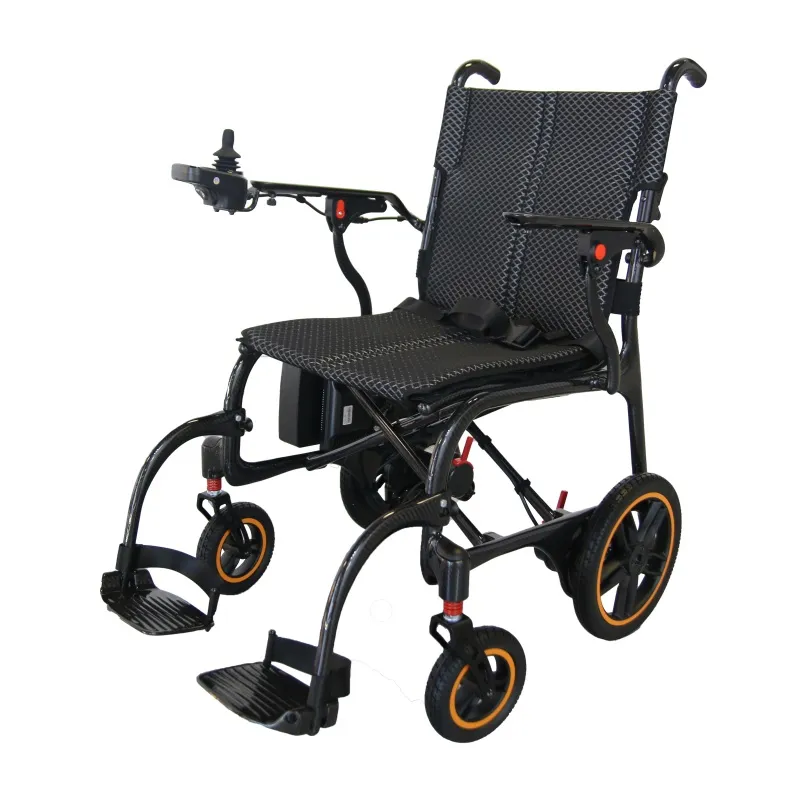
Why are people with disabilities increasingly focusing on lightweight carbon electric wheelchairs?
One of the biggest pain points of traditional electric wheelchairs is their weight. A typical electric wheelchair requires two drive motors, a battery, a controller, a frame, a seat, tires, and other structural components, resulting in a total weight that can reach tens of kilograms or even higher. While driving may not be difficult for users capable of operating the wheelchair independently, the weight becomes a significant issue when loading it into a car, carrying it up stairs, loading it onto an airplane, or undertaking long-distance travel.
Assuming a traditional electric wheelchair weighs 35 kg, while a lightweight carbon fiber power wheelchair weighs around 20 kg, the difference of 15 kg represents a reduction of approximately 43% in overall weight. For users capable of independent mobility, this difference is not merely numerical but directly impacts loading, handling, and the overall travel experience.
Currently, carbon fiber frame electric wheelchair products are already documented in publicly available FDA 510(k) filings. For example, a certain carbon fiber frame Power Wheelchair uses a 24V, 250W×2 brushless DC motor, a 24V lithium battery, and an electromagnetic braking system. It has undergone stability, braking, energy consumption, strength, obstacle climbing, and power control tests according to the ISO 7176 series. Its publicly available information also explicitly compares the carbon fiber frame with an aluminum alloy frame, pointing out that the carbon fiber structure allows for a lighter overall vehicle design.
This demonstrates that carbon fiber electric wheelchairs are not simply replacing the metal frame of a traditional wheelchair with another material; rather, they have become a practical engineering solution for lightweight electric mobile devices.
What are the advantages of carbon electric wheelchairs?
The most obvious advantage of carbon fiber is its lightweight potential.
Carbon fiber composites have high specific strength and specific stiffness. Therefore, while meeting structural strength requirements, some structural weight can be reduced through reasonable laminated structures and frame design. For electric wheelchairs, reducing the frame weight also has the potential to reduce the overall vehicle weight.
However, the advantages of carbon fiber electric wheelchairs are not limited to "lightness."
The second advantage is stiffness.
A superior carbon fiber frame can maintain high stiffness in specific stress directions through fiber layup direction, material thickness, and structural design. This is significant for the handling and structural response of electric wheelchairs.
The third advantage is portability.
For people with disabilities who frequently travel by car, plane, or public transportation, folded size and weight are crucial. If a carbon fiber power wheelchair can compress its volume through a folding structure while maintaining low weight, it can reduce the transportation burden on users and caregivers.
The fourth advantage is design freedom.
Carbon fiber composites can be formed into different structural forms through molding, lamination, and other processes, allowing manufacturers to design products focusing on lightweighting, stiffness, and ergonomics.
However, it is important to emphasize that carbon fiber does not inherently mean "infinite strength" or "more durable than metal in all environments." Carbon fiber is a composite material, and its damage mode differs from that of metals such as aluminum alloys and steel. Localized impacts, joint area design, fiber layup, and manufacturing processes all affect the final performance. Therefore, the real focus should be on engineering-proven carbon fiber power wheelchairs as a whole, rather than simply purchasing products "made of carbon fiber materials."
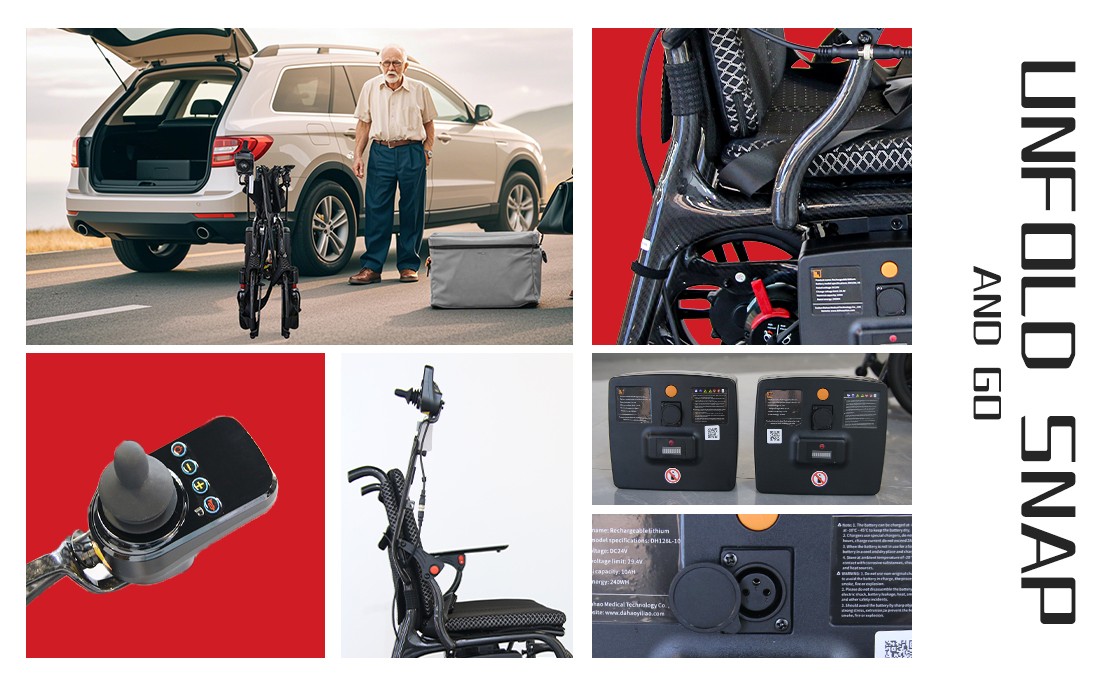
The first group suitable for carbon electric wheelchairs: People with disabilities who frequently travel and go out
For people with disabilities who frequently travel, carbon fiber electric wheelchairs can have very significant practical value.
For example, some users need to commute by car daily and visit shopping malls, parks, hospitals, or participate in social activities on weekends. If family members have to carry the electric wheelchair from the room to the trunk of the car every time they go out, the overall weight will become a long-term problem.
Even if traditional heavy-duty electric wheelchairs have excellent driving performance, their weight can reduce the user's freedom of movement.
Lightweight carbon fiber electric wheelchairs are generally more suitable for this kind of mobility scenario. In particular, carbon fiber electric wheelchairs with a quick-folding structure can shrink in size when not in use, making them easy to store in a car trunk.
It is important to note that "lightweight" does not mean that all carbon fiber electric wheelchairs can be lifted by one hand. The weight of carbon fiber electric wheelchairs on the market can vary greatly, ranging from a dozen kilograms to over twenty kilograms or even more. Therefore, when purchasing, you should directly check the product's net weight, and not judge the weight solely based on "carbon fiber."
For users who travel frequently, it's also important to confirm the folding dimensions, whether the battery is removable, the battery type, charging method, and relevant air transport requirements.
The second group suitable for carbon electric wheelchairs: Individuals with limited upper limb strength but capable of independent driving
Many people believe that electric wheelchairs primarily address leg mobility impairments, but in reality, the functional status of people with disabilities varies greatly.
Some people cannot walk normally with their lower limbs, but have good upper limb control and can independently drive an electric wheelchair using a joystick. For these users, lightweight carbon fiber electric wheelchairs can reduce the burden of transportation and daily management.
However, if the user has limited upper limb strength, it's not enough to only focus on the frame weight; the controller design also needs attention.
For example, how much force is required to operate the joystick? Is the sensitivity adjustable? Can the controller be installed on the left or right side? Can it be customized through a special control interface? After releasing the joystick, can the vehicle smoothly decelerate and automatically brake?
These questions are very important for people with disabilities.
Publicly available regulatory data on carbon fiber power wheelchairs shows that these products typically use joysticks to control speed and direction and are equipped with automatic electromagnetic braking systems. Some products use 24V, 150W×2 or 250W×2 brushless DC motors.
This indicates that the design focus of modern carbon fiber power wheelchairs is no longer just on a lightweight frame, but on integrating a lightweight frame, motor, controller, battery, and braking system into a complete electric mobility system.
The third group suitable for carbon electric wheelchairs: Individuals who require frequent wheelchair transport by family members
For some people with disabilities, the real difficulty is not driving, but "lifting the wheelchair."
If the user cannot load the electric wheelchair into the vehicle, then a family member must undertake the task of transporting it. Assuming a traditional electric wheelchair weighs 40 kg, while a lightweight carbon fiber electric wheelchair weighs 20 kg, the transport weight is reduced by half. This difference is very significant for people who need to be transported daily.
Especially in situations without ramps, electric tailgates, or high vehicle trunk height, the weight of the wheelchair directly affects whether family members are willing to frequently take the user out.
Therefore, the lightweight advantage of carbon fiber electric wheelchairs is particularly significant for home care scenarios.
Of course, family members still need to consider their own carrying capabilities when choosing a product. If the device is advertised as lightweight, but the battery is non-removable, the folding structure is complex, or the center of gravity is unbalanced after folding, the actual carrying experience may still be unsatisfactory.
Therefore, it is recommended to compare both the "overall weight" and the "weight of detachable components" when purchasing.
For example, if a product weighs 20 kg, but the battery is removable, the weight might be only 17 kg after removing the battery, making it much easier to carry. The specific weight must be based on the manufacturer's product specifications.
The fourth group suitable for carbon electric wheelchairs: People who frequently use cars for transportation
For disabled people who need to travel by car, the ease of loading the wheelchair into the car is a very real issue.
If the electric wheelchair cannot be folded, or is still bulky after folding, even if the product has excellent driving performance, it may limit the user's travel options.
Carbon fiber folding electric wheelchairs have a significant advantage in this regard. The combination of a lightweight frame and a folding structure can simultaneously reduce weight and transport volume.
For ordinary sedans, trunk space is usually limited. Therefore, users should measure the trunk opening height, width, and depth before purchasing and compare these figures with the dimensions of a folded carbon fiber power wheelchair.
For example, a wheelchair with a folded length of approximately 700–900 mm and a width of approximately 350–500 mm may fit well in the trunk of some vehicles, but the actual fit depends on the vehicle's structure.
This is why "folded dimensions" should be considered in conjunction with "overall vehicle weight," rather than just one indicator.
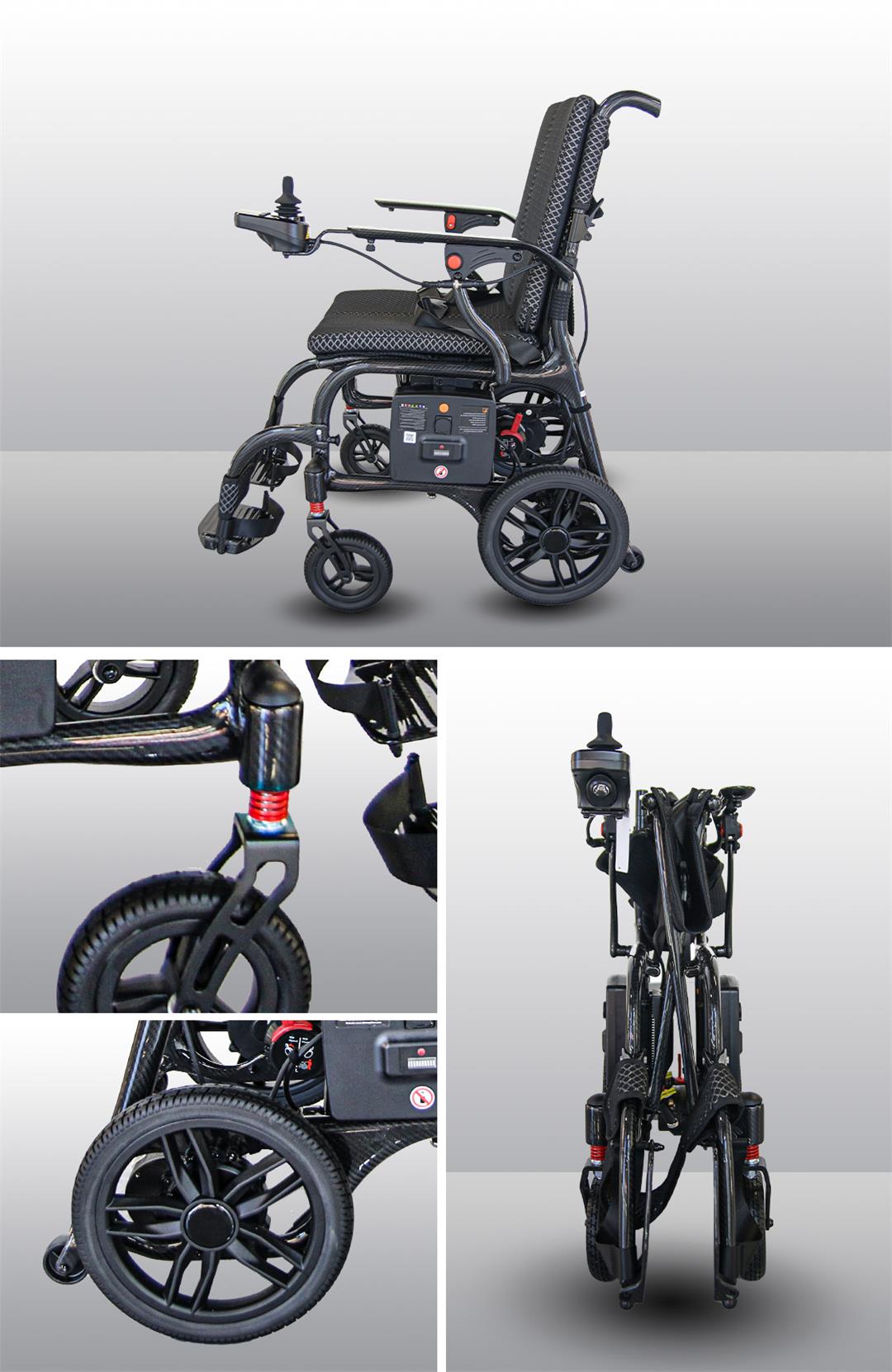
The fifth group suitable for carbon electric wheelchairs: People with disabilities who wish to maintain a high degree of independence
One of the greatest values of electric wheelchairs for people with disabilities is helping them regain mobility.
For individuals with limited lower limb function but sufficient cognitive and upper limb control abilities, being able to drive an electric wheelchair to the kitchen, shopping mall, office, hospital, or outdoor environments is itself an important component of independent living.
Lightweight carbon fiber electric wheelchairs further reduce barriers to transportation and storage, making them particularly suitable for users who value independent mobility.
For example, users can operate the joystick themselves to move around indoors, and then have family members assist in loading the folded electric wheelchair into the vehicle. The entire process is easier than moving a large, heavy electric wheelchair.
Of course, autonomous driving still requires users to have sufficient visual, cognitive, and upper limb control abilities. For those unable to safely operate the joystick, assistance from caregivers may be necessary, or a specialized electric wheelchair with appropriate control mechanisms may be required.
The sixth group suitable for carbon electric wheelchairs: People with disabilities requiring both indoor and outdoor use
Carbon fiber electric wheelchairs are often designed for both indoor and outdoor use, but this should not be interpreted as "all carbon fiber power wheelchairs are suitable for outdoor use."
Indoor environments require electric wheelchairs with a small turning radius, reasonable body width, precise low-speed control, and flexible maneuverability.
Outdoor environments are more complex, requiring handling of ramps, road seams, gravel, paved surfaces, grass, and varying weather conditions.
Therefore, a carbon fiber electric wheelchair truly suitable for both indoor and outdoor use needs to strike a balance between lightweight design and chassis performance.
For example, some publicly available FDA data shows that carbon fiber electric wheelchairs use approximately 7-inch front wheels and 12-inch rear wheels, dual brushless motors, electromagnetic brakes, and 24V lithium batteries, and have undergone ISO 7176 series tests, including stability, braking, obstacle climbing, and power control.
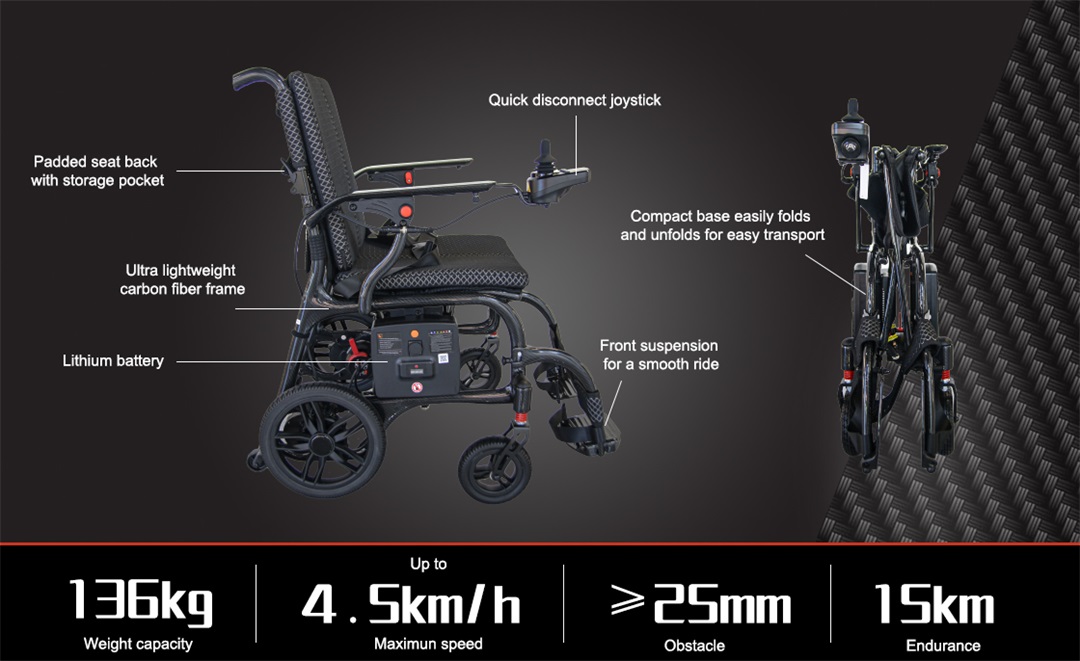
Other publicly available data indicates that a carbon fiber electric wheelchair can have a maximum load capacity of 136 kg, with an obstacle clearance of approximately 40 mm and a maximum safe operating slope of 9° as relevant performance indicators.
This data helps consumers understand a key issue: lightweight electric wheelchairs still need sufficient chassis performance, but specific parameters must be determined based on actual product testing results; data from one product cannot be directly applied to all carbon fiber electric wheelchairs.
Which disabled individuals may not be suitable for overly lightweight carbon electric wheelchairs?
Every product has its applicable limits, and carbon fiber electric wheelchairs are no exception.
First, for heavier users, the maximum load capacity needs to be a key focus. If the user's weight is close to the product's rated load limit, then purchasing a particular model simply because "carbon fiber is lighter" is not reasonable.
For example, if an electric wheelchair has a maximum load capacity of 136 kg, then in actual use, it's crucial to ensure that the user's weight and any carried items do not exceed the manufacturer's specified limits. While publicly available FDA data does show examples of carbon fiber power wheelchairs with a maximum load capacity of 136 kg, this is a specific product parameter and does not represent the same load-bearing capacity for all carbon fiber power wheelchairs.
Secondly, for individuals frequently using the wheelchair on challenging outdoor terrain, tires, ground clearance, motor torque, climbing ability, and stability are key considerations. If the product is primarily designed for lightweight urban and outdoor use, it should not be used as a heavy-duty outdoor off-road electric wheelchair.
Thirdly, for individuals requiring special seat support, the frame material should not be the sole focus. If the user has significant trunk control issues and requires lateral support, head support, a special seat cushion, or tilting functionality, then the seat system may be more important than lightweight design.
Fourthly, for individuals unable to independently control the joystick, it's necessary to assess whether alternative control methods are available. Some users may require customized controllers, special joysticks, or other assistive input methods.
Therefore, there is no single, universally applicable answer to the question of "which disabled individuals are suitable for carbon fiber electric wheelchairs?"
FAQ: Common Questions about Carbon Fiber Electric Wheelchairs
FAQ 1: Are carbon fiber electric wheelchairs suitable for all people with disabilities?
No. Carbon fiber electric wheelchairs are more suitable for users who need electric mobility assistance and value lightweight, portability, folding, and car transport. For users who require special seat support, high load capacity, or complex outdoor maneuverability, a specialized model should be selected based on specific needs.
FAQ 2: How much do carbon fiber electric wheelchairs typically weigh?
Weight varies greatly between products and cannot be judged solely by "carbon fiber." Lightweight products may be around 20 kg or even less, while some products with large-capacity batteries, complex seats, and more powerful power systems may be significantly heavier. When purchasing, you should directly check the manufacturer's published net weight, weight including battery, and weight after battery removal.
FAQ 3: Are carbon electric wheelchairs suitable for heavier people with disabilities?
Suitable products exist, but the specific maximum load capacity must be checked. Publicly available FDA data includes cases of carbon fiber power wheelchairs with a maximum load of 136 kg, but this is only a parameter for specific products and does not represent all carbon fiber electric wheelchairs.
FAQ 4: Are carbon fiber electric wheelchairs safe?
Safety depends on the overall vehicle design, manufacturing quality, usage, and applicable environment, not solely on the carbon fiber material. Legitimate electric wheelchairs should undergo relevant tests including stability, braking, strength, energy consumption, power control, and obstacle climbing. FDA publicly available information shows examples of carbon fiber power wheelchairs undergoing multiple performance tests according to the ISO 7176 series.
FAQ 5: Are carbon electric wheelchairs better than aluminum alloy electric wheelchairs?
There is no absolute superiority or inferiority between the two. One of the main advantages of carbon fiber is its lightweight potential, while aluminum alloy has mature technology, relatively controllable costs, and ease of processing. For users who travel frequently and need to move things, carbon fiber may be more attractive; for users who prioritize economy, ease of maintenance, or specific structural performance, aluminum alloy may also be a reasonable choice.