

With the accelerating pace of global population aging and the increasing number of people with chronic diseases, post-operative rehabilitation, and mobility impairments, how to safely and efficiently transfer patients has become a crucial issue that hospitals, nursing homes, and home care institutions must address. In actual care, many patients are not completely immobile, but rather unable to independently transfer from bed to wheelchair, from wheelchair to toilet, or from sofa to nursing bed. These seemingly simple actions have long troubled caregivers and their families.
Traditional manual lifting methods have significant drawbacks. On the one hand, as patients gain weight, the difficulty of single-person transport increases rapidly, making it difficult for a single caregiver to perform repetitive transfers safely and consistently. On the other hand, incorrect lifting postures can easily cause patients to fall or slip, and can also lead to lumbar, shoulder, neck, and muscle strain problems for caregivers. Especially in high-frequency care environments such as nursing homes and rehabilitation centers, where dozens of patient transfers may need to be performed daily, relying entirely on manual labor is not only inefficient but also poses a long-term risk of occupational injuries.
Patient lift transfer chairs are a type of professional nursing aid developed to meet this industry demand. They use mechanical structures to help caregivers lift, move, and reposition patients, significantly reducing the burden of manual handling. Currently, patient lift transfer chairs on the market are mainly divided into two types: electric lift transfer chairs powered by batteries and motors, and hydraulic lift transfer chairs that do not require batteries and use a manual hydraulic system for lifting and lowering. While both ultimately aim to improve patient transfer safety, they differ significantly in their power source, operating costs, maintenance methods, and suitable scenarios.
Many consumers have a very practical question when purchasing a patient lift transfer chair:
"Can the device still work without batteries?" The answer is yes. Hydraulic lift transfer chairs can operate normally without batteries or charging. Hydraulic lift transfer chairs convert mechanical force into lifting power through manual operation of a hydraulic pump, thus adjusting the patient's seat height and not relying on a power system. Some manual hydraulic patient transfer devices use foot pedals or handle hydraulic mechanisms, allowing for patient transfer assistance without motors or batteries.
So, how exactly does a patient lift transfer chair work without batteries? Why doesn't a hydraulic lift transfer chair need electricity? What are the differences between it and an electric lift transfer chair? How should home care and medical institutions choose between them? This article will provide a comprehensive analysis from the perspectives of device principles, structural design, usage scenarios, safety performance, and future development trends.
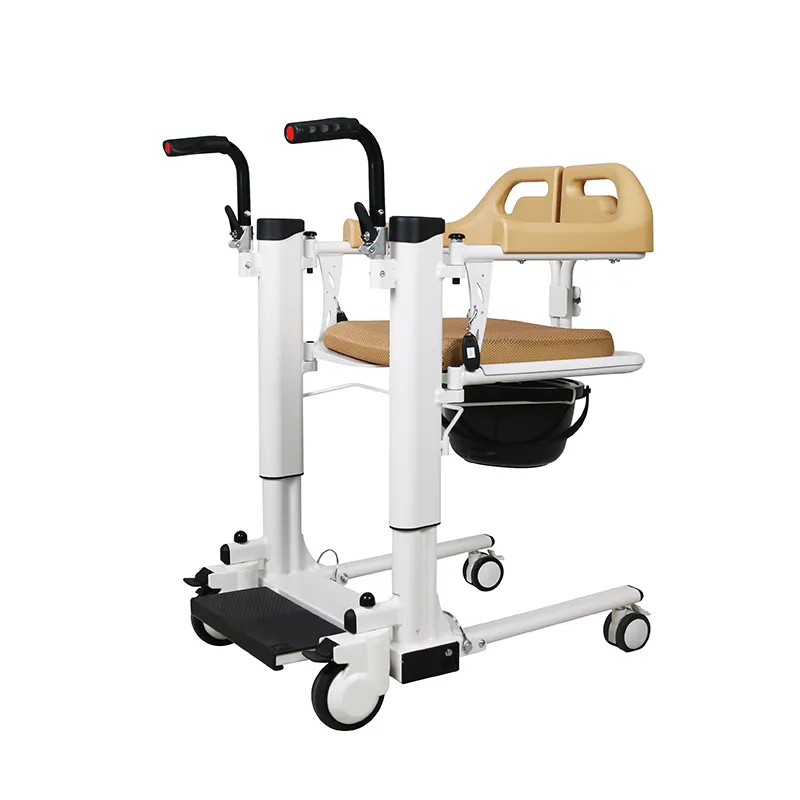
Why does the question of whether a patient lift transfer chair needs batteries arise?
In recent years, with the development of intelligent nursing equipment, many users have become accustomed to electric products. For example, electric wheelchairs, electric nursing beds, and electric lifting tables are all powered by motors and batteries. Therefore, when consumers first encounter a patient lift transfer chair, they easily assume that this device must also rely on batteries to operate.
In reality, the development path of patient lift transfer chairs has not been solely based on electrification. Early patient transfer equipment largely used mechanical structures, with hydraulic systems being a very mature solution. Only in recent years, with the decrease in motor costs and the improvement of battery technology, have electric lift transfer chairs gradually become more widespread.
The working method of an electric lift transfer chair is relatively straightforward: The battery provides electrical power, the controller receives button commands, and then drives the motor to propel the lifting mechanism. For example, a common 24V electric lifting system raises and lowers the seat via an electric push rod. Caregivers only need to press a control button to complete the patient transfer.
The biggest advantage of this method is its labor-saving nature. For hospitals and nursing homes that frequently transfer patients, the electric lift transfer chair significantly reduces the physical exertion of caregivers.
However, electric systems also have some practical problems. First, the battery needs to be charged regularly; if it is not charged for a long time, the device may not be able to complete the lifting operation. Second, the battery, motor, controller, and wiring system require maintenance. Additionally, the flexibility of electric equipment is affected in environments with power outages, temporary outdoor care, or limited power supply.
Therefore, although the electric lift transfer chair improves automation, the nursing industry still needs a simpler, more stable, and electricity-independent solution, which is a major reason why the hydraulic lift transfer chair has persisted for so long.
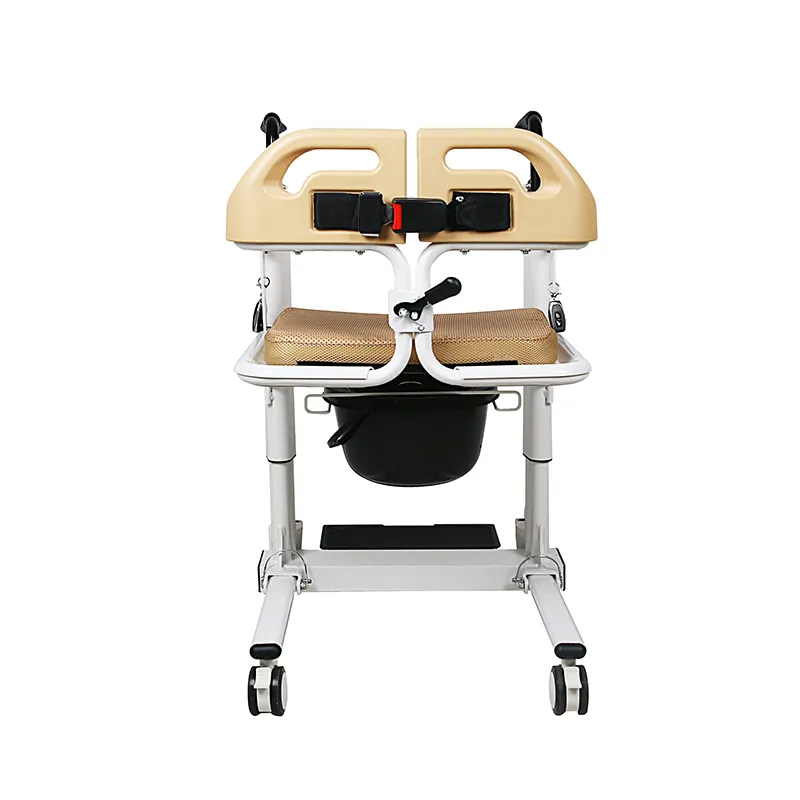
Why doesn't the hydraulic lift transfer chair need batteries?
The core technology of the hydraulic lift transfer chair is hydraulic transmission.
Simply put, the hydraulic system utilizes the incompressibility of liquids to amplify force through pressure transmission. Nurses only need to operate a handle or foot pedal to pump hydraulic oil into the cylinder, causing the piston to move and thus raising or lowering the frame or seat.
A typical hydraulic lift transfer chair usually includes the following components:
Hydraulic cylinder: responsible for generating the lifting force;
Hydraulic pump: responsible for building pressure;
Mechanical support frame: responsible for supporting the patient's weight;
Cast system: responsible for moving the device;
Locking mechanism: ensures stability during the transfer.
Its operation can be simply understood as: Nurses apply force → Hydraulic pump generates pressure → Hydraulic oil pushes the piston → Lifting mechanism moves → Patient position adjustment is completed.
The entire process does not require:
Batteries;
Motors;
Chargers;
Electronic control modules.
Therefore, the biggest feature of a hydraulic lift transfer chair is its "readiness." Even if the device is left unused for a long time, as long as the mechanical structure is normal and the hydraulic system is not damaged, basic lifting operations can still be performed. Some manual hydraulic patient lift devices on the market explicitly adopt a zero-electricity design, using a manual pump to complete the lifting and lowering, requiring no batteries or charging.
This is very important for home care environments. For example, some elderly people require home care during the day and occasionally need assistance with bed-to-chair transfers. If the device is only used infrequently, checking the battery level and waiting for charging before each use adds inconvenience. A hydraulic lift transfer chair, however, can be used immediately.
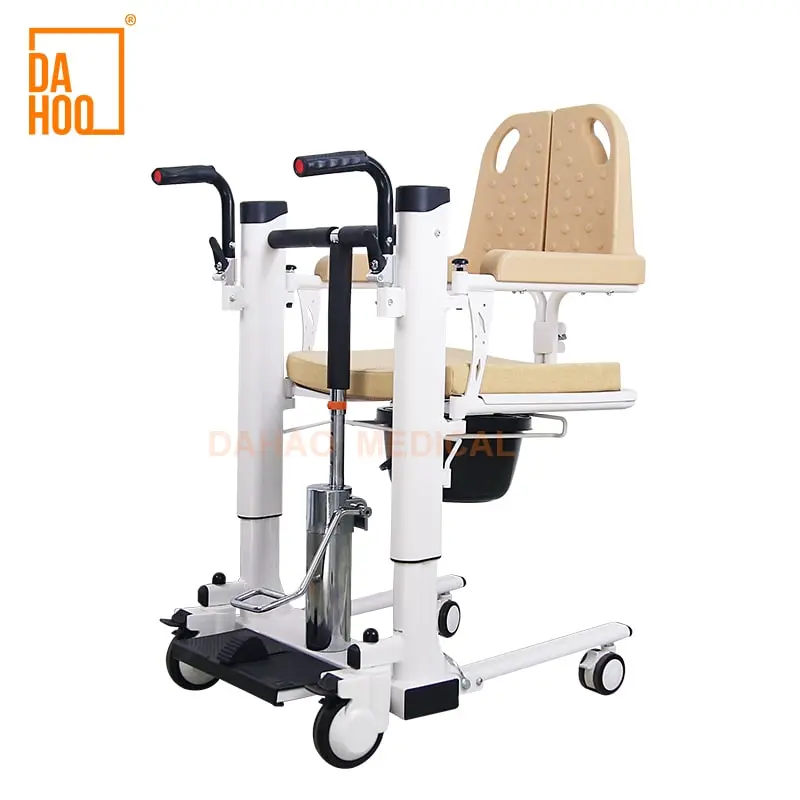
What nursing tasks can a battery-free lift transfer chair perform?
Many people believe that devices without batteries have limited functionality, which is a major misconception about hydraulic lift transfer chairs.
In fact, hydraulic lift transfer chairs can perform many common nursing tasks, including: bed-to-wheelchair transfers; wheelchair-to-toilet transfers; bed-to-sofa transfers; assisting patients to sit up; and assisting with standing exercises.
Some multi-functional hydraulic lift transfer chairs also incorporate features such as a commode chair and a shower chair, meeting various needs in home care. For example, some manual hydraulic transfer chairs feature an open seating design, allowing patients to easily enter the device from the bedside, adjust the height, and then move to the target position.
However, it's important to note that different types of patients require different lift transfer chairs.
For example: For patients who can partially stand and still have some leg support, a standing-assisted hydraulic lift transfer chair can be chosen.
For patients who are completely unable to bear weight and are bedridden for extended periods, a full-body support patient lift device with a sling system may be necessary.
Therefore, when choosing a patient lift transfer chair, one should not only consider whether it has electricity, but also choose a structure suitable for the patient's physical condition.
What is the difference between a hydraulic and an electric lift transfer chair?
Although both hydraulic and electric lift transfer chairs are patient transfer devices, their design philosophies differ.
Electric lift transfer chairs prioritize automation.
The advantages of electric lift transfer chairs are mainly reflected in: Simple operation; Automatic lifting process; Low strength requirement for caregivers; Suitable for high-frequency use.
For example, in large nursing homes, a caregiver may need to assist multiple patients with transfers each day. Manually operating the hydraulic pump each time would increase the workload in the long run; therefore, an electric lift transfer chair better meets the needs of high-efficiency care.
Hydraulic lift transfer chairs, on the other hand, prioritize reliability and simplicity.
The advantages of hydraulic systems include: no batteries required; no charging required; low maintenance costs; and fewer points of failure.
For home care users, hydraulic lift transfer chairs are highly practical. Many families don't use the device dozens of times a day, but rather to assist elderly people in transferring to other areas under specific circumstances. In these situations, the non-electric structure is more convenient.
From a cost perspective, electric lift transfer chairs are generally more expensive due to the added motor, battery, and control system, and the long-term cost of battery replacement must be considered. Hydraulic lift transfer chairs, on the other hand, have a relatively simple structure, and long-term maintenance costs are usually lower.
Is a hydraulic lift transfer chair safe? What is its load-bearing capacity?
Safety is the most important concern for all lift transfer chair users.
Many people wonder: "Without a motor, is the hydraulic force sufficient?"
In fact, hydraulic systems have a very strong force amplification capability. Many industrial devices use hydraulic drives because hydraulics can generate a large output force with a small input force.
The load-bearing capacity of patient lift transfer chairs on the market generally varies depending on the design:
Home care type: Approximately 100kg–150kg;
Advanced care type: Approximately 150kg–200kg;
Professional institutional type: Some products can reach over 200kg.
The specific load-bearing capacity depends on:
Frame material;
Hydraulic cylinder specifications;
Chassis width;
Casing structure;
Safety lock design.
A qualified patient lift transfer chair needs to consider not only static load-bearing capacity but also the dynamic usage environment.
For example:
Patient weight 100kg;
Equipment weight 40kg;
Additional impact during movement.
Therefore, the structural design needs to have a higher safety margin.
Furthermore, correct operation is also a crucial safety factor. When using a patient lift transfer chair, caregivers should pay attention to:
Ensure the casters are locked;
Check the seat fixing structure;
Ensure the patient's sitting posture is stable;
Complete the lifting and lowering movements slowly.
No nursing equipment can completely replace proper operation; equipment safety and proper usage are equally important.
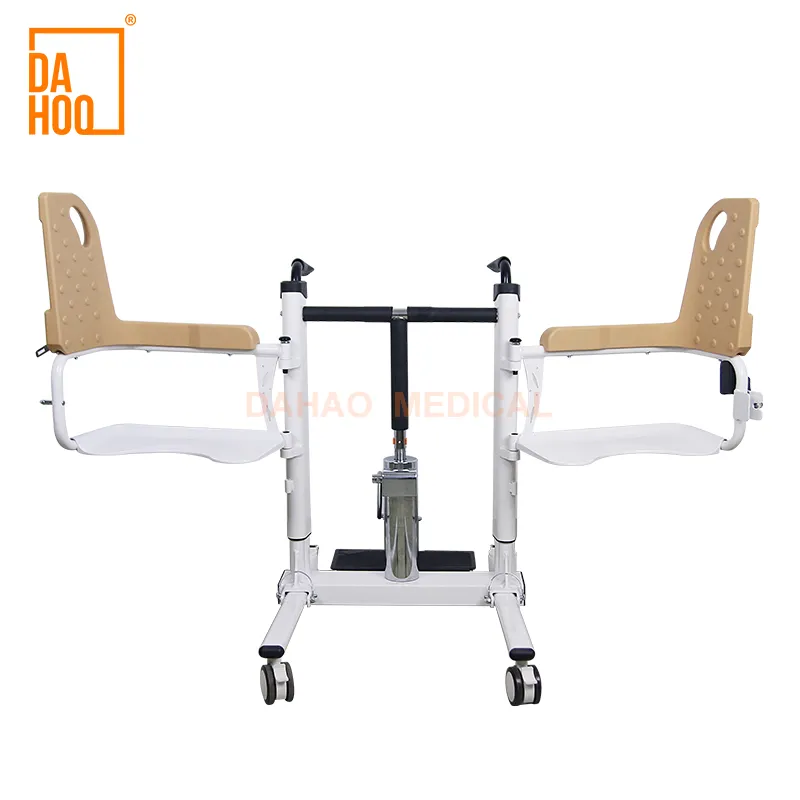
Which scenarios are more suitable for using a hydraulic lift transfer chair?
A hydraulic lift transfer chair is not a simple replacement for an electric lift transfer chair; it has its own advantageous application scenarios.
First, home care environments.
For families caring for elderly relatives or family members with limited mobility, a hydraulic lift transfer chair eliminates the need to worry about charging; the device is always ready to use.
Second, small nursing homes.
Some nursing homes have a limited number of patients but still require reliable care equipment. A hydraulic lift transfer chair can serve as a daily care tool or a backup device.
Third, environments with limited power.
For example, in some special care settings or temporary medical areas, where a continuous power supply cannot be guaranteed, a non-electric hydraulic device is more reliable.
Fourth, as a backup solution for electric equipment.
Some large medical institutions typically deploy both electric and hydraulic equipment. Electric equipment is used for high-frequency tasks, while hydraulic equipment is used for power outages or as an emergency backup.
FAQ: Frequently Asked Questions about Patient Lift Transfer Chairs and Hydraulic Lift Transfer Chairs
Q1: Can the patient lift transfer chair still raise and lower without batteries?
Yes. If a hydraulic lifting mechanism is used, the patient lift transfer chair does not require batteries; lifting and lowering can be achieved manually or by foot-operated hydraulic pump.
Q2: Does the hydraulic lift transfer chair require electricity?
No. The hydraulic lift transfer chair has no motor or battery system and does not rely on a power source.
Q3: Is the hydraulic lift transfer chair suitable for patients who are completely immobile?
It depends on the specific structure. Some hydraulic devices are suitable for patients requiring standing assistance, while some patient lifting devices with sling systems can support more types of patients. Before choosing, the weight capacity and applicable range of the device should be confirmed.
Q4: Is an electric lift transfer chair safer than a hydraulic lift transfer chair?
Not necessarily. The safety of both depends mainly on design quality, usage, and whether it meets the patient's needs. Electric devices require less effort, while hydraulic devices have a simpler structure; each has its advantages.
Q5: What is the biggest advantage of the hydraulic lift transfer chair?
The biggest advantage is that it does not require batteries; the device will not stop working due to a lack of power. It also has a simple structure and is easy to maintain, making it suitable for home care and backup care scenarios.
Q6: Can a patient lift transfer chair reduce injuries to caregivers?
Yes. Proper use of a patient lift transfer chair can reduce the pressure on the lower back and shoulders caused by manual lifting, improving safety during patient transfers.
