

The aging of the population all over the globe will soon be one of the major problems of humankind. On the other hand, the demand for living independently and high-quality travels will be even bigger. As a result, electric wheelchairs are now not only the traditional assistive mobility devices, but also the important rehabilitation tools, incorporating the features of lightweight construction, intelligent control, safety protection, and comfort.
Among all the various electric wheelchair models, carbon fiber electric wheelchairs have become a hot item among consumers, hospitals, and professional caregivers because of their advantages in materials and manufacturing methods.
People with mobility impairments and limitations of any age, as well as recovering from operations or needing wheelchair support over an extended period of time, have the possibility to buy a quality carbon fiber electric wheelchair not only as a means of transport but rather as a lifestyle choice of being freer, safer, more secure, and more reliable. But there is a lot to know and different things to consider. First, carbon fiber electric wheelchairs are available in a variety of types with big differences between companies regarding characteristics such as weight, battery, motor, battery life, folding mechanism, maximum load, intelligent functions, etc.
If buyers only pay attention to the price, the external look, or even the brand of the wheelchair, chances are high that they end up buying only a product satisfying their looks only and not really being their perfect match.
Many people have such difficulties while buying wheelchairs made of carbon fiber: Is the quality of carbon fiber really higher than that of aluminum alloy? Is the lighter electric wheelchair the better one? Is the greater battery life the longer the range? How to select the power of motor? Why is the size when folded so critical? These all are directly related to the usage of your electric wheelchair.
From the point of view of a professional, an excellent carbon fiber electric wheelchair has to be able to provide a harmonious compromise in various parameters such as structural robustness, overall weight, drive performance, battery mileage, driving comfort, safety features, and ergonomic comfort. If all these aspects are addressed together then only will the end-result have you pick out a product that you will be able to keep going for a long time without having regrets.
According to the assistive device market, a segment of lightweight electric wheelchairs is emerging very fast right now.
Even though traditional steel electric wheelchairs offer excellent structure characteristics, the weight restricts them in mobility, transportation, storage aspects, as well as to daily handling. On the contrary, electric wheelchairs manufactured in carbon fiber retain structure strength but dramatically cut down weight which means they will be a good option for people who regularly travel, car travel, or need more convenience.
Therefore, when you buy a carbon fiber electric wheelchair you should do some background research into the main features and specifications of the product rather than simply rely on a word label or the word carbon fiber.
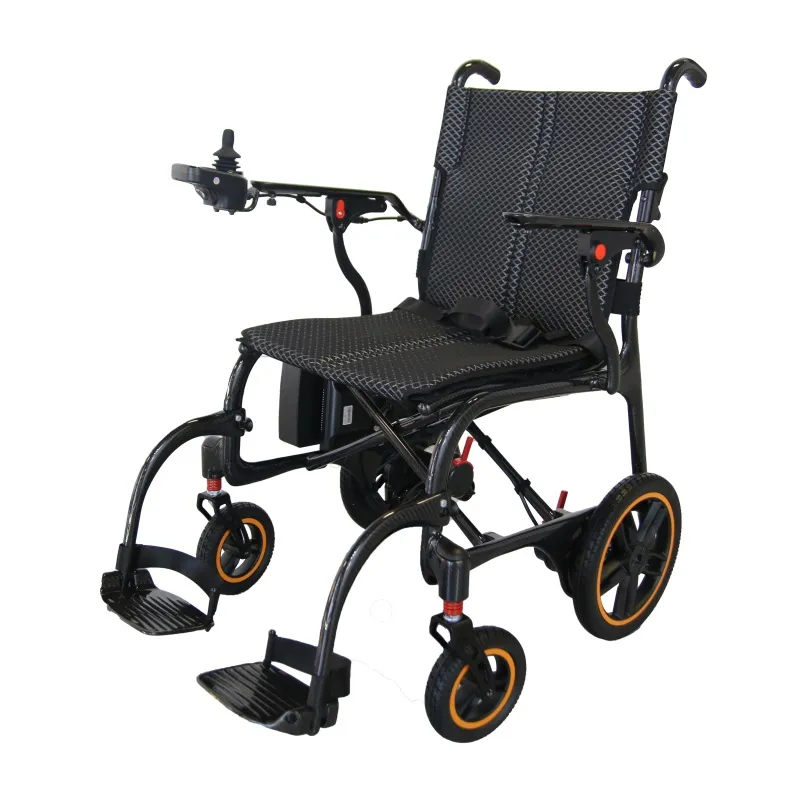
Why is it that Carbon Fibeer electric Wheelchairs is a topic in the headlines nowadays?
One of the main reasons for the rise in popularity of carbon electric wheelchairs is the performance improvements brought about by material advancement. Before the 90's most electric wheelchairs would have had a steel frame, which was the strongest and most easily processed material available at the time. However the density of steel resulted in a very heavy wheelchair in general, which was an inconvenience for those that had to handle the chair on a daily basis.
Over the last couple of decades aluminum alloy has become the favored choice for manufacturing lightweight electric wheelchairs. Compared to steel the major advantages of aluminum alloys are lower weight and enhanced ability not to corrode which are the two main reasons that aluminum alloy materials are being used as a popular option for many middle to high-end wheelchairs.
Sure, carbon fiber started to catch people's eye mainly when the demand for "lighter, stronger, and more portable" wheelchair frames was getting higher and higher.
Carbon fiber is one of the most advanced fiber materials in which the predominant element is carbon giving it very high strength, low density, and excellent stiffness. This composite material has already seen a broad application in aviation and racing cars as well as other high-end sports equipments. The primary advantage that carbon fiber is bringing to electric wheelchairs is a remarkable reduction in weight without losing structural rigidity.
Take one of the traditional wheelchairs as an example which would weigh over 40kg and even be up to 50kg, nowadays many carbon fiber wheelchair models have a weight between 20kg and 30kg which is a big difference. Imagine that every day you get your wheelchair from home or carry one when going somewhere. These kinds of differences definitely could play an important role in one's quality of life.
It is also very essential that everyone is to keep an open mind as not all "carbon fiber electric wheelchairs" are the same. Carbon fiber itself differs in grades; manufacturing procedures, fiber layup direction, and frame engineering all have great influence on the quality of the final product. So buyers should make sure to pay the most attention to the frame building style and product layout when comparing carbon fiber content.
What are the main factors to pay attention to when you are buying a carbon electric wheelchair?
1. Frame Material and Construction: Deciding the Longevity of the Product and Safety
The frame is the fundamental structure of a carbon fiber electric wheelchair made from high-performance carbon fiber, and it is the main part that determines the strength, steadiness, and life span of the device.
Some shoppers assume that when a product is advertised as "carbon fiber," it is referring to the fact that everything in the wheelchair is made using high-grade carbon fiber. In many cases it's only the surface and/or a small portion that are done with this material and the structural parts will be another material.
A top-quality carbon fiber electric chair has the primary load-bearing framework made of carbon fiber giving the chair the benefit of weight saving combined with high stiffness.
Following are the factors that the buyer shall check:
Firstly, make sure that carbon fiber is the main construction material of the frame and not just a carbon fiber overlay.
Secondly, verify the product’s maximum load-bearing capability which is basically reflecting one of the aspects (frame strength). It’s commonly understood that adult carbon fiber electric wheelchairs are usually loaded up to 100kg to 150kg, although reinforced designs can bear even more.
In addition to that, the frame’s method of joining different parts should be kept in mind. A good carbon fiber electric wheelchair will employ a more robust, well-connected framework to minimize the chance of looseness due to regular usage or repeated folding.
The users who are going to use the wheels for years might think of frame stability first rather than only focusing on weight. An electric wheelchair that is very light without the adequate strength and structural stability could be an unsafe option when it is on rough or complex terrain.
2. Overall Weight: Is Lightweight Truly for You?
Consumers pay great attention to weight when purchasing a carbon fiber electric wheelchair, and it is a major factor differentiating carbon fiber products from conventional electric wheelchairs.
Different kinds of electric wheelchairs have their average weights, like:
Ordinary electric wheelchairs: around 40kg to 60kg.
Lightweight aluminum alloy electric wheelchairs: roughly approximately 25kg to 40kg.
Carbon fiber electric wheelchairs: from about 20kg to 30kg.
Less weight gives considerable convenience. For driving users and occasionally going out users, lightweight chair reduces load on carry-out effort. For those planning to bring it aboard a car, the lighter models take up the least space of car trunk. Travelers find them easier to be carried.
Nevertheless, consumers have been known at times to hold a wrong view that the lighter the better.
In that aspect, a lighter electric wheelchair does not necessarily offer better performance. In fact, the lower overall weight could possibly indicate less battery capacity, less powerful motors, or an overly simpli fied frame design.
For instance, an ultralight electric wheelchair that weighs around 15kg might be adequate only for short-distance indoor use, but in the case where the user frequently encounters outdoor slopes, lawns, or various rough terrains, such a chair may lack adequate power supply.
You may be advised that when picking up a carbon fiber electric wheelchair, your weight selection should be based primarily on usage scenario rather than just blindly going for the lightest.
When deciding, a balance should be set between the different parameters of performance, weight, battery size, and range as they are all connected factors.
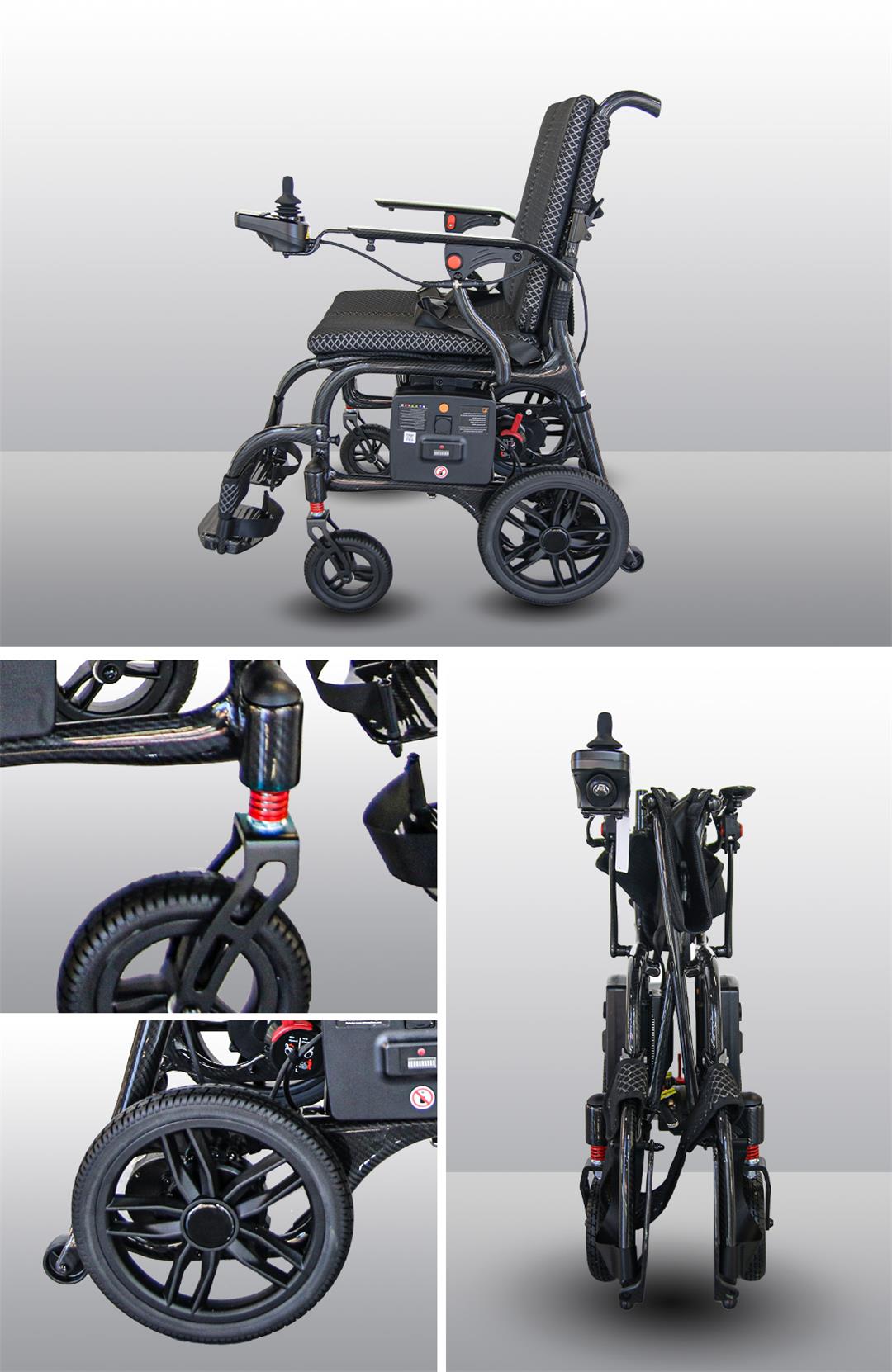
3. Battery Capacity and Range: How Far Can The Carbon Electric Wheelchair Take You?
Batteries or their characteristics constitute one of the fundamental factors in buying a carbon fiber wheelchair and the buyer can't skip this. Appearance-wise and light-weight-wise many buyers may select an electric chair, however what in fact makes it so usable for a user on a daily basis is how long the battery lasts. A carbon fiber chair is light and yet lacks the distance, then it will still be very limited in real-life applications.
To date, majority of manufacturers of carbon electric Wheelchair use lithium battery for their power source. Lithium batteries have several advantages over the traditional lead-acid batteries such as lighter weight, greater charging efficiency, longer cycle life, etc., which make lithium batteries highly suitable for the lightweight wheelchairs trend.
Voltage and mAh are the two key factors when it comes to battery capacity. Common battery ratings you'll see when buying wheelchairs include 12Ah, 20Ah, 24Ah, 30Ah, and above. Theoretically, the larger the battery capacity, the farther the wheelchair can be run. As an example, it might be said if a carbon fiber electric wheelchair runs on a 12Ah lithium battery that it could go for a distance of around 10-15 km whereas a 20Ah-24Ah battery would allow one to cover 15-25 km and with a larger capacity battery it is possible for the electric wheelchair to go theoretically beyond 30 km.
However, please understand that the figures for the range announced by the manufacturer are derived from the manufacturer’s conditions under the lab environment in general and in reality, it's influenced by a number of other elements. These might involve the weight of the rider, the speed of the wheelchair, the slope the wheelchair is going to, temperature, air pressure in the wheels, driving habits, etc., that can all alter how much battery power is consumed.
As a sample scenario, the same wheelchair would be close enough to what was claimed by the manufacturer in case if it’s only moving at low speed on a flat indoor ground for a short period of time; however, it would be able to get about only a third of its total battery capacity if it had gone outside, climbed an incline, rode over a bumpy floor or operated in a sub-zero temperature without stopping at any stage on that trip.
In this case, it must be pointed out that if you do decide to take up this kind of wheelchair, you cannot go for the "the bigger the battery the better only" type of thinking but instead, it should also depend on the area of operations that a person is mostly going to be using the wheelchair for. If the user is a home or an indoor wheelchair, for example, shopping centers or hospitale premises, then a battery of medium capacity will suffice. However, if the user is shopping often, traveling, or making long trips, the choice of battery with a larger capacity will be more appropriate.
In addition, portability of the battery is also important. People who fly frequently and need to make long trips, for example, a removable lithium battery design is more convenient for them.
4. Motor Power: Determining the Speed and Traverse Capabilities of Carbon Electric Wheelchairs
Motor is the main power unit of a carbon fiber electric wheelchair affecting its initial speeds and climbing power as well as traversal on different kinds of surfaces.
The dual drive motor is the most commonly used motor in electric Wheelchairs where both wheels are independently driven by two motors and that helps in better performance, higher power and steering flexibility.
Typical motor power ratings are as follows:
180W×2;
200W×2;
250W×2;
300W×2 and so forth.
If the user is only doing indoor activity, 180W to 200W dual-motor will be adequate as most interior environments offer minimal obstacles.
We recommend users who are doing a lot of outdoor activities, like going on hills, street ramps, lawns or rough ground to consider a powerful motor because the weak motor will slow them down as well as shorten the battery life or even fail to get them up the hill.
In most cases, stronger motor power translates to greater reserve capacity however it also poses issues like heavier overall weight, faster battery use, and higher cost.
As a result, the motor choice has to be based on real environment not on the power rating alone.
For the general householder, the 200W×2 motor is a normal power configuration which should meet their most daily activity needs. If users regularly go outside and also are heavy weight or live in a sloping area then they can consider the higher power motor power settings.
5. Folding Dimension and Portability: One of the Most Prominent Merits of Carbonr Electric Wheelchairs
Comparing with conventional electric Wheelchairs, the feature that most distinguishes carbon electric Wheelchairs is that they can be easily taken along with you when your lifestyle is more active. Both the overall weight as well as the size of the wheelchair after folding are important indicators of its portability.
User can think of electric chair as a piece of furniture for their home but it can also serve as the main companion on shopping or visiting, or on other occasions requiring social interaction. Thus, a foldable carbon fiber electric wheelchair offering quick fold/unfold operation will enable their lives much easier and happier.
Main factors to pay attention to when buying a foldable wheelchair include:
Folded length;
Folded width;
Folded height;
Folding method;
Level of ease when folding it up
Say, a couple of the best foldable carbon fiber electric Wheelchairs available currently have folded widths around 30cm, therefore, they easily are carried along with your car or in a small van.
Still, remember to pay attention how a foldable chassis can negatively impact the overall product's longevity over time. There are some very rudimentary folding designs that are easy to assemble and disassemble but that also tend to loosen at the connections repeatedly after just a few folds.
So a great foldable carbon fiber electric chair is something like one that is not only foldable but even better it is foldable and also stays steady when left folded together.
The size when being packed up is actually much more an issue to car users than the maximum speed. It's true the factor that determines your lifestyle is not whether you can carry the wheelchair or not but whether you can effortlessly retrieve it from where you left it or not.
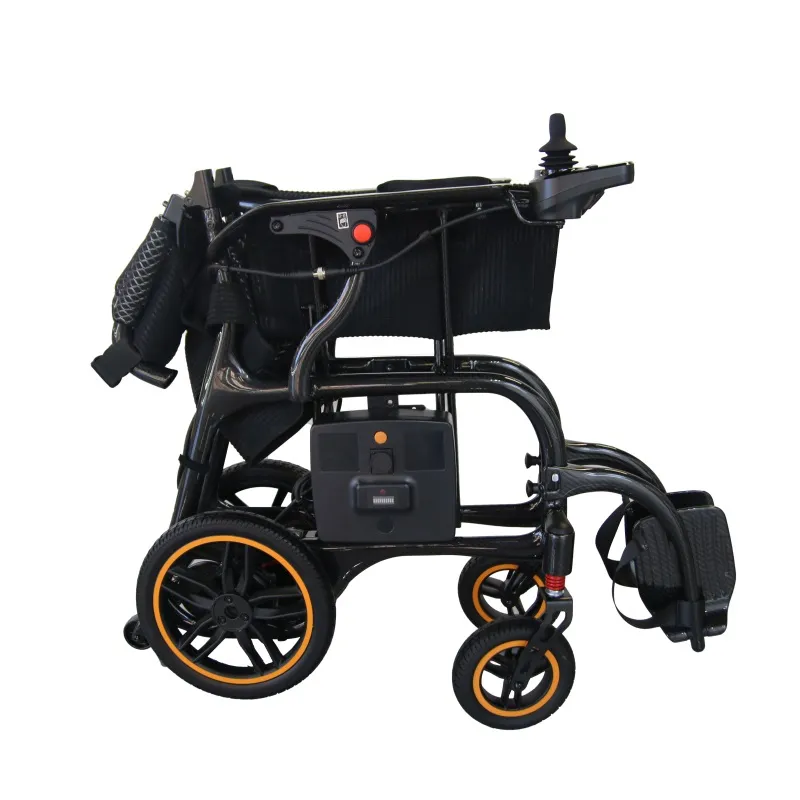
6. Load-Bearing Capacity: Lightweight Doesn't Mean Reduced Load Capacity
Many consumers, seeing the lighter weight of carbon electric wheelchairs, worry about their load-bearing capacity.
In fact, the biggest characteristic of high-quality carbon fiber material is that it maintains high strength while reducing weight.
The load-bearing range of ordinary adult carbon fiber electric wheelchairs is typically between 100kg and 150kg, with some reinforced models exceeding 150kg.
When choosing a load-bearing capacity, it's necessary to consider not only the user's weight but also the items they carry. For example, if a user weighs 80kg and frequently carries backpacks and shopping items, choosing a product with a load-bearing capacity of around 120kg is usually more reasonable.
Leaving some safety margin can reduce the stress on the frame, motor, and connecting components during long-term use.
At the same time, load-bearing capacity also affects driving stability. Exceeding the product's designed load-bearing range will not only reduce range but may also affect braking performance and handling safety.
Therefore, when purchasing a carbon fiber electric wheelchair, the load-bearing parameters must be carefully checked, and one should not only focus on weight and appearance.
7. Control System: Determining Ease of Operation and Safety
The control system is of paramount importance for first-time electric wheelchair users.
Most carbon fiber electric wheelchairs currently employ intelligent joystick control systems. Users can control forward, backward, steering, and stopping by pushing the joystick.
An excellent control system typically possesses the following characteristics:
Smooth start-up without sudden lurches;
Sensitive but not overly sensitive steering;
Timely braking;
Adjustable speed;
Suitable for users of varying driving skill levels.
For elderly users, ease of operation is more important than feature abundance. Overly complex controls can actually increase the learning curve.
Some high-end carbon fiber electric wheelchairs also support speed adjustment. For example, a low-speed mode can be selected indoors to improve safety, while a high-speed mode can be selected outdoors to improve mobility.
Furthermore, the joystick position needs to be considered. Some users have weaker hand strength or unilateral limb dysfunction, so an adjustable joystick position is more user-friendly.
8. Safety Features: Parameters Not to Be Ignored When Purchasing a Carbon Electric Wheelchair
While electric wheelchairs are convenient, they are essentially mobile devices, therefore safety performance is extremely important.
When purchasing a carbon fiber electric wheelchair, the following safety features should be given priority:
First, an electromagnetic braking system. Compared to traditional mechanical brakes, electromagnetic brakes automatically lock the motor after operation, improving parking stability.
Second, an anti-tipping design. Some products are equipped with rear anti-tipping wheels, reducing the risk of tipping over when going uphill, downhill, or during sudden starts.
Third, a seatbelt design. For users with weaker body control, seatbelts provide extra protection.
Fourth, tire design. For outdoor use, non-slip tires improve traction.
Furthermore, slope stability is crucial. A high-quality carbon fiber electric wheelchair should undergo slope testing to ensure stability within normal operating ranges.
9. Seat Comfort: Ergonomics Must Be Considered for Long-Term Use
Many people focus on power and weight when purchasing carbon fiber electric wheelchairs, neglecting seat comfort.
In reality, for users who use the wheelchair for several hours or more daily, seat design directly impacts their quality of life.
Several aspects need attention:
Is the seat width suitable?
Does the backrest provide sufficient support?
Does the seat cushion have pressure-reducing functions?
Is the armrest height adjustable?
Is the footrest position comfortable?
If the seat size is unsuitable, long-term use may cause lower back fatigue, increased pressure on the hips, or even abnormal posture.
Especially for people with limited mobility who spend long hours in electric wheelchairs daily, ergonomic design is just as important as power performance.
An excellent carbon fiber electric wheelchair needs to be both lightweight and comfortable.
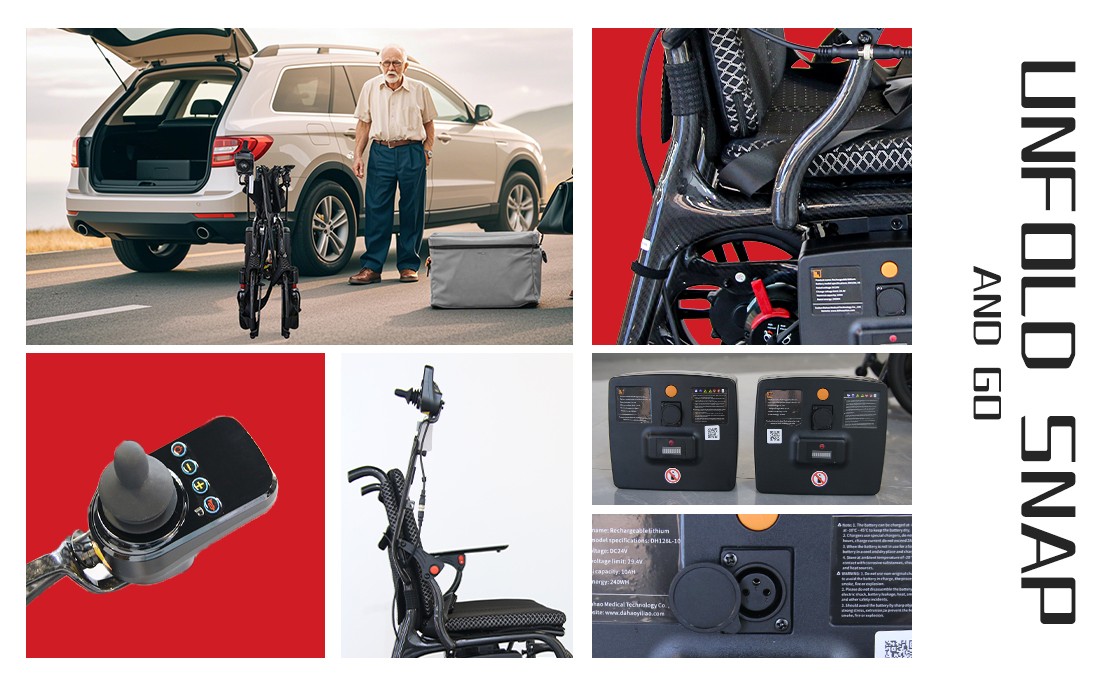
FAQ: Frequently Asked Questions about Carbon Fiber Electric Wheelchairs
1. Why are carbon fiber electric wheelchairs more expensive than ordinary electric wheelchairs?
The higher price of carbon fiber electric wheelchairs is mainly due to the higher cost of carbon fiber materials and the more stringent manufacturing process. Compared to ordinary steel or aluminum alloy electric wheelchairs, carbon fiber can maintain high strength while reducing weight, thus increasing manufacturing costs.
However, the higher price does not mean that all users must choose carbon fiber products. For users who frequently transport goods, travel, or prioritize portability, the convenience offered by carbon fiber is more significant.
2. How long can a carbon fiber electric wheelchair typically be used?
Under normal circumstances, a high-quality carbon fiber electric wheelchair typically has a lifespan of over 5 years, depending on usage frequency, maintenance, and the quality of core components.
The carbon fiber frame itself has good fatigue resistance and is usually not the most easily worn part. Electronic components such as the battery, motor, and controller require maintenance or replacement based on usage.
3. Can a carbon fiber electric wheelchair fit in a car trunk?
Most folding carbon fiber electric wheelchairs can fit in the trunk of a regular car, but this depends on the vehicle's space and the wheelchair's folded dimensions.
Before purchasing, it is recommended to check the product's folded length, width, and height parameters and confirm this based on your car model.
4. What is the typical range of a carbon fiber electric wheelchair?
Currently, the range of carbon fiber electric wheelchairs on the market is typically between 15 and 30 kilometers, with higher-capacity battery versions potentially reaching even higher ranges.
Actual range will be affected by user weight, road conditions, speed, battery status, and temperature; therefore, the manufacturer's stated data should only be used as a reference.
5. Are carbon electric wheelchairs suitable for the elderly?
Yes. This is especially suitable for elderly users whose mobility is declining, who require long-term assistance with mobility, and who want a lightweight device that is easy to transport.
However, when choosing a device, it is important to focus on ease of operation, safety features, and seat comfort, rather than just lightweight design.