

For individuals who rely on electric wheelchairs, air travel presents a practical challenge: standard electric wheelchairs tend to be heavy and bulky. Moving them—whether from home to the airport, from the check-in counter to the boarding gate, or during the aircraft loading and unloading process—involves significant handling and transport issues. If a wheelchair is excessively heavy, it is difficult for the user to handle and complicates the task for airport staff during loading and unloading.
With advancements in lightweight technology, carbon fiber is increasingly being used for wheelchair frames, resulting in lighter, more portable models. Furthermore, foldable designs allow for a more compact footprint during transport. Consequently, foldable carbon fiber electric wheelchairs are attracting growing interest from users who frequently travel by air, car, and other modes of transport.
In terms of airport use, foldable carbon fiber electric wheelchairs offer clear portability advantages, the most immediate being their reduced weight. Carbon fiber addresses the issue of weight, while the folding mechanism addresses the issue of bulk; the combination of the two simplifies handling, storage, and transport within the airport environment.
However, it is important to note that "greater convenience for airport travel" does not mean all foldable carbon fiber power wheelchairs can be taken directly into the aircraft cabin. Whether a wheelchair can be brought into the cabin, whether it must be checked as baggage, and how the battery should be transported depend on specific factors such as the airline, aircraft model, and battery type and capacity.
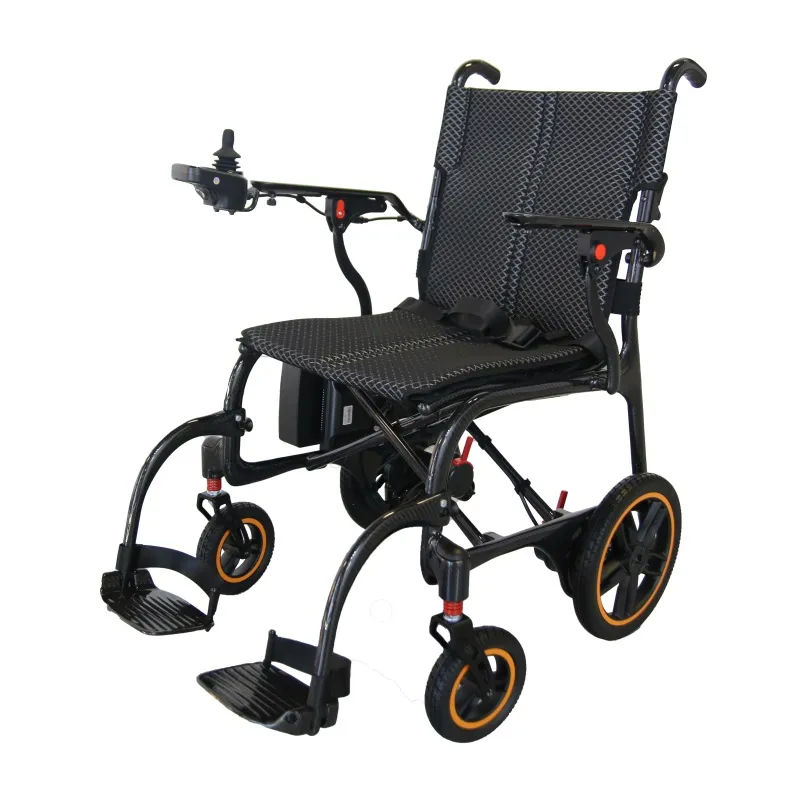
Why is handling standard power wheelchairs at the airport often troublesome?
Airports are environments that require navigating long distances. Users may need to travel significant distances between the parking lot or drop-off zone and the check-in counter, security checkpoint, departure lounge, and boarding gate. While electric wheelchairs assist with mobility within the airport, they often still require manual handling during the check-in, loading/unloading, and transport phases of the flight. Traditional steel electric wheelchairs are typically heavy, with some models weighing 25–30 kg or more. While aluminum alloy models offer some weight reduction, they can still be heavy if equipped with large batteries, motors, and comprehensive seating systems.
For frequent travelers, handling equipment weighing over 20 kg—or even 30 kg—is no easy task. The challenge is compounded when carrying luggage as well.
This is a key reason behind the emergence of lightweight electric wheelchairs. A well-designed carbon fiber frame reduces structural weight, while a folding mechanism minimizes transport dimensions; consequently, foldable carbon fiber electric wheelchairs address the two primary pain points of air travel: weight and bulk.
Why are carbon fiber power wheelchairs better suited for air travel?
Carbon fiber composites possess high specific strength and specific stiffness, enabling significant weight reduction while still meeting structural performance requirements.
For instance, if a traditional electric wheelchair weighing 28 kg is optimized with a carbon fiber frame and other components to weigh 22 kg, the 6 kg reduction represents a decrease of approximately 21%. While a difference of a few kilograms might be negligible during daily use, it becomes highly significant in airport scenarios where the chair must be manually lifted, loaded into a vehicle, or stowed.
Of course, one cannot simply assume that all carbon fiber electric wheelchairs are lighter than those made of aluminum alloy or other materials. Total weight also depends on the battery, motor, seat, wheels, and accessories. Therefore, determining whether a wheelchair is truly lightweight requires looking at the actual total weight rather than just the frame material.
The true advantage of carbon fiber lies in its ability—given a sound structural design—to provide sufficient strength and stiffness with a lighter frame, thereby creating opportunities for overall weight reduction.
Folding mechanisms address the "bulk" issue in airport transport
If carbon fiber primarily reduces weight, the folding mechanism primarily addresses the issue of bulk.
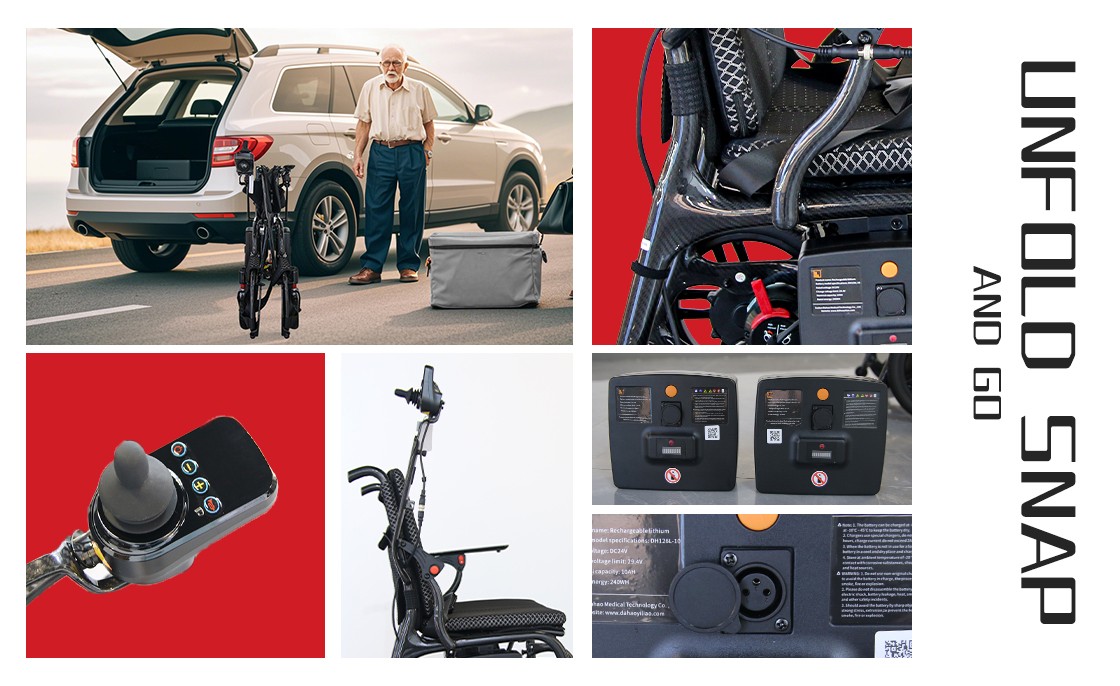
Fixed-frame electric wheelchairs typically feature a solid, one-piece structure that occupies a significant amount of space during transport. A foldable carbon fiber electric wheelchair is used for normal operation when unfolded; once folded, its length, width, and height are reduced, making it easier to fit into a car trunk and more convenient for airport staff to handle and store.
This is particularly important for frequent flyers. Airport staff may need to move the wheelchair to a designated transport area; a smaller product size allows for more maneuvering space.
However, it must be emphasized that the folding mechanism must lock securely when unfolded. Lightweight design and foldability should not come at the expense of frame stability. A high-quality foldable carbon fiber electric wheelchair should offer convenient folding, stable unfolding, and reliable locking.
Therefore, when selecting a product, one should consider not only the folded dimensions but also the locking mechanism and the rigidity of the frame.
Can a foldable power wheelchair always be taken into the aircraft cabin?
This is a common source of misunderstanding in air travel.
The answer is: not necessarily.
Although foldable power wheelchairs are easier to make compact than rigid-frame models, whether they can be stowed in the cabin depends on factors such as the aircraft model, cabin space, wheelchair dimensions, and specific airline regulations.
US Department of Transportation regulations on air travel accessibility require eligible airlines to provide priority cabin storage space for standard-sized foldable manual wheelchairs; however, this does not mean that all foldable electric wheelchairs are automatically permitted in the cabin.
For electric wheelchairs, the battery is often a critical issue requiring advance verification. The FAA has established specific regulations regarding the transport of batteries for electric wheelchairs and mobility aids. For lithium-ion batteries, key considerations include battery capacity, whether the battery is installed in the device, and whether it is adequately protected during transport. FAA guidelines indicate that a special 300 Wh limit applies in certain cases, and airlines may also impose stricter requirements.
Thus, "foldable" primarily implies greater ease of transport; it does not automatically grant permission to bring the chair into the cabin.
Battery capacity is a key parameter for the air transport of power wheelchairs
One of the major differences between electric wheelchairs and standard luggage is the issue of battery transport. Battery energy is typically expressed in watt-hours (Wh), calculated using the formula:
Wh = Voltage (V) × Capacity (Ah)
For example, a 24 V, 10 Ah battery has a rated energy of approximately 240 Wh.
This parameter is crucial for air travel. Airlines usually require information regarding the battery type, capacity, and whether it is detachable to determine the specific transport method.
The FAA notes that lithium-ion batteries used in electric wheelchairs and mobility aids are subject to specific air transport requirements. If the battery must be removed, terminals must be protected against short circuits and appropriate measures taken to prevent damage, in accordance with relevant regulations. Airlines may also implement policies stricter than regulatory requirements, so users should verify these details before traveling.
Therefore, if international travel is a primary reason for purchasing an electric wheelchair, it is advisable to prioritize checking the battery's Wh capacity and detachability, rather than focusing solely on the driving range.
What are the practical advantages of foldable carbon fiber wheelchairs at the airport?
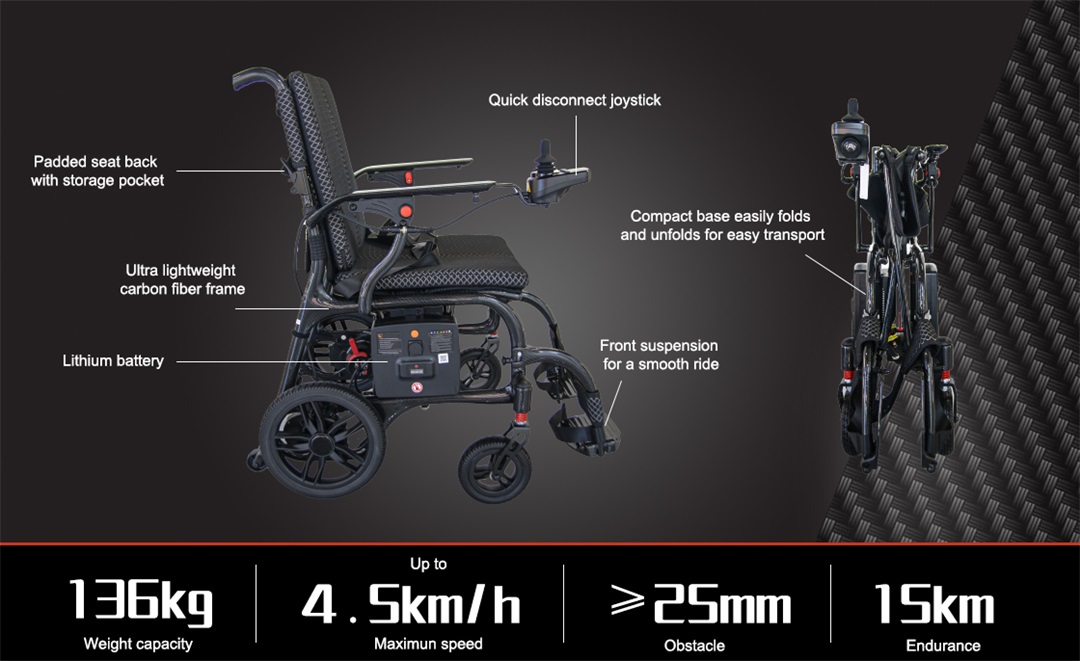
Considering the entire travel journey, the advantages of foldable carbon fiber electric wheelchairs are evident in four key areas.
First, they are lighter. A carbon fiber frame reduces the overall weight of the wheelchair, making manual handling and loading/unloading much easier.
Second, they are more compact. Folding the wheelchair reduces the space required for transport, making it ideal for car trunks, hotel rooms, and airport transfers.
Third, they are easy to stow. Travelers need to carry luggage alongside the wheelchair; a foldable electric wheelchair minimizes the space it occupies.
Fourth, they are suitable for various modes of transport. Airports are just one scenario; the lightweight and foldable nature of these wheelchairs is equally valuable for users traveling by taxi, private car, train, or long-distance transport.
Thus, foldable carbon fiber electric wheelchairs are not designed solely for boarding a plane; they are well-suited for the entire travel experience.
What are the differences between carbon fiber, aluminum alloy, and steel electric wheelchairs?
The main characteristics of steel frames are their proven structural design and relatively low cost; however, due to the material's higher density, they are typically heavier than other types when built to the same dimensions. Aluminum alloy has a lower density than steel, allowing for reduced frame weight; it is currently widely used in lightweight electric wheelchairs.
Carbon fiber offers superior specific strength and specific stiffness, and its weight can be further optimized through fiber layup orientation and structural design. Consequently, from a lightweighting perspective, carbon fiber electric wheelchairs hold significant development potential.
However, it is important to note that material is not the sole factor determining the vehicle's total weight. A carbon fiber power wheelchair equipped with a high-capacity battery, dual motors, and a large seat could potentially weigh more than a simply configured aluminum alloy electric wheelchair.
Therefore, when purchasing, one should directly compare "total weight + load capacity + battery capacity + folded dimensions" rather than focusing solely on the material type.
Which power wheelchair specifications should be prioritized for air travel?
For frequent flyers, it is recommended to focus on the following specifications:
First is the total weight. A lower weight generally makes manual handling easier, though frame strength and load capacity should not be sacrificed merely to reduce weight.
Second is the folded dimensions. In addition to the unfolded size, one must know the length, width, and height when folded, as this directly affects transport by car and storage.
Third is the maximum load capacity. Products may be rated for 100 kg, 120 kg, or 150 kg, for example; specific manufacturer specifications should be consulted. Users should not consistently exceed the rated load capacity.
Fourth is battery capacity and type. It is advisable to check the Watt-hour (Wh) rating on the battery label and confirm whether the battery is detachable.
Fifth is the folding mechanism. Airport environments are often busy; if a foldable carbon fiber wheelchair requires complex tools to fold, its practical convenience is reduced. An ideal folding mechanism should be simple to operate and feature a clear locking status.
Sixth is product technical documentation. Frequent flyers should request that the manufacturer provide details on total weight, folded dimensions, battery specifications, and removal instructions to facilitate advance declaration to the airline.
FAQ
Q1: Are foldable carbon fiber electric wheelchairs suitable for air travel?
It is suitable for air travel scenarios, offering a weight advantage—particularly regarding manual handling and transport. However, the specific transport method depends on the airline, aircraft model, and battery specifications.
Q2: Is a carbon fiber power wheelchair necessarily lighter than an aluminum alloy one?
Not necessarily. While carbon fiber offers high specific strength and stiffness—beneficial for weight reduction—the overall weight of the wheelchair is also influenced by the motor, battery, seat, and configuration. Ultimately, the total weight of the complete unit should be compared directly.
Q3: Can a foldable electric wheelchair be taken directly into the aircraft cabin?
There is no one-size-fits-all answer. Cabin access depends on factors such as available aircraft space, wheelchair dimensions, and airline policies. Being foldable does not automatically guarantee permission to bring it into the cabin.
Q4: Why is special attention paid to the battery when flying with a power wheelchair?
Batteries are classified as special items for air transport, and requirements vary based on battery type, capacity, and installation method. For lithium-ion batteries in particular, it is essential to verify the Watt-hour (Wh) rating and whether the battery needs to be removed beforehand.
Q5: What kind of electric wheelchair should I choose if I fly frequently?
It is recommended to prioritize features such as lightweight design, foldability, compact folded dimensions, and batteries that are clearly identifiable and compliant for transport, while also ensuring that load capacity, stability, and range meet your practical needs.