

As the population ages, the demand for patient-transfer equipment in hospitals, nursing homes, rehabilitation centers, and home-care settings continues to grow. For individuals with limited mobility—such as those who are bedridden, have weak lower limbs, or cannot stand independently—moving from a bed to a wheelchair, nursing chair, or the toilet often requires significant assistance from caregivers.
Traditional manual handling relies heavily on the physical strength of caregivers. When a patient is heavy, has poor body control, or requires frequent transfers, this approach places a heavy strain on the caregiver’s back and increases the risk of the patient slipping or colliding with objects.
Electric patient lifters, by contrast, use an electric motor, a sling, and a mechanical support structure to lift and transfer patients. This reduces the need for caregivers to manually lift patients and provides greater control throughout the transfer process.
So, are electric patient lifters superior to manual handling? What are their advantages, and how should one choose the right equipment for different care settings? This article explores these questions by examining how these devices work, the various types available, key technical specifications, and safety considerations.
What Is an Electric Patient Lifter?
An electric patient lifter is a piece of care equipment designed to assist in moving or transferring patients.
These devices use an electric drive system to operate a boom or lifting mechanism. A specialized sling supports the patient’s body, allowing them to be raised to the appropriate height for safe transfer between a bed, wheelchair, or nursing chair.
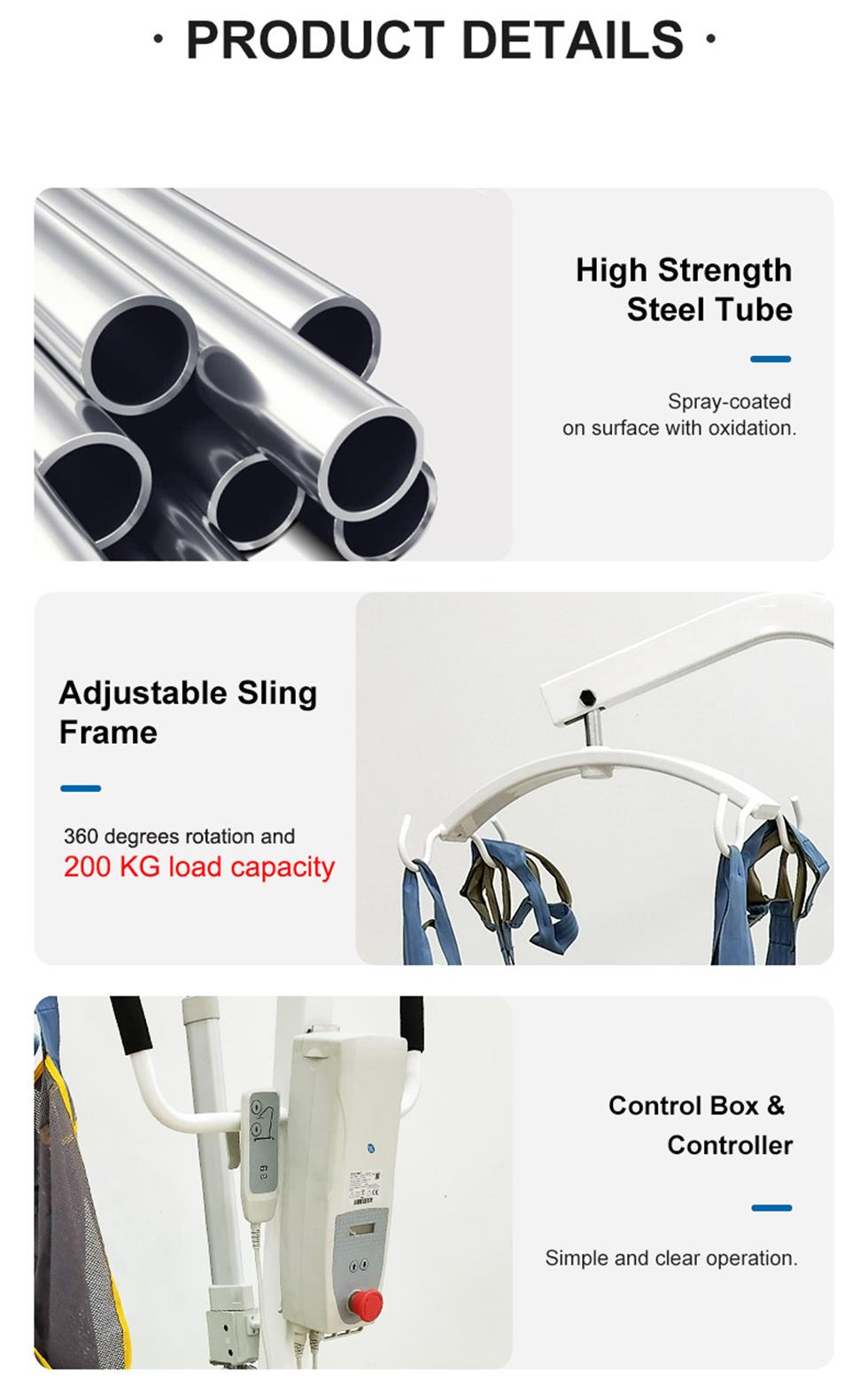
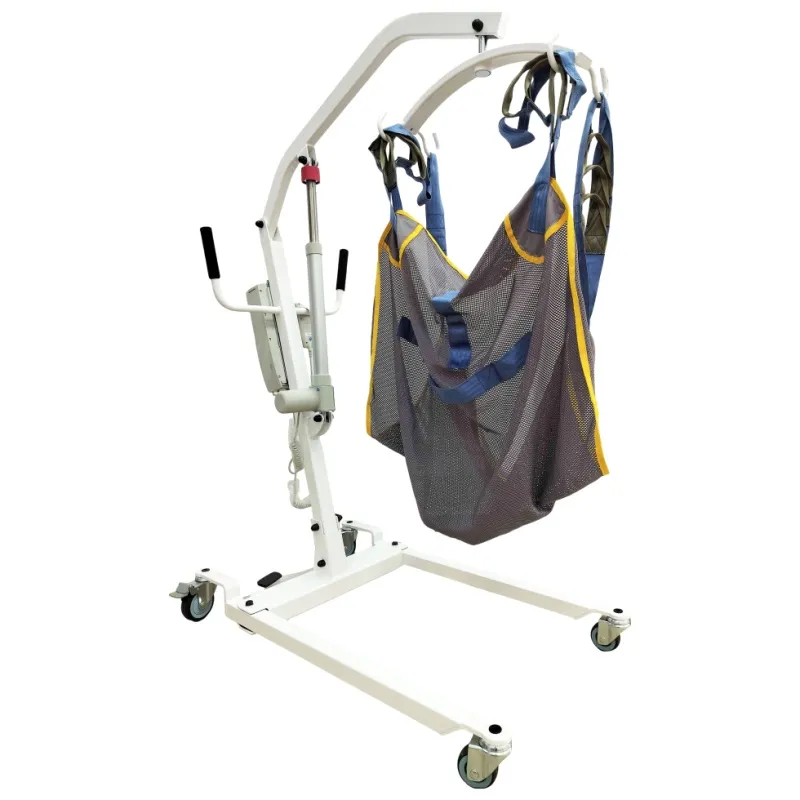
A typical electric patient lifter consists of the following components:
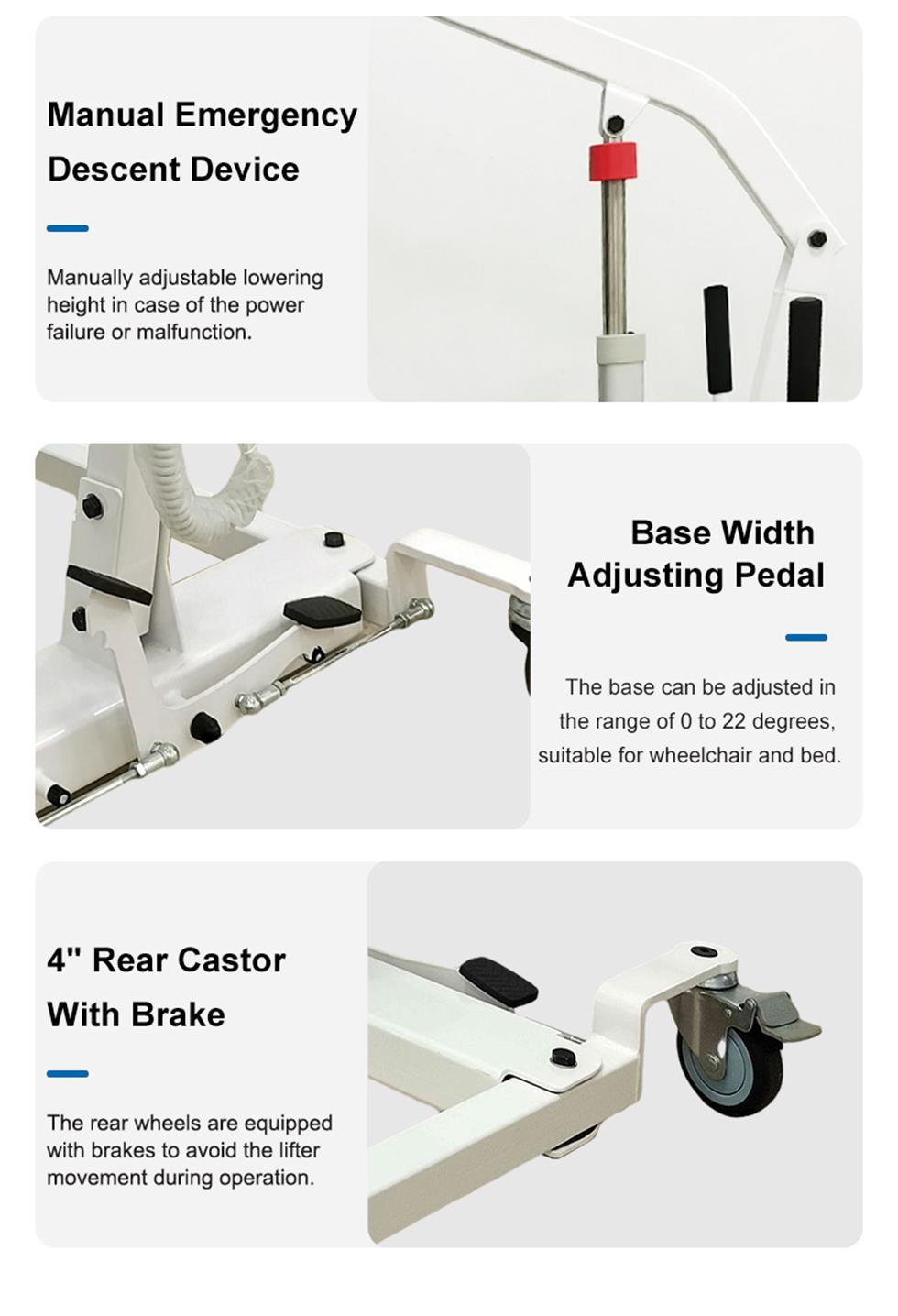
1.Base: Supports the entire unit; some models feature an adjustable width.
2.Mast: Connects the base to the boom, providing primary structural support.
3.Boom: Controls the lifting and lowering of the patient.
4.Electric Actuator: Provides the power for lifting and lowering.
5.Patient Sling: Supports the patient’s body and serves as a critical safety component during the transfer process.
6.Control System: Allows for the raising and lowering of the device via a remote control; some models also feature a battery level indicator and an emergency descent function.
7.Casters: Facilitate the movement of the device and are typically equipped with locking mechanisms.
Compared to manual handling, the primary distinction of an electric patient hoist is that the mechanical system handles the bulk of the lifting force, rather than relying entirely on the caregiver’s back, shoulders, and arms.
What are the differences between manual handling and using an electric patient hoist?
1. Characteristics of Manual Handling
Manual handling is typically performed by one or more caregivers who assist a patient in changing positions by supporting, lifting, or carrying them.
This method requires no additional equipment and offers greater flexibility; it is suitable for patients who can actively cooperate and possess some ability to stand or move on their own.
However, manual handling has significant limitations when it comes to patients who cannot stand independently, have poor body control, or have a higher body weight. For instance, if an 80 kg patient is unable to support their own weight, the caregiver must bear a substantial portion of the load during the transfer. Repeating this process multiple times a day increases the risk of musculoskeletal injuries to the caregiver’s back.
2. Characteristics of Electric Patient Hoists
An electric patient hoist uses a sling to support the patient and an electric motor to perform the lifting. The caregiver’s role is primarily to position the sling, operate the remote control, maneuver the device, and monitor the patient’s condition.
Key advantages include reducing the need for manual lifting, enhancing stability during transfers, and decreasing repetitive physical strain.
On the other hand, electric patient hoists require an initial investment for purchase, training for operation, and ongoing maintenance; they also necessitate sufficient space for the device to be maneuvered.
3. Comparison of the Two Transfer Methods
| Comparison | Manual Transfer | Electric Patient Lifter |
| Power Source | Caregiver's physical strength | Electric motor |
| Caregiver Workload | Relatively high | Reduced lifting effort |
| Patient Support | Manual support | Sling-based support |
| Transfer Stability | Depends on caregiver skills | Controlled mechanical lifting |
| Initial Cost | Low | Higher |
| Space Requirements | Usually lower | Requires equipment clearance |
| Training | Manual handling skills | Equipment and sling operation |
| Suitable Applications | Patients with partial mobility | Patients requiring substantial assistance |
In general, manual-assisted transfers may offer more flexibility for patients who can stand independently and cooperate well. For patients who cannot stand on their own and require full-body support, an electric patient hoist is typically the superior option.
Are electric patient hoists better than manual handling? What are their advantages?
1. Reducing the physical burden on caregivers’ backs
This is one of the most significant advantages of an electric patient hoist.
When handling patients manually, caregivers are often required to repeatedly bend over, twist their bodies, and lift the patient. If a patient suddenly loses their balance, caregivers may need to rapidly adjust their own body posture, which further increases the risk of musculoskeletal injuries.
Electric patient lifts use a motor to handle the primary lifting task, reducing the extent to which caregivers must bear the patient's weight directly.
For hospitals and nursing homes where patients must be moved between beds and chairs multiple times a day, such equipment can significantly reduce repetitive physical exertion.
2. Enhancing safety during patient transfers
During manual handling, if a patient suddenly experiences leg weakness or a loss of balance—or if a caregiver handles the patient improperly—there is a risk of the patient slipping or colliding with objects.
Electric patient lifts use a sling and a lifting mechanism to support the patient’s body, ensuring they remain in a relatively stable position throughout the transfer.
However, such equipment cannot entirely eliminate the risk of falls. Accidents can still occur due to factors like incorrect sling attachment, unfastened buckles, improperly sized slings, or overloading the equipment. Therefore, following standardized operating procedures and performing pre-use checks is essential.
3. Adapting to the diverse care needs of patients
Electric patient lifts can be used with various types of slings, providing different levels of bodily support.
For instance, patients who cannot stand independently may use a full-body sling, while those with some degree of trunk control (ability to maintain a seated posture) can use a specialized seated-position sling, as specified by the equipment guidelines.
This versatility allows electric patient lifts to be used in a wide range of settings, including long-term bedridden care, post-operative rehabilitation, and the daily transfer of elderly individuals.
4. Improving care efficiency
In hospitals and nursing homes, patients may require frequent transfers—such as moving between a bed and a chair, using the toilet, or participating in rehabilitation activities—throughout the day.
Electric patient lifts reduce the need for manual lifting and physical exertion, helping to standardize care procedures. However, actual efficiency also depends on factors such as the time required to attach the sling, the patient's level of cooperation, the available space for maneuvering the equipment, and the caregiver's proficiency; therefore, mechanical transfers are not necessarily faster in every situation.
What are the common types of electric patient lifts?
Because patients have different physical conditions, it is necessary to select the appropriate transfer equipment. There are three primary types of electric patient lifts.
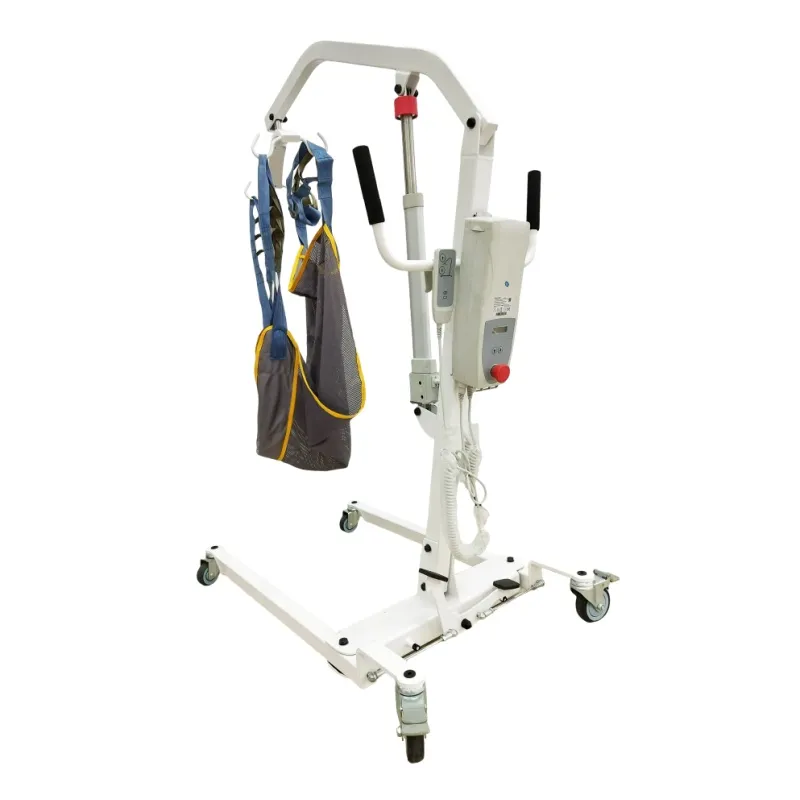
1. Full-Body Electric Patient Lifter
This is a common type of electric patient lifter, typically consisting of a base, a vertical mast, a boom (lifting arm), and a full-body sling.
Supported by the sling, a patient can be transferred between surfaces—for example, from a bed to a wheelchair, or from a wheelchair to a care chair. Its primary feature is the extensive support it provides, making it suitable for patients who cannot stand independently, lack sufficient lower-limb strength, or require full-body support.
2. Sit-to-Stand Lift
A sit-to-stand lift is designed to assist patients who possess some degree of lower-limb weight-bearing capacity and trunk control, helping them transition from a seated to a standing position.
These devices are usually equipped with knee support pads, footrests, and body straps, enabling patients to utilize their own remaining strength to stand up and complete a transfer.
This type is well-suited for patients undergoing rehabilitation or elderly individuals with some level of mobility; however, it is not appropriate for patients who are completely unable to bear weight or maintain trunk stability.
3. Ceiling Patient Lift
A ceiling patient lift facilitates patient transfers via a fixed overhead track and an electric hoist mechanism, eliminating the need to maneuver a base unit across the floor.
Its main advantage is that it saves floor space, making it ideal for hospitals and nursing homes where frequent patient transfers are required. The drawback is that it necessitates the prior installation of a track system, which imposes specific requirements regarding building structure, placement, and initial budget.
Comparison of Different Types of Electric Patient Lifters
| Lift Type | Main Features | Suitable Applications |
| Full Body Electric Lift | Full-body sling support | Bed-to-wheelchair transfers |
| Sit-to-Stand Lift | Assisted standing | Patients with partial weight-bearing ability |
| Ceiling Patient Lift | Rail-mounted lifting system | Hospitals and long-term care facilities |
What specifications should you consider when purchasing an electric patient lift?
Product specifications directly influence the suitability and safety of an electric patient lift. When making a purchase, it is recommended to focus on the following five aspects:
1. Safe Working Load (Maximum Weight Capacity)
Weight capacity is one of the most critical factors to consider when selecting an electric patient lifter.
Standard mobile electric patient lifters typically have a rated capacity of approximately 150–200 kg, while heavy-duty models can support 250 kg or more, depending on the product's construction and the manufacturer's design.
| Patient Weight | Suggested Equipment Capacity |
| 50–80 kg | 150 kg rated capacity may be sufficient |
| 80–120 kg | Consider 180–200 kg models |
| 120–150 kg | Consider heavy-duty models |
| Above 150 kg | Select a suitable bariatric patient lift |
The above information is intended for preliminary selection purposes only. In practice, you must verify the rated load capacity of the entire system—including the lift unit, sling, spreader bar hooks, and all connecting hardware. For example, even if the lift unit itself is rated for 200 kg, you must ensure that the sling is not limited to a lower capacity (e.g., 120 kg).
2. Motor Performance and Lifting Speed
Electric patient lifts typically use an electric linear actuator to raise and lower the boom. Motor performance directly affects lifting stability, operational noise, and the overall lifespan of the equipment.
Key factors to consider include the motor’s rated thrust, performance under load, noise levels, overload and overheating protection, and the inclusion of an emergency lowering function.
Faster lifting speeds are not necessarily better; the priority during patient transfer is smooth, controlled movement, avoiding any sudden starts or stops.
3. Battery Life and Runtime
Most mobile electric patient lifters are powered by rechargeable batteries, allowing for use in areas without a fixed power source.
When purchasing, check the battery voltage, capacity, time required for a full charge, availability of a spare battery, and the estimated number of cycles (lifts/transfers) possible on a single full charge.
Note that the number of cycles achieved during no-load testing may differ from the actual performance in a real-world caregiving environment.
4. Base Width and Caster Design
The base is a critical structural component that determines the stability of the lift. Many mobile patient lifts feature an adjustable base, allowing the width to be modified to accommodate different beds, wheelchairs, or other furniture.
Casters influence the unit’s maneuverability and steering. When selecting a lift, examine the caster diameter, swivel flexibility, and braking mechanisms—ensuring, above all, that the unit remains stable while supporting a patient.
5. Sling Size and Compatibility
The patient sling is essential for providing proper body support and ensuring safety during transfers.
Common types include full-body slings, seated-position slings, toileting slings, and slings with head support. These are available in various sizes (typically S, M, L, and XL), though sizing standards may vary between manufacturers.
When selecting a sling, consider the patient’s height, weight, physical condition, and specific transfer requirements. Additionally, verify that the sling’s attachment method is fully compatible with the patient lift.
Common Safety Issues and Solutions for Electric Patient Lifters
While electric patient lifters can reduce the risks associated with manual handling, improper selection or operation of the equipment can still lead to serious accidents.
| Common Problems | Possible Causes | Recommended Solutions |
| Patient Slipping | Incorrect sling size or installation | Select compatible sling and inspect connections |
| Lift Cannot Raise Patient | Overload or low battery | Check rated capacity and battery |
| Unstable Movement | Base not properly positioned | Adjust base and inspect casters |
| Abnormal Noise | Motor or mechanical failure | Stop operation and inspect equipment |
| Emergency Lowering Failure | Poor maintenance or system fault | Test emergency function regularly |
| Sling Damage | Fabric wear or damaged stitching | Replace damaged slings immediately |
Key considerations for practical use:
First, inspect the sling. Before every use, check the fabric, stitching, loops, and buckles. Discontinue use if any signs of wear or tearing are found.
Second, verify the weight capacity. Ensure the patient’s weight does not exceed the rated load capacity of the lift or the sling.
Third, adjust the base correctly. Follow the manufacturer’s instructions to set the base width and ensure the equipment is positioned stably. The wheelchair or care chair receiving the patient must be properly secured.
Fourth, monitor the patient continuously. During the transfer, pay close attention to the position of the patient’s head, limbs, and the sling. Never leave a patient unattended while they are in the lift.
Fifth, ensure proper training. Caregivers must be proficient in attaching the sling, operating the remote control, performing emergency lowering, and troubleshooting potential malfunctions.
How should hospitals, nursing homes, and families choose an electric patient lift?
Requirements for electric patient lifters vary depending on the setting.
| Application | Recommended Lift Type | Key Requirements |
| Home Care | Mobile Electric Patient Lift | Compact design, easy operation |
| Nursing Homes | Full Body Electric Lift | Durability, sling compatibility |
| Hospitals | Electric Patient Lift / Ceiling Lift | High-frequency operation, safety |
| Rehabilitation Centers | Sit-to-Stand Lift | Controlled standing assistance |
| Bariatric Care | Heavy-Duty Patient Lift | Higher rated capacity, wider support |
For home care, prioritize factors such as equipment dimensions, ease of maneuverability, battery life, and operational simplicity. Before purchasing, measure the width of doorways, room dimensions, and transfer paths to ensure the equipment can access bedrooms or bathrooms.
For nursing homes, focus on equipment durability, the ease of cleaning and managing slings, and the efficiency of routine maintenance. Hospitals should select a variety of lifting equipment tailored to the specific physical conditions of patients in different departments.
The most effective procurement approach is to first assess the patient’s mobility, weight-bearing requirements, and the frequency of transfers, then determine the appropriate product type and configuration.
Frequently Asked Questions (FAQ) about Electric Patient Lifts
Q1: Are electric patient lifts safer than manual handling?
For patients who require full-body support, using an electric patient lifter correctly can generally reduce the risks associated with manual lifting. However, this requires selecting the appropriate equipment and sling, as well as following proper operating procedures.
Q2: Can electric patient lifts be used for home care?
Yes. Mobile electric patient lifts are suitable for certain home care settings; before purchasing, it is necessary to measure doorway widths, room dimensions, and the intended transfer paths.
Q3: What is the typical weight capacity of an electric patient lifter?
Common models generally have a rated weight capacity of around 150–200 kg, while some heavy-duty models can support 250 kg or more. Always refer to the safe working load (SWL) specified by the manufacturer.
Q4: How many caregivers are required to operate an electric patient lift?
This depends on the patient’s physical condition, the design of the equipment, and established care protocols. Some transfers can be performed by a single trained caregiver, while other situations may require the assistance of two or more caregivers.
Q5: Are electric patient lifts suitable for patients who are completely unable to stand?
Electric patient lifters that use a full-body sling are generally suitable for patients who cannot stand independently; however, the appropriate sling must be selected based on the patient’s physical condition and their need for head and neck support. Conversely, sit-to-stand (standing-assist) lifts are not suitable for patients who are completely unable to bear any weight.