

As the population ages, electric wheelchairs have become essential assistive devices, helping seniors improve their mobility and overall quality of life. Compared to traditional steel or aluminum alloy models, carbon fiber electric wheelchairs are gaining increasing attention from consumers due to their lightweight potential, high specific strength, and ease of transport.
Are carbon fiber electric wheelchairs truly well-suited for seniors? Are they safer or more comfortable than standard models? For seniors who require assistance from family members for transport—whether for medical appointments or daily outings—what practical advantages does carbon fiber offer, and what potential drawbacks might be overlooked?
In reality, determining whether a carbon fiber power wheelchair is the right choice for a senior involves more than just looking at the material and weight. One must also consider factors such as seat comfort, ease of operation, battery range, braking performance, weight capacity, and after-sales support. This article analyzes the benefits of the material and key technical specifications to help consumers make informed decisions when selecting a power wheelchair.
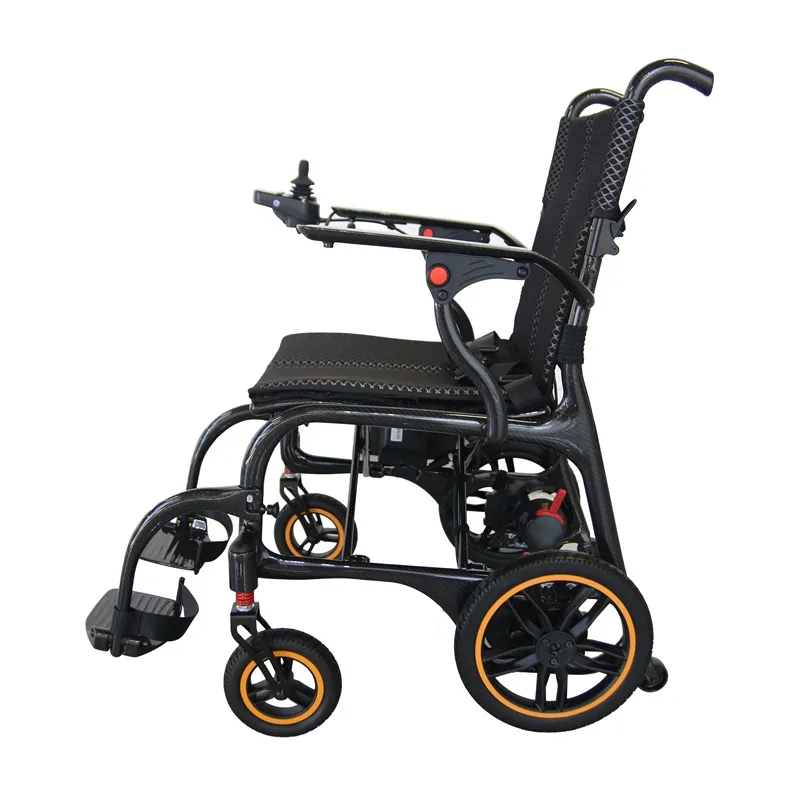
Why Are Carbon Fiber Power Wheelchairs Gaining Popularity?
Carbon fiber power wheelchairs utilize carbon fiber-reinforced composite materials for some or all of their structural components. Thanks to its high specific strength and stiffness, carbon fiber allows for a reduction in the weight of various parts while still meeting necessary structural performance standards.
Traditional steel electric wheelchairs are generally more affordable, feature well-established designs, and are easy to repair, though they tend to be quite heavy. Aluminum alloy wheelchairs offer a balanced compromise between weight, cost, and strength, making them a common choice. Carbon fiber models, however, prioritize a lightweight design—an ideal feature for scenarios that require frequent folding, loading into vehicles, or manual handling.
For seniors, a power wheelchair is more than just a means of getting around; it is a key to maintaining independence in daily life. For instance, when a senior needs to travel to a hospital, visit a park, or go out with family, a wheelchair that is too heavy can become a significant burden, making it difficult for family members to lift it into the trunk of a car. When designed effectively, lightweight carbon-fiber electric wheelchairs can reduce the physical burden of handling and enhance mobility.
However, the use of carbon fiber does not automatically guarantee that a product will be lighter, stronger, or safer. Components such as motors, batteries, wheels, and seats also account for a significant portion of the total weight; therefore, consumers should focus on the overall weight of the wheelchair rather than just the weight of the frame.
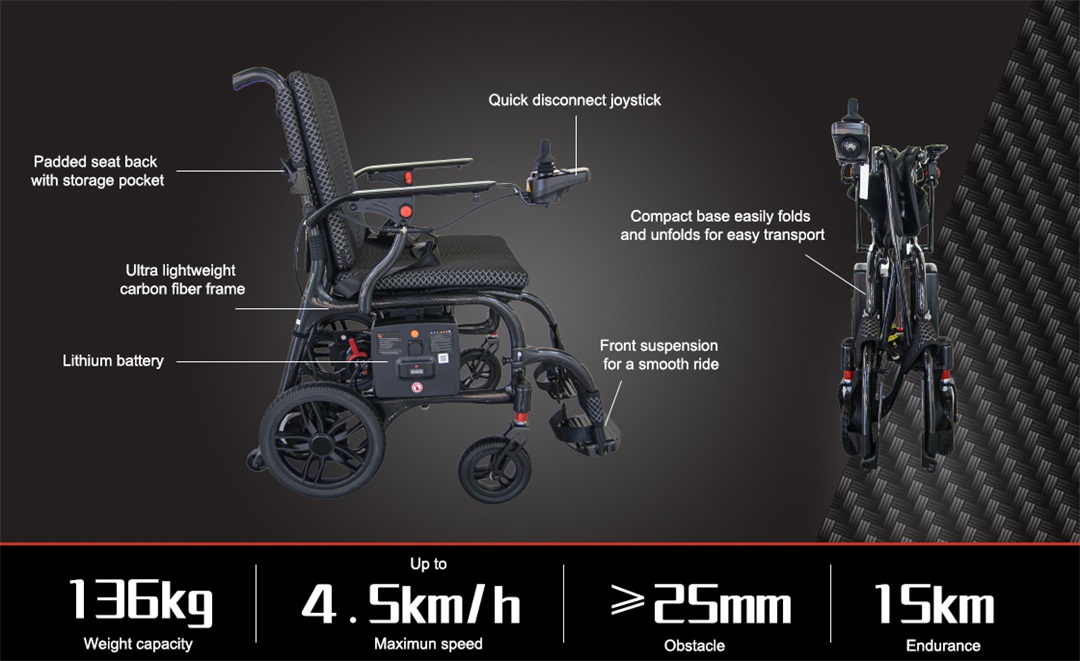
What are the advantages of carbon-fiber electric wheelchairs for the elderly?
1. Lightweight design for easier handling and storage
Lightness is the most prominent potential advantage of carbon-fiber electric wheelchairs. For families who frequently need to load a wheelchair into a vehicle, its total weight directly impacts how difficult it is to handle.
For instance, consider two electric wheelchairs weighing 18 kg and 25 kg, respectively—a difference of 7 kg. For family members who assist an elderly person with the wheelchair daily, this difference can significantly affect their experience. (Note: This is merely an illustrative example; not all carbon-fiber electric wheelchairs weigh as little as 18 kg.)
When purchasing, verify whether the stated weight includes the battery, footrests, and other components. If the battery is detachable, check the total weight without it, and consider whether individual parts are easy to carry. Even with a lightweight electric wheelchair, elderly individuals with limited upper-body strength should not attempt to lift the device on their own, especially in unsafe conditions.
2. Easy to fold, suitable for travel and outings
Many elderly individuals need to travel by car for medical appointments, family visits, or community activities. Consequently, whether an electric wheelchair can be folded quickly and fit into a car trunk is a highly practical concern.
While carbon fiber helps reduce the weight of certain structural elements, the ease of folding also depends on the frame design, locking mechanisms, battery placement, and overall dimensions. A lightweight wheelchair with a complex folding process may prove less practical than an aluminum-alloy model that is simpler to operate.
Before making a purchase, it is advisable to measure the dimensions of your car trunk, doorways at home, and elevator, and to confirm that the wheelchair can be easily stored once folded. For seniors who travel frequently, the combination of a lightweight design and a simple, easy-to-use folding mechanism is where the true advantages lie.
3. Reducing the Daily Burden on Caregivers
The user experience of an electric wheelchair for seniors affects not only the users themselves but also their family members and caregivers. Tasks such as lifting or moving the wheelchair, storing the device, removing the battery, and performing routine cleaning can all add to the workload of those providing care.
While carbon-fiber electric wheelchairs can make certain handling tasks easier by reducing the overall weight, other features—such as flip-up armrests, detachable footrests, reliable parking brakes, and an appropriate seat height—may be more critical if the senior’s primary challenge is getting into or out of the chair.
Therefore, when purchasing a carbon-fiber electric wheelchair, one should consider both the senior’s physical mobility and the specific caregiving environment, rather than focusing solely on weight.
Are carbon-fiber electric wheelchairs truly suitable for all seniors?
The answer is no. Seniors have diverse physical conditions, living environments, and mobility needs, meaning that the most appropriate power wheelchair will vary from person to person.
For seniors who frequently go out or need to travel by vehicle, a lightweight carbon-fiber electric wheelchair offers significant practical value. In such cases, key factors to consider include the total weight of the chair, the ease and speed of folding, battery range, and how convenient it is to transport.
For seniors who spend most of their time at home, factors like the width of the wheelchair, its turning radius, seat comfort, and maneuverability at low speeds are often more important. Even if a wheelchair is made of carbon fiber, it will fail to meet the user's needs if it is too wide to pass through doorways in the home.
For elderly individuals with limited muscle strength, poor postural stability, or those who require assistance from family members, the priority should be on seat support, armrest design, braking reliability, and safety during transfers. If a senior cannot reliably control the joystick, or if they have significant cognitive or judgment impairments, a rehabilitation professional should first assess whether they are capable of operating an electric wheelchair independently.
Ultimately, determining whether a carbon-fiber electric wheelchair is a good choice depends on whether it meets the senior’s specific, practical needs—rather than being based solely on their age or the materials used in the chair’s construction.
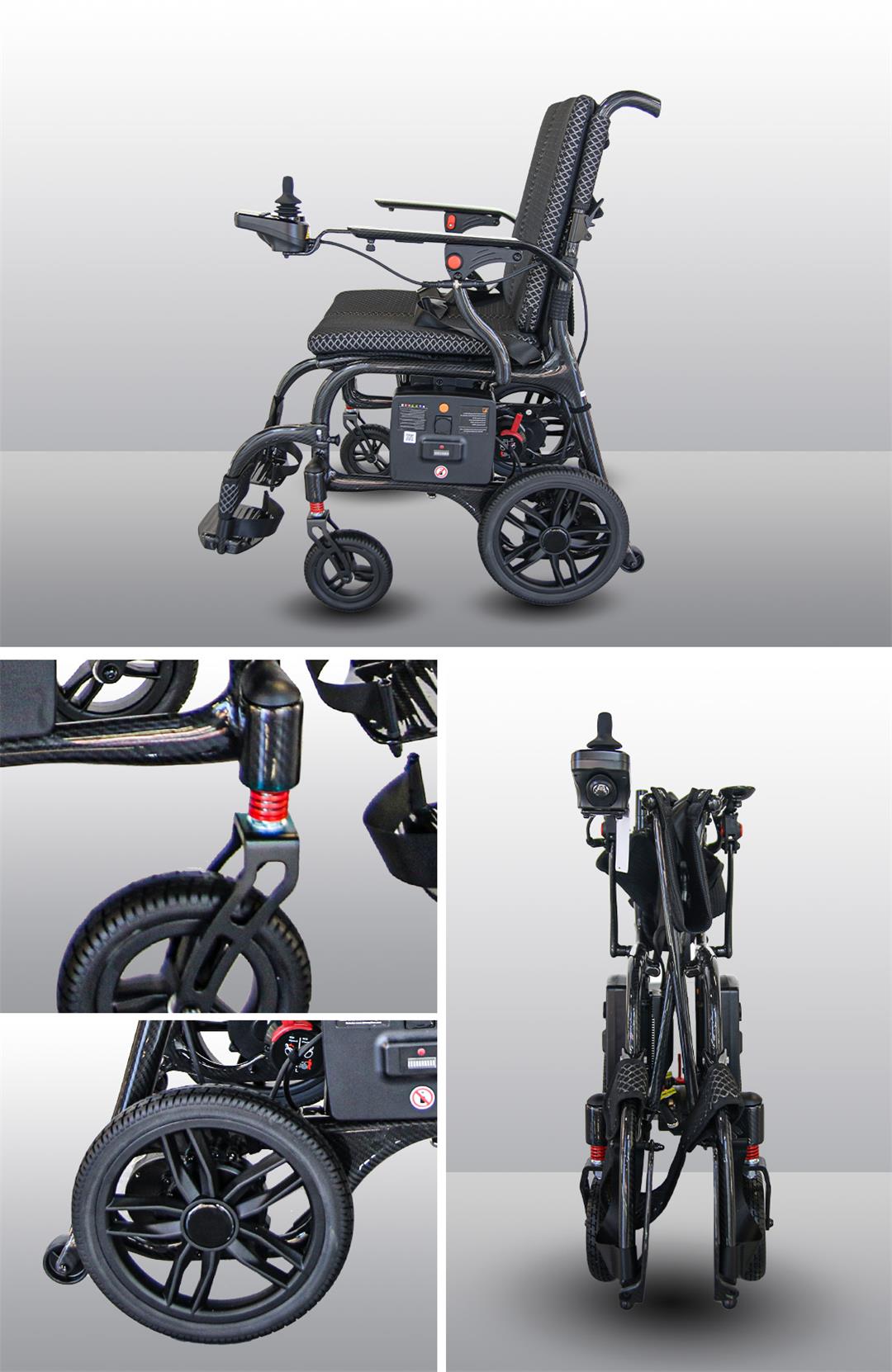
When purchasing a carbon-fiber electric wheelchair, which specifications are the most important?
When purchasing an electric wheelchair for seniors, consumers should focus on comparing the following specifications: total unit weight, weight capacity, battery range, seat dimensions, braking system, and folded dimensions. The parameters below serve as a preliminary guide; for specific products, always refer to the official user manual and testing documentation.
| Parameter | Reference Range or Selection Guide | Key Consideration |
| Total Weight | Lightweight models may target 15–25 kg | Confirm whether the battery is included |
| Maximum Load | Common models may support 100–150 kg | Choose according to user weight and rated capacity |
| Advertised Range | Approximately 10–25 km for some models | Actual range depends on terrain, load, and battery condition |
| Maximum Speed | Prioritize adjustable speed and smooth acceleration | Suitable for the user's reaction time and control ability |
| Seat Width | Common options are approximately 40–50 cm | Match the user's body measurements |
| Battery | Check voltage, capacity, and replacement availability | Consider charging convenience and long-term costs |
| Braking System | Verify braking performance and parking stability | Important for safe stopping and slope use |
| Folded Dimensions | Measure the storage space before purchasing | Ensure compatibility with the car and home |
1. Total Unit Weight: Don’t Be Misled by Promotional Figures
Different brands may use varying methods to state weight. Some might advertise only the frame weight, while others may list the weight excluding the battery—neither of which represents the actual total weight you would need to lift or transport.
Consumers should verify whether the stated weight includes the battery, seat, and footrests, and determine the weight of individual components if the battery is removed. If family members need to frequently load the wheelchair into a vehicle, it is advisable to perform a physical lifting test before making a purchase.
2. Battery Range: Nominal Range Does Not Equal Real-World Range
The range of an electric wheelchair is influenced by factors such as battery capacity, the user’s weight, travel speed, road conditions, and ambient temperature. The maximum range claimed by manufacturers is typically measured under specific, ideal conditions, and the actual range in daily use may be lower.
Battery energy can be estimated using the following formula:
Battery Energy (Wh) = Battery Voltage (V) × Battery Capacity (Ah)
For example, a 24 V, 10 Ah battery has a nominal energy of 240 Wh. If a power wheelchair consumes an average of 20 Wh per kilometer under certain conditions, its theoretical range would be approximately 12 km. This is merely an illustrative calculation, not a result from actual product testing.
If an elderly user needs to travel to places like a hospital or a park, ensure the battery range provides a sufficient buffer beyond the expected round-trip distance—do not rely solely on the maximum range advertised. Additionally, check whether the battery is easy to replace and confirm that the manufacturer provides compatible chargers and reliable after-sales support.
3. Seat Comfort: Do Not Sacrifice Support for the Sake of a Lighter Weight
Since seniors may spend long periods in an electric wheelchair, factors such as seat width, seat depth, backrest support, and the positioning of the footrests are crucial. A seat that is too narrow may cause localized pressure, while one that is too wide can compromise bodily stability; an improper seat depth may increase pressure on the back of the thighs. If an elderly user has significant spinal deformity, difficulty maintaining a stable sitting posture, or is at risk of pressure ulcers, a seating assessment by a rehabilitation professional should be considered.
A carbon fiber frame alone does not guarantee comfort. A high-quality electric wheelchair for the elderly should offer adequate body support and sound ergonomic design, in addition to being lightweight.
4. Braking and Maneuverability: Safety Outweighs Top Speed
For elderly users, the ability of a power wheelchair to start smoothly, turn at low speeds, and come to a reliable stop is generally more important than its maximum speed.
When purchasing, pay attention to features such as electromagnetic braking, stability while stationary, anti-tip mechanisms, and the sensitivity of the joystick. The ISO 7176 international standard series covers testing for wheelchair stability, braking performance, and electronic control systems; consumers may request relevant test documentation from the manufacturer, ensuring that the reports correspond to the specific model in question.
Before purchasing, it is best to have the elderly user test the wheelchair in a safe environment—practicing starting, stopping, reversing, and turning. If the user cannot operate the joystick with consistent control, the suitability of the product should be re-evaluated.
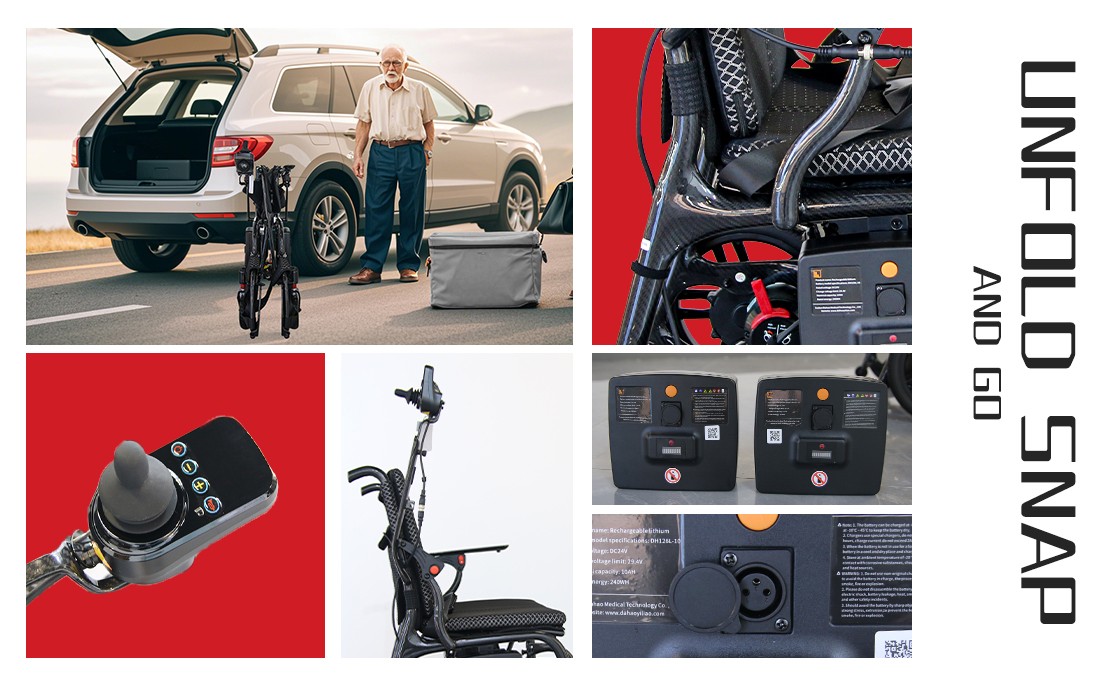
Frequently Asked Questions (FAQ)
FAQ 1: Are carbon fiber electric wheelchairs necessarily better than aluminum alloy ones?
Not necessarily. While carbon fiber offers a superior strength-to-weight ratio and higher stiffness, the total weight of the wheelchair also depends on the motor, battery, and structural design. Aluminum alloy electric wheelchairs may offer advantages in terms of price, ease of repair, and manufacturing maturity; the choice should be based on individual needs.
FAQ 2: Are carbon fiber power wheelchairs suitable for people over 80?
Age is not the sole criterion. If an elderly person can maintain a stable sitting posture, understand how to operate the controls, and maneuver the device safely, it may be suitable. If there are significant cognitive impairments or an inability to maintain control, a professional assessment should be sought first.
FAQ 3: Is a carbon fiber power wheelchair always better if it is lighter?
Not necessarily. A wheelchair must also meet requirements for load capacity, stability, braking performance, and durability. It is more sensible to choose a product that balances weight with safety performance, rather than focusing solely on achieving the lowest possible weight.
FAQ 4: What is the typical range of a carbon fiber electric wheelchair?
Some models have a stated range of approximately 10–25 km; however, the actual range depends on factors such as battery capacity, payload, terrain, and how the wheelchair is used. When purchasing, please refer to the specific specifications and testing conditions provided for the model in question.
FAQ 5: Can I repair a carbon fiber power wheelchair myself if it gets damaged?
Attempting to repair critical load-bearing structures on your own is not recommended. Carbon fiber composites may sustain internal damage that is difficult to detect. If you notice cracks, unusual noises, or significant wobbling, stop using the wheelchair immediately and contact a professional technician for repairs.
